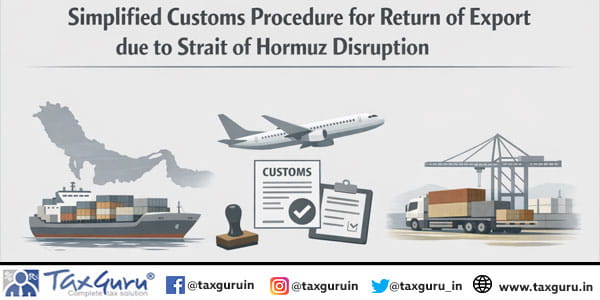
Summary: Circular No. 09/2026-Customs, dated 08.03.2026 introduces a temporary simplified procedure for handling export cargo returning to India due to disruption of shipping routes following the closure of the Strait of Hormuz. Issued under Section 143AA of the Customs Act, 1962, the circular allows vessels carrying export cargo that could not reach their destination to berth at the same Indian port of departure, except in transshipment cases. The procedure varies depending on whether the vessel remained within territorial waters, filed an Export General Manifest (EGM), or visited a foreign port without discharging cargo. In many cases, containers can be offloaded without filing a Bill of Entry, subject to verification of documents and seal integrity by Customs. Shipping Bills and Let Export Orders may be cancelled, and exporters can take the goods back to their factories under the Back-to-Town facility. Export incentives such as IGST refund or duty drawback will be blocked or recovered if already granted. The relaxation is valid for 15 days from 08 March 2026.
Return of Export Cargo from International Waters
(Section 143AA of the Customs Act, 1962)
Background
Due to the closure of the Strait of Hormuz and disruption of shipping routes, vessels carrying export cargo from India are unable to reach destination ports and are returning to Indian ports.
To address this exceptional situation, the CBIC has prescribed a simplified procedure under Section 143AA of the Customs Act, 1962.
1. Key Condition
Returned vessel must berth only at the same Indian port from which it departed, except in transshipment cases.
2. Procedure in Different Situations
Scenario A
Vessel within Indian territorial waters & EGM / SDM not filed
Procedure:
a. Undertaking by Master/Captain
Vessel has not crossed Indian territorial waters
b. No Sea Arrival Manifest required
c. Containers may be offloaded without filing Bill of Entry
d. Verification by Customs
_Shipping documents
_Container numbers
_Seal integrity
If seal is tampered → 100% examination
e. Cancellation of Export Documents
_Shipping Bill
_Let Export Order (LEO)
2. Back to Town facility
_Exporter may bring goods back to factory
Scenario B
Vessel within territorial waters with EGM/SDM filed
OR
Vessel in international waters but did not call any foreign port
Procedure:
1. Undertaking by Master
a. Vessel either:
b. Did not cross territorial waters OR
c. Crossed but did not call any foreign port
2. No Sea Arrival Manifest required
3. Containers may be offloaded without Bill of Entry
4. Verification
a. SDM
b. Shipping documents
c. Container seals
Tampered seal → 100% examination
5. System change in ICES
a. New facility to cancel Shipping Bill even after EGM
6. Export incentive control
a. Prevents disbursement of incentives
7. Information sharing
a. Cancelled Shipping Bills shared with:
_RBI
_DGFT
_Other agencies via ICEGATE
8. Interim procedure
a. Until system update → manual records to be maintained
Scenario C
Vessel visited a foreign port but cargo not discharged
Procedure:
1. Cargo treated as Exported out of India
2. Sea Arrival Manifest (SAM) must be filed
3. Procedures of Scenario B (points ii to vi) to be followed.
4. Recovery of Export Benefits
a. If already disbursed, Customs will manually recover:
i. IGST refund
ii. Duty Drawback
iii. Any other export incentives
5. Transshipment Cargo
a. Handled as per existing Customs provisions.
6. Validity of Relaxation
The relaxation is temporary.
Valid for 15 days from 08 March 2026
7. Practical Impact for Exporters
a. No need to file Bill of Entry for re-import
b. Fast unloading of returned cargo
c. Shipping Bills can be cancelled
d. Export benefits will not be allowed / must be reversed
e. Exporter can take goods back through Back-to-Town facility