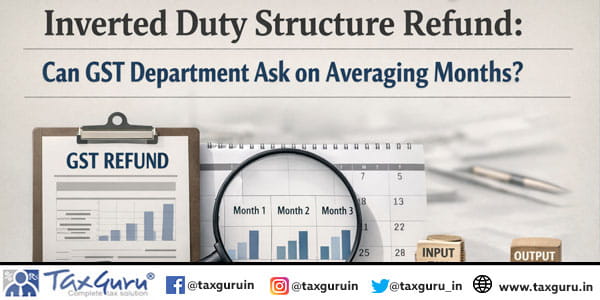
Refund under the Inverted Duty Structure (IDS) is a month-wise statutory entitlement under GST and cannot be averaged or clubbed across multiple months. Section 54(3) of the CGST Act read with Rule 89(5) of the CGST Rules mandates that refund of unutilised input tax credit is to be computed for each “relevant period,” which corresponds to the monthly tax period for regular taxpayers. There is no legal provision permitting the department to combine an eligible month with a non-eligible month, net off refunds, or apply averaging merely because no refund arose in a preceding or succeeding month. While ITC balances may carry forward, refund eligibility depends strictly on the tax structure of the particular month. Courts have consistently held that refund provisions must be applied exactly as prescribed by statute and that authorities cannot impose extra-statutory conditions. Accordingly, departmental objections seeking averaging of months are legally unsustainable and should be firmly challenged.
Background
Refund under Inverted Duty Structure (IDS) is one of the most litigated areas under GST. While the law clearly permits refund of unutilised ITC where the rate of tax on inputs exceeds the rate of tax on outputs, a recurring practical issue faced by taxpayers is:
“If refund is eligible in one month and not in another, can the department ask to average or club both months?”
This article explains the legal position, common departmental objections, and how industry should respond.
What the Law Says
Refund under IDS is governed by:
- Section 54(3) of the CGST Act, 2017
- Rule 89(5) of the CGST Rules, 2017
The refund formula prescribed under Rule 89(5) is applied for a “relevant period”.
As per Section 2(106) of the CGST Act,
“Tax period” means the period for which return is required to be furnished, which is monthly for regular taxpayers.
Therefore, refund eligibility is month-wise and tax-period specific.
There is no provision under GST law which:
- Allows averaging of two or more months
- Requires clubbing of a non-eligible month with an eligible month
- Permits netting off refund of one month against another
- Each month stands independent for the purpose of refund computation.
Common Departmental Objection
Many taxpayers receive notices stating:
“Since no refund arose in previous month, refund should be calculated by averaging both months.”
This objection is:
- Legally incorrect
- Procedurally unsupported
- Contrary to portal design
Why Averaging Is Not Sustainable…?
1. Rule 89(5) is a Statutory Formula
The formula prescribed cannot be modified or diluted by administrative interpretation.
2. Carry Forward of ITC ≠ Averaging of Refund
While ITC balance carries forward, refund entitlement depends on the tax structure of that particular month, not the previous or subsequent month.
Judicial Support
Courts have consistently held that:
- Refund provisions must be applied strictly as per statute
- Authorities cannot impose extra-statutory conditions
Key rulings:
- VKC Footsteps India Pvt. Ltd. (SC) – refund governed strictly by Rule 89(5)
- Amit Cotton Industries (Guj HC) – substantive refund cannot be denied by procedural innovations.
CBIC Circular No. 135/05/2020-GST also does not prescribe any averaging mechanism.
Conclusion
Refund under Inverted Duty Structure is a statutory right, not a concession.
Averaging of months has no legal sanction under GST law and should be firmly contested by taxpayers.