Introduction to India’s Trade Digitization and Monitoring Systems
India’s international trade has grown rapidly, driven by e‑commerce, simplified export-import procedures, and robust digital platforms like ICEGATE (Customs). Alongside this growth comes the need for transparency and real-time oversight of forex flows to prevent fraud, money‑laundering, and delays. To this end, the Reserve Bank of India (RBI) has developed automated surveillance systems – the Export Data Processing and Monitoring System (EDPMS) and Import Data Processing and Monitoring System (IDPMS). These platforms integrate data from customs and banks to track all export and import transactions in real time. Indeed, RBI itself cites IDPMS and EDPMS as key “SupTech” (supervisory technology) tools for regulatory monitoring. By digitizing trade data, India aims to improve ease of doing business, ensure foreign exchange repatriation, and strengthen policy planning.
Overview and Objectives of EDPMS
The Export Data Processing and Monitoring System (EDPMS) was launched by the RBI in March 2014. It is a centralized online platform jointly operated with Customs and Authorised Dealer (AD) banks to monitor all export shipments and the realization of export proceeds. Its main objectives are to ensure that exporters repatriate 100% of export earnings within the stipulated period, and to create a single source of truth for all export data. In practice, EDPMS tracks each export’s shipping bill and matches it with the corresponding foreign currency receipt (FIRC). By requiring AD banks to report each shipment and inward remittance in the system, EDPMS brings uniformity and transparency to export reporting across banks. It automatically flags delays or discrepancies in payments, enabling RBI to act on overdue shipments. In short, EDPMS helps RBI enforce FEMA export realisation rules, simplifies documentation for exporters, and supports export growth by providing a clear audit trail of forex flows.
Workflow of EDPMS
EDPMS operates on a structured, step-by-step workflow involving the exporter, Customs and the AD bank. Key steps include:
- Shipping Bill Filing: When an exporter ships goods, they file an electronic Shipping Bill (SB) with Customs. The SB includes all export details and the exporter’s chosen AD bank (via the bank’s code).
- Data Upload to EDPMS: Customs (via the ICEGATE system) uploads the SB data – such as shipment value, buyer, and AD code – to the EDPMS database. (Courier shipments are similarly fed via the ECCS system)
- Bank Data Entry: The exporter’s AD bank retrieves the new SB details from EDPMS on the same day. The bank verifies the shipment and acknowledges it in the system.
- Realization of Export Proceeds: Once the foreign buyer pays, the AD bank receives the funds. The bank then reports the foreign exchange received (through the e‑FIRC/eBRC system) in EDPMS, linking it to the original SB.
- Shipping Bill Closure: After full payment is received and reconciled, the AD bank updates EDPMS to mark the shipping bill as closed. If the payment amount differs (e.g. partial payment, exchange fluctuation) or payment is delayed, the bank records a write-off or extension in EDPMS.
- Alerts for Overdue Transactions: If an SB remains open beyond the allowed period (normally 9 months from shipment), it appears as outstanding in EDPMS. Exporters see this in their export outstanding statements (XOS). The system will automatically caution‑list the exporter after two years if proceeds are still unpaid.
This end-to-end flow ensures every export shipment is tracked from filing to payment. It leverages Customs’ electronic data and bank reporting to keep RBI’s database up to date in near real time.
Key Features and Benefits of EDPMS
EDPMS offers several features and advantages for exporters, banks, and regulators:
- Centralized Forex Monitoring: As RBI notes, EDPMS is “a single platform to monitor the FOREX” from exports. Rather than siloed bank records, all export data is consolidated, giving RBI a unified view of forex inflows.
- Automated Data Capture: Customs’ EDI system automatically feeds SB data into EDPMS. This eliminates manual entry errors and speeds up processing. Even small courier shipments must be routed through EDPMS, with data sent daily via ICEGATE/ECCS.
- Real-Time Updates: AD banks are required to enter shipping details and payment receipts in EDPMS on the same day of receipt. This real-time updating means RBI can monitor trends and overdue items as they arise.
- Risk Control and Alerts: EDPMS automatically flags mismatches or delays. For example, if a payment is made without a corresponding SB entry, or vice versa, the system generates an alert to the bank. This helps prevent under‑invoicing or unpaid shipments. Chronic defaulters are identified via RBI’s caution list (an “XOS”), prompting banks to demand full advance or LC cover.
- Unified Reporting: All AD banks access the same database, promoting consistency. Banks no longer rely on separate forms – instead they issue electronic Bank Realisation Certificates (eBRCs) directly from EDPMS data. This simplifies exporters’ documentation.
- Ease of Doing Business: By reducing paperwork (no hard-copy shipping bills needed for EDI ports) and providing transparency, EDPMS streamlines export compliance. Recent RBI directives even allow small-value shipments (under US$1,000) to be closed on a simple declaration (relaxing the old eBRC requirement).
- Data for Policymaking: With all export transactions digitized, RBI gains valuable data for trade analysis and balance‑of‑payments forecasting. As an RBI official noted, platforms like EDPMS are examples of how regulators leverage technology for surveillance.
In summary, EDPMS automates the export life‑cycle, improves accuracy, reduces delays, and brings exporters and banks closer to compliance.
Overview and Objectives of IDPMS
Mirroring EDPMS, the Import Data Processing and Monitoring System (IDPMS) was developed to track imports. IDPMS went live on October 10, 2016. A Reserve Bank working group recommended creating “a robust and effective IT‑based system ‘IDPMS’ on the lines of ‘EDPMS’. The goal of IDPMS is to ensure that payments for imports (which use precious foreign exchange) align with the actual goods landed. It was conceived “to facilitate efficient processing of all import transactions and effective monitoring thereof”. In practice, IDPMS links Customs’ Bill of Entry (BoE) data with bank payment data so RBI can verify that importers are not over‑invoicing or falsely reporting imports. By integrating Customs, banks, and RBI, IDPMS promotes transparency in import financing, simplifies compliance, and helps RBI manage forex outflows.
Workflow of IDPMS
The IDPMS workflow parallels EDPMS but in reverse. Key steps include:
- Bill of Entry Filing: When imported goods arrive, the importer files an electronic Bill of Entry (BoE) with Customs. Critically, the BoE now includes the code of the importer’s AD Category‑I bank (the importer reports which bank will pay).
- Data Transmission to RBI: Customs (via ICEGATE or ECCS for couriers) sends the BoE details to the RBI’s IDPMS database on the same day. This daily automated upload was recently established for courier shipments. Thus, the system gains primary data (importer name, invoice value, currency, BoE number, AD code) up front.
- Bank Data Entry: The importer’s AD bank downloads new BoEs from IDPMS and initiates payment. When the importer instructs payment (through an LC or wire transfer), the bank enters the outward remittance message (ORM) into IDPMS and links it to the corresponding BoE.
- Reconciliation and Closure: Once the payment covers the invoice value, the AD bank updates IDPMS to close the BoE. IDPMS allows flexibility: one BoE may be settled by multiple ORMs, or one ORM can cover several BoEs.
- Alerts for Discrepancies: If payment is made without a matching BoE (or vice versa), or if amounts differ, IDPMS raises an alert. The AD bank must then resolve the mismatch (often requiring documentary proof of additional freight/insurance or applying a write-off).
- Extensions and Write-offs: If payments are delayed beyond the normal credit period, the AD bank can grant extensions or write off minor variances (up to 5% of invoice) under RBI’s guidelines. Such adjustments are also recorded in IDPMS.
- Reporting to RBI: Throughout, banks upload and download data daily, maintaining real-time monitoring. When IDPMS launched, RBI required all outstanding import dues to be uploaded to the system for closure.
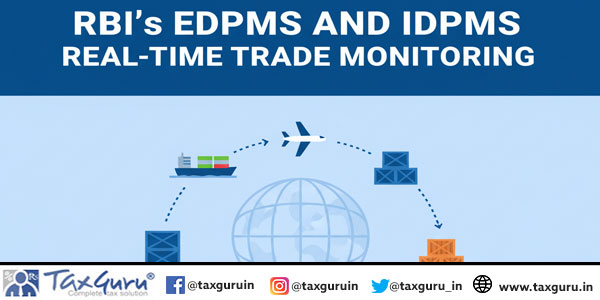
In this way, each import’s financing is documented from customs clearance through final payment, allowing RBI to track foreign exchange utilization on imports.
Key Features and Benefits of IDPMS
IDPMS provides several benefits analogous to EDPMS:
- Comprehensive Import Tracking: IDPMS integrates Customs and banking data. By “coordinating with Customs authorities and other stakeholders,” it captures every import transaction and payment. This prevents cases where an importer might pay in forex but falsely declare no import, or vice versa.
- Real-Time Visibility: Since BoEs and payments are uploaded daily, RBI and banks have up-to-date information on import transactions. Delays or missing documents quickly become visible in the system.
- Enhanced Compliance: IDPMS makes it easier to enforce FEMA rules on import financing. For example, it helps catch over‑invoicing (excessive declared value) because payments can only be reconciled against BoEs recorded in the system.
- Reduced Paperwork: Like EDPMS, IDPMS reduces manual paperwork. BOEs are filed digitally, and the bank’s ORM is reported electronically. The centralized system eliminates duplicate reporting across agencies.
- Flexibility in Settlements: The ability to match multiple BoEs to one payment (and vice versa) helps in complex import cases (e.g. partial shipments). The system automatically allocates payments, simplifying bookkeeping.
- Policy and Forex Planning: For RBI, IDPMS provides real‑time data on import payments for balance-of-payments monitoring and policy analysis.
- Ease of Doing Business: Clearing agents and importers benefit from predictable compliance rules. The RBI has advised banks to process IDPMS data daily, making trade processing smoother.
Overall, IDPMS enhances transparency in imports and helps banks and regulators manage India’s foreign exchange resources effectively.
Timelines, Regulatory Requirements, and Non-Compliance Consequences
Timelines: Under FEMA, exporters must realize and repatriate 100% of export proceeds within nine months of shipment (RBI may grant extensions up to 15 months on valid grounds). In EDPMS, uncollected payments beyond this period appear as export outstanding. If two years elapse from the due date (even with extensions), the exporter is automatically flagged as a caution-listed defaulter. For imports, payment timelines are generally as per the contract (often sight or 30/90 days); banks may allow extensions (usually 6 months at a time, up to 3 years) for disputes or genuine delays. However, as a practical matter, RBI expects Bills of Entry to be presented to banks promptly (often within 30–90 days of payment) so that IDPMS entries can be closed.
Regulatory Requirements: Both systems are governed by RBI Circulars and FEMA regulations. Key mandates include: AD banks must upload shipping bill/BoE details and payment data on a daily basis; include the AD code in all customs documents (the single link between Customs and banks); and treat all import/export remittances through the EDPMS/IDPMS. Exporters must obtain an electronic BRC (eBRC) via EDPMS for each shipment in order to claim incentives, though RBI has temporarily relaxed this for small shipments. Importers must file complete BoEs with correct AD codes to enable payment reconciliation.
Consequences of Non-Compliance: Failure to comply can trigger serious consequences. For exports, mismatches or delays cause the RBI to warn exporters (via “caution-listing”) and require them to export only on full advance or irrevocable LC. Exporters on the caution list may be denied new export incentives and could have their IEC (import-export code) deactivated. Banks that fail to report accurately can face regulatory action by RBI. For imports, an un-filed BoE or unmatched payment could lead banks to hold remittances and the Customs department to withhold clearances. In extreme cases, RBI can invoke FEMA penalties (fines, prosecution) for willful mis-reporting. In the forthcoming Draft Trade Regulations 2025, RBI has proposed even tighter rules – e.g. if an exporter’s dues exceed ₹25 crore and remain unpaid for over two years, further exports are only permitted against advance payment or LC. These steps underscore that timely, accurate reporting in EDPMS/IDPMS is mandatory to avoid legal and financial penalties.
Roles and Responsibilities of Stakeholders
- Exporters/Importers: Traders are responsible for accurate documentation. Exporters must file shipping bills promptly and provide all export documents to their AD bank. They should inform their buyers about exchange details and ensure full collection of dues. Importers must file Bills of Entry with Customs (including the chosen AD bank’s code) when goods arrive, and authorize payment through the bank. Both exporters and importers must coordinate with their bank to keep EDPMS/IDPMS records up to date.
- Authorized Dealer (AD) Banks: Category-I banks play a central role. They must register exporters/importers, verify KYC, and report transactions to RBI. Specifically, AD banks must download SB/BoE data from EDPMS/IDPMS daily and enter every subsequent step (document negotiation, remittance, extensions, write-offs) into the system. For exports, banks issue eBRCs based on EDPMS data. For imports, they record outward remittances (ORM/A1/A2) and reconcile them against BoEs. Banks must grant extensions or write-offs as per RBI guidelines and advise customers before caution-listing. Failure by banks to update these systems regularly is a common problem (as RBI has noted). In short, AD banks are the primary users of EDPMS/IDPMS and the linkage between RBI and traders.
- Customs Authorities: Customs departments (both at ports and SEZs) must modify their systems to capture the AD bank code for every export/import. They transmit shipping bill and BOE data electronically to RBI’s portals. As per an official advisory, Customs now feeds all courier and cargo CBEs/CSBs to IDPMS/EDPMS on a daily basis. Customs also issues acknowledgments (digital shipping bills) that enable banks to proceed without needing paper copies. Essentially, Customs provides the essential trade data that triggers tracking in EDPMS/IDPMS.
- Reserve Bank of India (RBI): RBI designs and maintains the EDPMS and IDPMS platforms. It issues the rules and circulars (e.g. FEMA Directions, A.P. (DIR) series) governing their use. RBI reviews the data, issues caution-listings, and liaises with Customs and banks. Through these systems, RBI fulfills its mandate to ensure the orderly flow of trade-related foreign exchange. The central bank also uses EDPMS/IDPMS data for policy-making (as part of its SupTech initiatives). In proposed 2025 regulations, RBI has emphasized that AD banks must formulate clear internal policies for handling and reporting trade transactions. Overall, RBI is the regulator, technologist, and enforcer of compliance in this ecosystem.
Each stakeholder must work together: exporters/importers supply accurate data, Customs transmits it, banks enter payments, and RBI oversees the entire process. This collaborative framework is critical for the systems to function.
Common Errors and Challenges in EDPMS/IDPMS
Both systems have faced implementation hurdles. Common issues include:
- Data Mismatches: If the export invoice or import invoice details (e.g. buyer/seller name, invoice number, currency) don’t exactly match the customs declaration, the transaction is flagged. For example, a shipping bill name slightly different from the bank’s records can cause an EDPMS discrepancy. Banks must then investigate minor differences (such as exchange rate variances, freight, or insurance) and adjust entries. RBI allows small write-offs (up to 5%) to resolve this, but large mismatches can stall clearance.
- Missing AD Code: A very common problem is omitting or using the wrong AD bank code on Customs forms. Courier shipments often had errors in CBEs where the AD code was invalid or blank. As a result, those entries were rejected by IDPMS/EDPMS. To avoid this, importers/exporters must check the code before Customs clearance. Customs is raising awareness, but any omission still blocks automated tracking.
- Delayed Data Entry: Banks sometimes lag in downloading and updating new SB/BoE data. If a shipping bill is not entered into EDPMS promptly, an incoming payment cannot be reconciled. In 2017, the Commerce Secretary noted that many ADs were not updating EDPMS timely, causing huge mismatches between actual exports and system records. Late eBRC issuance also delays export incentive claims. Similar delays in IDPMS can hold up shipments, as banks will not process payments without proper BOE entries.
- Small-Value Shipments: The previous system was burdensome for small e-commerce exports. Banks used to charge ₹1,000–2,000 just to reconcile a USD 500 shipment. This discouraged exporters from filing those shipments at all. RBI has since eased this through a dispensation rule, but it highlights a challenge: balancing compliance with practical costs.
- System and Integration Issues: Technical glitches (portal downtime, interface errors) can disrupt updates. When Customs integrated ECCS with RBI’s systems, many invoices failed transmission due to format errors. Such IT issues require coordination between Customs, RBI, and banks to resolve. Frequent RBI notification changes also confuse users if not timely communicated.
- Compliance Knowledge Gaps: Many MSME traders and smaller bankers remain unfamiliar with EDPMS/IDPMS processes. Lack of training means mistakes (like late BoE filing or missing eBRC submission) occur. Awareness campaigns by trade associations have helped, but ongoing education is needed.
In practice, these errors can lead to shipments being held, penalties, or unnecessary caution-listing. Exporters/importers and banks must double-check documentation and follow guidelines closely to avoid these pitfalls.
Best Practices for Compliance
To minimize issues and ensure smooth processing, trade practitioners should adopt the following best practices:
- Reconcile Data Early and Often: Before shipment or payment, cross-check all invoice and shipping details (names, values, currency) with Customs declarations. Any differences should be explained in advance (e.g. freight adjustments).
- Submit Documents Promptly: Exporters should file shipping bills with Customs immediately upon dispatch, and share all documents (invoices, B/L, insurance) with the bank without delay. Importers should file BoEs as soon as goods arrive. Timely submissions prevent EDPMS/IDPMS hold-ups.
- Use Valid AD Codes: Confirm that the correct AD bank code is entered in every SB or BE. If using multiple ADs, ensure each transaction references the right one. Tools like the ECCS transmission utility have error checks – use them to verify successful uploads.
- Monitor System Entries: Exporters and importers should ask their banks for periodic printouts or online status of open EDPMS/IDPMS records. Banks often provide export outstanding statements (XOS) and import pending entries. Checking these regularly (weekly or monthly) helps catch missing entries or mismatches quickly.
- Communicate with Your Bank: Keep open lines with the AD bank’s forex team. If you plan a large export or import, notify them so they can prepare EDPMS/IDPMS entries in advance. Similarly, update the bank on any expected third-party payments or changes in terms.
- Claim eBRC and Extensions: For exports, always obtain the eBRC from the bank once payment is received, as it’s needed for incentives. For any payment delay or shortfall, apply for RBI‑permitted extensions/write‑offs immediately, documenting the reasons. This keeps shipping bills from going overdue.
- Stay Informed: RBI periodically issues new instructions. For example, banks were recently asked to allow faster closures for small exports and to implement unified policies for trade transactions. Keep abreast of such changes via RBI circulars or industry alerts.
By following these practices and maintaining transparent records, exporters and importers can avoid compliance gaps. As one trade expert notes, using technology (even third-party platforms) to automate reminders and tracking can greatly reduce errors.
Future Developments and Integration
Looking ahead, EDPMS and IDPMS are evolving along with India’s digital trade infrastructure:
- Unified Trade Platforms: The government is moving toward greater integration among trade systems. For example, eBRC issuance has been integrated into DGFT’s portal, and there are plans to link EDPMS/IDPMS with GSTN and other government databases. A cohesive trade ecosystem could allow one-click verification of exports and imports across agencies.
- Advanced Analytics and AI: RBI and fintech firms are exploring AI/ML tools to analyze EDPMS/IDPMS data for anomalies in real time. Early warning systems could automatically flag suspicious transactions or emerging bottlenecks (like spikes in unpaid shipments). Such “tech adoption” was highlighted in RBI’s vision for regulators.
- Mobile and API Integration: Banks are developing APIs and apps so exporters/importers can update and view EDPMS/IDPMS status instantly. Likewise, Customs’ ICEGATE/ECCS portals increasingly offer instant checks on whether a CBEs/CSBs was successfully transmitted to RBI.
- Regulatory Streamlining: RBI’s Draft Trade Regulations 2025 proposes to consolidate EDPMS/IDPMS instructions into a single framework, relax some restrictions (e.g. on merchanting trade), and require banks to publicly display their trade transaction policies. If adopted, this could simplify the rulebook for exporters/importers.
- Blockchain and Secure Sharing: In the longer term, concepts like blockchain are being discussed for secure sharing of shipping docs and payments. This could eventually link IRs (Insurance Receipts), B/Ls, e-invoices and customs data in one ledger, feeding EDPMS/IDPMS automatically.
- User-Friendly Features: Feedback from industry is driving user interface improvements. For example, there is talk of enabling exporters to upload their service export details directly into EDPMS (currently done via forms). More online help desks and auto-alerts on overdue bills are expected.
These future steps aim to make EDPMS/IDPMS more efficient and integrated. Already, RBI’s push to use these systems as “SupTech” suggests they will remain central to India’s trade compliance architecture.
Conclusion
In the digital era, effective trade monitoring is vital for economic health. The RBI’s EDPMS and IDPMS systems represent a leap forward: they transform exports and imports from paperwork to real‑time data flows. For exporters and importers, understanding these platforms is no longer optional – it’s essential. By following best practices, coordinating with banks, and using the EDPMS/IDPMS tools, traders can ensure smooth transactions and avoid regulatory headaches. For banks and regulators, these systems provide the transparency needed to uphold FEMA regulations and facilitate responsible growth in India’s foreign trade. In short, EDPMS and IDPMS are key cogs in India’s vision of a fully digital, compliant, and transparent trading ecosystem.