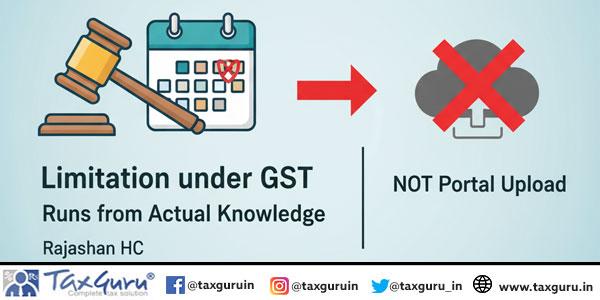
Communication of Order under Section 107 GST Act, Limitation Runs from Actual Knowledge, Not Mere Uploading on Portal: Rajasthan High Court in M/s Sahil Steel v. State of Rajasthan & Ors.
Issue:
Whether the limitation period under Section 107(1) of the GST Act, 2017 should be reckoned from the date of uploading the order on the common portal or from the date when the assessee actually received communication/was able to access the order.
Background and Factual Matrix
The petitioner, M/s Sahil Steel, challenged an order dated 22.04.2025 from the Appellate Authority which rejected their appeal on the grounds of limitation. The petitioner’s tax consultant had used his own email-ID and mobile number for the firm’s GST registration. A dispute arose between the petitioner and the consultant, who refused to provide the login credentials for filing returns.On 05.02.2024, the petitioner requested the Commercial Taxes Officer to change the login credentials, but the request was accepted on 17.03.2025. Before the credentials were changed, an assessment order dated 05.03.2025 was issued, and the petitioner’s bank account was attached. The petitioner became aware of the assessment order, which was uploaded to the common portal on 25.07.2024, only after receiving the bank attachment order. The appeal was subsequently filed on 25.03.2025.
Arguments of the Parties
- Petitioner’s Argument: The petitioner contended that the appeal was filed within the limitation period reckoned from the date of actual communication. They argued that the 90-day limitation period should not start from the date of uploading the order on the common portal. The petitioner stated that they could not access the portal until their credentials were updated and urged that the uploading of the order could not be deemed “communication” under the circumstances.
- Respondent’s Argument: The respondents argued that uploading the order on the common portal on 25.07.2024 constituted communication. They further submitted that the dispute between the petitioner and their tax consultant could not be taken as a “refuge” to seek condonation of delay.
Court’s Reasoning and Conclusion
The High Court allowed the writ petition and quashed the Appellate Authority’s order. The court found that in this specific factual backdrop, it could be understood that the assessee was unable to access the common portal due to the dispute with the tax consultant. The court noted that the petitioner’s request to change credentials was made on 05.02.2024 but was accepted as late as 17.03.2025, so the petitioner could not be accused of delay.
The court concluded that the period of limitation could not be reckoned from any date prior to 17.03.2025 (when the credentials were changed and the petitioner could access the portal) or at the worst, from 05.03.2025 (when the petitioner received the intimation of the bank attachment). Since the appeal was filed on 25.03.2025, it was deemed to be within time. The court noted that a purposive interpretation of “communication to such person” under section 107(1) was necessary to protect a statutory right to appeal.
Final Takeaway
The judgment clarifies that simply uploading an order on the common portal does not constitute valid communication in all circumstances. The court’s decision provides a crucial precedent for cases where taxpayers are unable to access the portal due to circumstances beyond their control, such as a dispute with a consultant and a delay by the department in updating credentials. It upholds the principle that a taxpayer’s right to appeal should not be denied due to a lack of effective communication from the tax authorities.