#AD
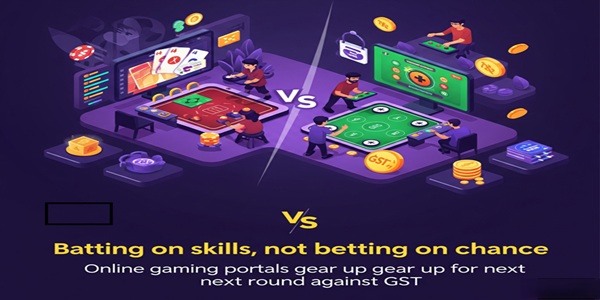
Batting on skills, not betting on chance – Online gaming portals gear up for next round against GST
On Tuesday, July 15, the Supreme Court of India will resume hearing the matter between the online gaming platforms and the GST (Goods and Services Tax) Authorities. The GST on fantasy and other skill-based online gaming portals has been a subject of debate ever since the GST authorities started demanding a whopping 28 per cent tax on these companies on the entire amounts staked by players under rule 31A of CGST Rules for the period up to September 2023. Since then, the gaming industry is fighting for a more pragmatic approach and a reasonable closure from the authorities. The entire industry is now before the Supreme Court.
In recent times, the Supreme Court has stayed the show cause notices and have commenced detailed hearings on the matter – marathon hearings were already underway for 13 days, almost consecutively, in May.
Too taxing
During their oral arguments against the GST authorities, Gameskraft’s lawyers strongly countered that they don’t fall under Rule 31A at all, but have to be valued under Section 15 (1) of the CGST Act, which states that the value of a supply of goods or services would be the transaction value, or the price actually paid/payable, was more appropriate. He added that in Gameskraft’s case, it would be 18 per cent GST on the commission/platform fees actually charged from the players for playing on the platform.
Incidentally, several companies are also challenging what is effectively a retrospective application by GST authorities of the October 2023 GST amendment which formally placed online gaming at par with casinos and horse racing, in the category of ‘supply of actionable claims’. which are taxed at 28 per cent as well.
No goods, no services
The basic argument of online gaming portals is that despite being played with real money, fantasy cricket, poker, rummy etc. are clearly games of skill, as opposed to games of chance and hence cannot be taxed in the same manner as betting, gambling and horse racing.
In the course of his arguments before the apex court, senior counsel Harish Salve, on behalf of E-Gaming Federation and other companies, argued that while online platforms facilitate gameplaying, they don’t fall under supply of goods or supply of services, and hence, cannot be taxed under GST.
Further stating that there is no “actionable claim” arising from playing a game of skill with monetary stakes, he criticized Rule 31 A of CGST, terming it a “colourable exercise of legislative power”. Pointing out that levying GST on online gaming as gambling contradicts the constitutional framework, and betting and gambling can be taxed only under a new levy that has to draw power from Entry 97 of List I, and not under GST.
Karnataka’s new bill
Interestingly, Karnataka government is working on establishing a dedicated Karnataka Online Gaming and Betting Regulatory Authority through a legislation called Karnataka Police Amendment Bill 2025. To be tabled in the upcoming legislative session, the bill will exempt, regulate and license ‘games of skill’, while banning games of chance, online betting, and other unregistered platforms. Based on judicial precedence, the proposed regulatory authority will maintain a clear demarcation between games of skill and games of chance, and issue licenses only to operators of skill-based gaming platforms.
TN shows the way
The 2021 case of Junglee Games India Pvt. Ltd. vs Union of India played a pivotal role in shaping the legal framework surrounding games of skill. In this landmark judgment, the Madras High Court struck down specific provisions of the Tamil Nadu Gaming and Police Laws (Amendment) Act, 2021, emphasizing that an outright ban on skill-based games involving monetary stakes amounts to an unreasonable restriction on the fundamental right to practice a profession under Article 19(1)(g) of the Constitution.
The Court clarified that games of skill, even when played for money, constitute legitimate economic activity and cannot be classified as gambling. This reasoning has laid the groundwork for consistent judicial support of the view that such games fall within the protective scope of Article 19(1)(g). Consequently, any attempt to impose excessive or disproportionate restrictions on these activities would be constitutionally invalid.