Shivam Attires Pvt. Ltd Vs ACIT (ITAT Raipur)
The Income Tax Appellate Tribunal (ITAT) Raipur has dismissed an appeal filed by Shivam Attires Pvt. Ltd. for the Assessment Year 2018-19, affirming the disallowance of Rs. 25,81,110/- claimed by the company for employee contributions to EPF (Employees’ Provident Fund) and ESIC (Employees’ State Insurance Corporation). The decision, pronounced on January 17, 2025, aligns with recent pronouncements by higher courts, notably the Supreme Court’s judgment in Checkmate Services Pvt. Ltd. v. Commissioner of Income Tax-1.
The case originated from an order passed under Section 154 of the Income Tax Act, 1961, by the Deputy Commissioner of Income Tax, Central Processing Centre (CPC), which disallowed the deduction. Shivam Attires subsequently appealed to the Commissioner of Income Tax (Appeals), National Faceless Appeal Centre (NFAC), which upheld the disallowance.
Initial Tribunal Dismissal and High Court Intervention
Initially, the ITAT had dismissed Shivam Attires’ appeal on July 7, 2023, without delving into the merits of the disallowance. The Tribunal’s reasoning at that time was that the application under Section 154 of the Act was limited to rectifying glaring, patent, and obvious mistakes apparent from the record, and the issue at hand did not fall within that narrow scope.
However, Shivam Attires challenged this decision before the Hon’ble Jurisdictional High Court of Chhattisgarh, Bilaspur. The company contended that taxing an amount on which tax is not legally imposable constitutes an apparent mistake that touches upon the merits of the case, and therefore, rectification under Section 154 should be permissible. Reliance was placed on the decision in Akbar Mohammad Prop. M/s Mohd. Rafique Associates vs The ACIT, CPC, Banglore. The High Court considered the assessee’s arguments and, in its order dated December 15, 2023, set aside the matter, directing the ITAT to re-adjudicate the appeal on its merits. This direction necessitated a fresh hearing at the ITAT Raipur bench.
Arguments Presented
During the re-hearing, the counsel for Shivam Attires, Shri Yash Jain, argued that the disallowance was made on a “debatable issue.” He contended that such debatable adjustments were beyond the jurisdiction of the CPC when processing returns under Section 143(1) of the Act. To support this position, he cited the Hon’ble Mumbai High Court’s decision in Khatau Junkar Ltd. and the ITAT Raipur bench’s ruling in Gurmeet Singh Hora, which was further followed in Satpal Singh Sandhu vs DCIT. The core of this argument was that, at the time of the original adjustment, various High Courts held divergent views on the deductibility of late employee contributions, rendering it a debatable matter.
Conversely, Smt. Anubhaa Tah Goel, representing the revenue, asserted that the issue was squarely covered by the judgment of the Hon’ble Jurisdictional High Court of Chhattisgarh in M/s BPS Infrastructure vs. ITO, dated April 12, 2024. She maintained that the BPS Infrastructure ruling had clarified that the issue of delayed payment of employees’ share of ESI/PF contributions was no longer an open question (res integra), particularly in light of the Supreme Court’s definitive judgment in Checkmate Services Pvt. Ltd..
Judicial Precedents and Analysis
The central point of contention revolved around whether the deduction for employee contributions to EPF and ESIC, deposited by the employer after the due dates stipulated by the respective welfare statutes but before the income tax return filing deadline under Section 139 of the Act, should be allowed.
The ITAT, in its detailed analysis, emphasized the overriding impact of the Supreme Court’s decision in Checkmate Services Pvt. Ltd. (Civil Appeal No. 2833 of 2016, decided on October 12, 2022). This landmark judgment critically distinguished between an employer’s contribution and an employee’s contribution to social security funds.
The Supreme Court in Checkmate Services observed that earlier High Court judgments (such as Commissioner of Income-Tax v. Aimil Ltd. (Delhi High Court), Commissioner of Income-Tax and another v. Sabari Enterprises (Karnataka High Court), Commissioner of Income Tax v. Pamwi Tissues Ltd. (Bombay High Court), Commissioner of Income-Tax, Udaipur v. Udaipur Dugdh Utpadak Sahakari Sandh Ltd. (Rajasthan High Court), and Nipso Polyfabriks) had largely relied on the omission of the second proviso to Section 43B(b). The Supreme Court clarified that these decisions did not adequately consider the implications of Section 2(24)(x) of the Act, which deems amounts received by an employer from employees (by way of deduction or otherwise) as “income” for the employer.
The apex court underscored that when Parliament introduced Section 36(1)(va) and Section 2(24)(x) in 1988-89, its intention was to treat employee contributions distinctly. While Section 36(1)(iv) deals with the employer’s own contribution as a primary liability, Section 36(1)(va) pertains to amounts deducted from employees’ salaries, which are held in trust by the employer. These amounts are deemed income of the employer under Section 2(24)(x) unless they are deposited into the respective fund on or before the due date specified in the relevant welfare enactments (e.g., EPF Act, ESIC Act).
The Checkmate Services judgment explicitly stated that the non-obstante clause in Section 43B, which allows deductions for certain liabilities if paid before the income tax return filing date, does not dilute or override the employer’s obligation to deposit employee contributions by their specific statutory due dates. The Court reasoned that employee contributions are not part of the employer’s income in the traditional sense, nor are they a statutory payout for the employer; rather, they are “others’ income” temporarily held by the employer. Their deemed inclusion as income under Section 2(24)(x) is precisely to ensure their timely deposit. Therefore, the deduction under Section 36(1)(va) is contingent upon deposit on or before the due date mandated by the welfare laws, irrespective of the income tax return filing date.
Impact of Jurisdictional High Court and Other Rulings
The ITAT then turned to the Chhattisgarh High Court’s decision in M/s BPS Infrastructure vs. ITO, which directly applied the principles laid down in Checkmate Services. The Chhattisgarh High Court, in BPS Infrastructure, unequivocally held that the issue of delayed payment of employees’ share of ESI/PF contributions is “no more res integra” due to the Supreme Court’s pronouncement. The High Court, after quoting extensively from Checkmate Services, dismissed the appeal in BPS Infrastructure, concluding that the ITAT had rightly dismissed the assessee’s appeal in that case.
Further bolstering its decision, the ITAT referenced the latest judgment from the Hon’ble Mumbai High Court in Rohan Korgaonkar vs DCIT (dated February 7, 2024). This judgment reiterated that the principles established in Checkmate Services apply regardless of whether the assessment order was made under Section 143(1)(a) of the Act. The Mumbai High Court affirmed that deductions for employee contributions are allowable only if deposited on or before the due date prescribed under the EPF/ESIC Acts, and the processing of returns under Section 143(1)(a) does not alter this fundamental requirement.
Conclusion
Based on the binding judicial precedents, particularly the Supreme Court’s ruling in Checkmate Services and its subsequent application by the Chhattisgarh High Court in BPS Infrastructure and the Bombay High Court in Rohan Korgaonkar, the ITAT Raipur concluded that the payments related to employees’ provident fund contributions made after the due date under the relevant statutes are indeed liable for disallowance. This holds true even if the income tax return was processed under Section 143(1) prior to the pronouncement of the Checkmate Services judgment.
The Tribunal found the decision of the Ld. CIT(A) to be justified and well-reasoned, as it concurred with the view taken by the Supreme Court. Consequently, the assessee’s appeal was dismissed, reinforcing the strict requirement for timely deposit of employee contributions to welfare funds for claiming deductions under the Income Tax Act.
FULL TEXT OF THE ORDER OF ITAT RAIPUR
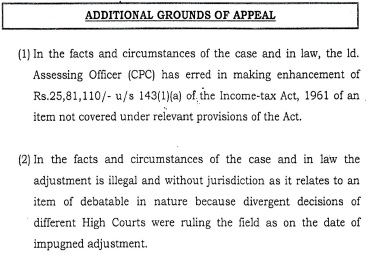
The captioned appeal of the assessee is directed against the order of Commissioner of Income Tax (Appeal), National Faceless Appeal Centre (NFAC) [in short “Ld. CIT(A)”] u/s 250 of the Income Tax Act, 1961 (in short “the Act”), for the Assessment Year 2018-19, dated 22.12.2021, which in turn arises from the order u/s 154 of the Act, dated 19.12.2019, passed by the Deputy Commissioner of Income Tax, Central Processing Centre(CPC) (for short, “The Ld. AO”).
2. The grounds of appeal along with additional grounds of appeal in present appeal raised by the assessee, reads as under:
1. In the facts and circumstances of the case and in law, the ld. Assessing Officer has erred in determining total income at Rs.7,07,15,109/- by denying deduction of Rs.25,81,110/- claimed u/s 36(1)(va) r.w.s.43B of the Income-tax Act,1961 in respect of amount deposited towards employees contribution to EPF and ESIC.
2. In the facts and circumstances the ld. Commissioner of Income-tax (Appeals) has erred in confirming the order of ld. Assessing Officer.
3. The impugned order is bad in law and in facts.
4. The appellant craves leave to add, alter or omit all or any grounds of appeal in the interest of justice.
3. This matter was earlier disposed of by this tribunal vide its order dated 07.07.2023, by dismissing the appeal of the assessee with the findings that the recourse under the scope of section 154 is limited, the remedy u/s 154 can be sought only for the matters consisting a mistake to be rectified, only in a case where an order passed by the Ld. AO is found to be suffering from a mistake which is glaring, patent, apparent and obvious from record. Accordingly, the order of Ld. CIT(A) adverting on the merits of issue, without dealing with the maintainability of the application u/s 154 of the Act was modified and uphold to the extent the order of Ld. AO was approved.
3.1 Subsequently, the aforesaid order of Tribunal dated 07.07.2023 in the present case i.e., in ITA No. 111/RPR/2021 for the AY 2018-19 was assailed by the assessee before the Hon’ble Jurisdictional High Court of Chhattisgarh, Bilaspur, raising the contention that the Tribunal instead of deciding the case on merits has simply adjudicated the issue on the ground that the rectification application was not maintainable. It is submitted before the Hon’ble HC that as per settled proposition, the assessee cannot be taxed on the amount on which the tax is not legally imposable, therefore, apparently it would be a mistake which also touches upon the merits. Reliance is placed on the decision Akbar Mohammad Prop. M/s Mohd. Rafique Associates vs The ACIT, CPC, Banglore {2022 (2) TMI 479-ITAT, Jodhpur}. The contentions of the assessee with the request to remit the matter back to the appellate tribunal was considered by the Hon’ble High Court and has set aside the matter to ITAT, with the directions to re-adjudicate the same on merits. The relevant directions in the order of Hon’ble HC dated 15.12.2023 are extracted as under:
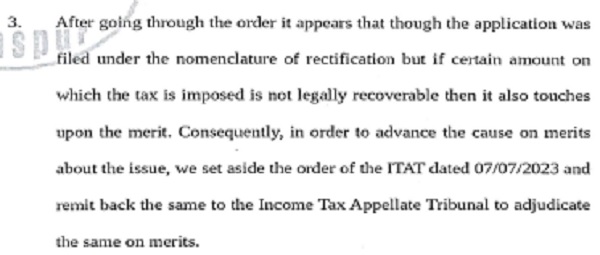
3.2. Respectfully following the directions of Hon’ble HC of CG, the matter thereafter has been fixed for hearing on 13.01.2025.
4. On the date of hearing, Ld. Counsel Shri Yash Jain, CA (in short “Ld. AR”) on behalf of the assessee and Smt. Anubhaa Tah Goel (“Ld. Sr. DR”) representing the revenue have raised their respective contentions and made necessary submissions. After hearing the Ld. Counsel of both the sides the matter was taken as heard.
5. At the outset, Ld. AR submitted a written synopsis, the same is culled out as under:

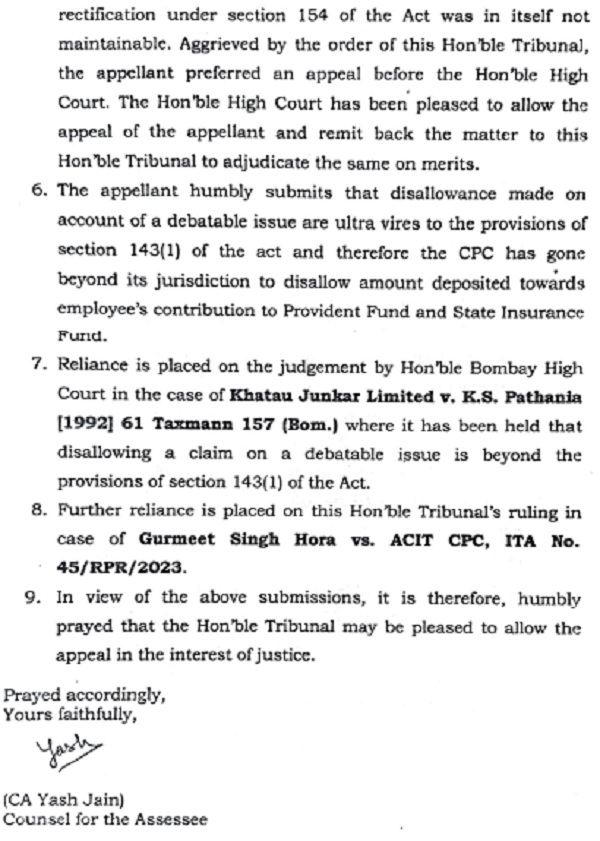
6. Based on aforesaid submissions, it was the prayer that disallowance made on account of a debatable issue was ultra virus to the provisions of section 143(1) of the Act and, therefore, it is beyond the jurisdiction of CPC as held by Hon’ble Mumbai HC in the case of Khatau Junkar Ltd. (supra) and also by the Jurisdictional bench of ITAT, Raipur in the case of Gurmeet Singh Hora (supra), which was further followed in the case of Satpal Singh Sandhu vs DCIT in ITA NO. 04/RPR/2023 for the AY 2019-20 vide order dated 11.05.2023. Accordingly, Ld. AR requested that the appeal of assessee may be allowed in the interest of justice.
7. Sr. DR on the other hand, submitted that the issue is squarely covered by the judgment of Hon’ble Jurisdictional HC in the case of BPS Infrastructure vs ITO in TAXC No. 87 of 2024 dated 12.04.2024, therefore, the contention raised by the Ld. AR have no substance to be hold good in the eyes of law, consequently, the appeal of assessee is liable to be dismissed.
8. We have considered the rival submission perused the material available on record and case laws relied upon by the parties. The sole controversy in the present case is whether deduction claimed u/s 36(1)(va) r.w.s 43B qua the employee’s contribution towards EPF & ESIC can be denied in a case where the payment was made after the due date in the respective statutes but was made before filing of the return u/s 139, especially in a case, where the return of the assessee is processed u/s 143(1)(a) as the issue was debatable in nature because of the divergent decisions of different High Court’s ruling the field as on the date of impugned adjustment.
8.1 In this case, the assessee has placed his reliance various judgments / decisions referred to (supra), however, subsequent to the orders relied upon by the Ld. AR, the issue has been deliberated upon by the Hon’ble Jurisdictional High Court of the Chhattisgarh in the case of M/s BPS Infrastructure Vs. ITO, Ward-1(3), Raipur, Tax Case No, 87 of 2024, dated 12.04.2024, which is relied upon by the revenue and rightly so, wherein it has been held that the issue of delayed payment of employees share of contribution towards ESI/PF is no more res integra in terms of principle of law laid down by the Hon’ble Apex Court in the case of Checkmate Services Pvt. Ltd. (supra), the relevant findings of Hon’ble Jurisdictional High Court in the case of M/s BPS Infrastructure Vs. ITO (supra) are as under:
13. As far as the issue involved pertaining to claiming of deduction under section 36 (1) (va) of the IT Act 1961 on delayed payment of employees share of contribution towards ESI/PF of Rs. 19,84,415, in the instant case is concerned is no more res integra. The Hon’ble Supreme Court has decided the legal issue on merits in the matter of Checkmate Services P. Ltd. v. Commissioner of Income Tax-1, {Civil Appeal No. 2833 of 2016, decided on 12.10.2022}, wherein at paragraphs 51 to 54, it was observed as under:
“51. The analysis of the various judgments cited on behalf of the assessee i.e., Commissioner of Income-Tax v. Aimil Ltd. [2010] 321 ITR 508 (Delhi High Court); Commissioner of Income-Tax and another v. Sabari Enterprises [2008] 298 ITR 141 (Karnataka High Court).; Commissioner of Income Tax v. Pamwi Tissues Ltd. [2009] 313 ITR 137 (Bombay High Court).; Commissioner of Income-Tax, Udaipur v. Udaipur Dugdh Utpadak Sahakari Sandh Ltd. [2013] 35 taxmann.com 616 (Rajasthan High Court) and Nipso Polyfabriks (supra) would reveal that in all these cases, the High Courts principally relied upon omission of second proviso to Section 43B (b). No doubt, many of these decisions also dealt with Section 36(va) with its explanation. However, the primary consideration in all the judgments, cited by the assessee, was that they adopted the approach indicated in the ruling in Alom Extrusions. As noticed previously, Alom Extrutions did not consider the fact of the introduction of Section 2(24)(x) or in fact the 8 other provisions of the Act.
52. When Parliament introduced Section 43B, what was on the statute book, was only employer’s contribution (Section 34(1)(iv)). At that point in time, there was no question of employee’s contribution being considered as part of the employer’s earning. On the application of the original principles of law it could have been treated only as receipts not amounting to income. When Parliament introduced the amendments in 1988-89, inserting Section 36(1)(va) and simultaneously inserting the second proviso of Section 43B, its intention was not to treat the disparate nature of the amounts, similarly. As discussed previously, the memorandum introducing the Finance Bill clearly stated that the provisions – especially second proviso to Section 43B – was introduced to ensure timely payments were made by the employer to the concerned fund (EPF, ESI, etc.) and avoid the mischief of employers retaining amounts for long periods. That Parliament intended to retain the separate character of these two amounts, is evident from the use of different language. Section 2(24)(x) too, deems amount received from the employees (whether the amount is received from the employee or by way of deduction authorized by the statute) as income – it is the character of the amount that is important, i.e., not income earned. Thus, amounts retained by the employer from out of the employee’s income by way of deduction etc. were treated as income in the hands of the employer. The significance of this provision is that on the one hand it brought into the fold of “income” amounts that were receipts or deductions from employees income; at the time, payment within the prescribed time – by way of contribution of the employees’ share to their credit with the relevant fund is to be treated as deduction (Section 36(1)(va)). The other important feature is that this distinction between the employers’ contribution (Section 36(1)(iv)) and employees’ contribution required to be deposited by the employer (Section 36(1)(va)) was maintained – and continues to be maintained. On the other hand, Section 43B covers all deductions that are permissible as expenditures, or out-goings forming part of the assessees’ liability. These include liabilities such as tax liability, cess duties etc. or interest liability having regard to the terms of the contract. Thus, timely payment of these alone entitle an assessee to the benefit of deduction from the total income. The essential objective of Section 43B is to ensure that if assessees are following the mercantile method of accounting, nevertheless, the deduction of such liabilities, based only on book entries, would not be given. To pass muster, actual payments were a necessary pre-condition for allowing the expenditure.
53. The distinction between an employer’s contribution which is its primary liability under law – in terms of Section 36(1)(iv), and its liability to deposit amounts received by it or deducted by it (Section 36(1)(va)) is, thus crucial. The former forms part of the employers’ income, and the later retains its character as an income (albeit deemed), by virtue of Section 2(24)(x) – unless the conditions spelt by Explanation to Section 36(1)(va) are satisfied i.e., depositing such amount received or deducted from the employee on or before the due date. In other words, there is a marked distinction between the nature and character of the two amounts – the employer’s liability is to be paid out of its income whereas the second is deemed an income, by definition, since it is the deduction from the employees’ income and held in trust by the employer. This marked distinction has to be borne while interpreting the obligation of every assessee under Section 43B.
54. In the opinion of this Court, the reasoning in the impugned judgment that the non-obstante clause would not in any manner dilute or override the employer’s obligation to deposit the amounts retained by it or deducted by it from the employee’s income, unless the condition that it is deposited on or before the due date, is correct and justified. The non-obstante clause has to be understood in the context of the entire provision of Section 43B which is to ensure timely payment before the returns are filed, of certain liabilities which are to be borne by the assessee in the form of tax, interest payment and other statutory liability. In the case of these liabilities, what constitutes the due date is defined by the statute. Nevertheless, the assessees are given some leeway in that as long as deposits are made beyond the due date, but before the date of filing the return, the deduction is allowed. That, however, cannot apply in the case of amounts which are held in trust, as it is in the case of employees’ contributions- which are deducted from their income. They are not part of the assessee employer’s income, nor are they heads of deduction per se in the form of statutory pay out. They are others’ income, monies, only deemed to be income, with the object of ensuring that they are paid within the due date specified in the particular law. They have to be deposited in terms of such welfare enactments. It is upon deposit, in terms of those enactments and on or before the due dates mandated by such concerned law, that the amount which is otherwise retained, and deemed an income, is treated as a deduction. Thus, it is an essential condition for the deduction that such amounts are deposited on or before the due date. If such interpretation were to be adopted, the non-obstante clause under Section 43B or anything contained in that provision would not absolve the assessee from its liability to deposit the employee’s contribution on or before the due date as a condition for deduction.”
14. Looking to the facts and circumstances of the case and law laid down by the Hon’ble Supreme Court in Checkmates Services (supra), the present appeal filed by the appellant is not only devoid of merits but also barred by limitation as provided under Section 253 of the Act. The learned ITAT has rightly dismissed the appeal of the assessee. We, therefore, are not persuaded to differ with the view taken by the ITAT and the reason assigned thereof.
8.2 Respectfully following the aforesaid decision of the Hon’ble Jurisdictional High Court, we are of the considered view that the payments qua the employees’ contribution to provident fund made after the due date under the relevant statutes shall be liable to be disallowed, even if the ITR is processed u/s 143(1) prior to the pronouncement of Judgment of Hon’ble Apex Court in the case of Checkmate(supra). In view of such observations the decision of Ld. CIT(A) following the decision of Hon’ble Supreme Court in the case of Allied Motors (P) Ltd. Vs CIT 91 Taxman 205 (SC), which is in concurrence with the view taken by Hon’ble Apex Court in Checkmate (supra), was justified well-reasoned and acceptable.
8.3 Our aforesaid view is further fortified by the Latest judgment of Hon’ble Mumbai High Court in the case of Rohan Korgaonkar vs DCIT (2024) 159 taxmann.com 321 (Bombay) dtd 07.02.2024, wherein Hon’ble Court on the issue in hand has held as under:
8. Checkmate Services (P). Ltd. (Supra) holds that the deductions can be claimed, or adjustments can be made under section 141(I)(a)(iv), read with section 36(1)(va) only when the employer deposits the contributions in the employee’s accounts on or before the due date prescribed under the Employee’s Provident Fund / Employees State Insurance Act. In this case, admittedly, the contributions were deposited in employees’ accounts beyond the due date. The circumstances that the assessment order was made u/s 143(1)(a) of the Act cannot make any difference.
8.4 In backdrop of aforesaid observations, we are of the considered view that the issue raised by the assessee assailing the applicability of the decision of Hon’ble Apex Court in the case of Checkmate (supra), qua the disallowance regarding employee’s contribution to provident fund under the provisions of section 143(1) on a date prior to the date of the order of Hon’ble Apex Court cannot be accepted and allowed.
9. In the result, appeal of the assessee is dismissed, in terms of our aforesaid observations.
Order pronounced in the open court on 17/01/2025.