In re Tata Motors Ltd. (CAAR Mumbai)
In a recent ruling by the Customs Authority for Advance Rulings (CAAR) Mumbai, the classification of a ‘Urea Injector’ has been deliberated upon and adjudicated. The case, titled In re Tata Motors Ltd., sought clarification on the appropriate classification of the said injector, which is an integral component in the Urea Dosing and Injection System utilized in commercial vehicles.
Background and Applicant’s Submission:
The applicant, Tata Motors Ltd., a prominent automobile manufacturer, filed an application seeking an advance ruling on the classification of the ‘Urea Injector.’ They argued that the injector, a crucial part of the Urea Dosing and Injection System, is primarily responsible for dosing and spraying the precise amount of urea required for Selective Catalytic Reduction (SCR) reactions with Nitrogen Oxide (NOx) emissions. The applicant contended that the injector should be classified under sub-heading 84249000 of the Customs Tariff Act, 1975, which pertains to mechanical appliances for projecting, dispersing, or spraying liquids or powders.
Analysis and Decision:
Upon thorough examination of the submissions made by the applicant, along with relevant legal frameworks and explanatory notes, the CAAR Mumbai arrived at its decision.
The ruling highlighted the distinction between ‘pumps’ and ‘spray nozzles’ as per the Customs Tariff Act. While pumps are covered under heading 8413, which encompasses various types of liquid pumps, the function of the ‘Urea Injector’ was deemed akin to that of a spray nozzle rather than a pump. As such, heading 8413 was deemed inapplicable.
Further scrutiny led to the classification under heading 8424, which encompasses mechanical appliances for projecting, dispersing, or spraying liquids or powders. The ‘Urea Injector’ was deemed to fall within this category, as it functions as a spray nozzle for urea in the exhaust system of diesel vehicles. Additionally, the specific mention of spray nozzles as parts under the Explanatory Notes to heading 8424 further supported this classification.
Conclusion:
In conclusion, based on the principles outlined in the General Rules of Interpretation (GIR) and in accordance with the Chapter Notes of Chapter 84 of the Customs Tariff Act, the ‘Urea Injector’ was classified under sub-heading 84249000. This ruling provides clarity on the classification of this essential component used in SCR systems for reducing NOx emissions from diesel engines.
This ruling by the CAAR Mumbai serves as a significant interpretation of the Customs Tariff Act, providing guidance on the classification of similar components in the automotive industry, thus contributing to clarity and consistency in customs classification procedures.
FULL TEXT OF THE ORDER OF CUSTOMS AUTHORITY OF ADVANCE RULING, MUMBAI
M/s Tata Motors Ltd (IEC No: 0388002808) (Hereinafter will be referred to as `Applicant’) filed an application for advance ruling in the Office of Secretary, Customs Authority for Advance Ruling, Mumbai. The said application was received in the secretariat of the CAAR, Mumbai on 04.08.2023, along with its enclosures in terms of Section 28H (I) of the Customs Act, 1962 (hereinafter referred to as the ‘Act’). The applicant is seeking advance ruling on the classification of ‘Urea Injector’ (hereinafter will be referred to as `subject goods’).
2. Submission by the Applicant:
2.1 The applicant is a leading automobile manufacturer and inter-alia engaged in manufacturing of a wide range of Commercial Vehicles and parts thereof for sale within India and abroad.
2.2 manufacturing of Commercial Vehicles, Applicant is importing Urea Injcetors. These Urea Injectors are part of Urea Dosing and Injection System.
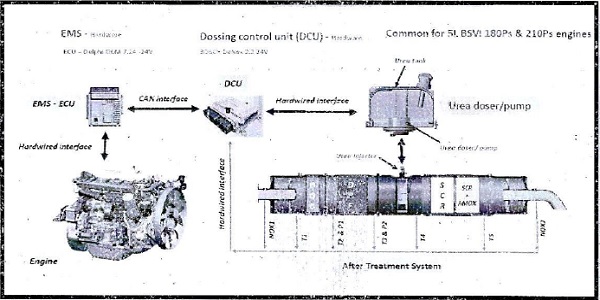
Image-1:Urea Dosing and Injection System
2.3 The increasing individual mobility of on-road and off-road transportation in today’s world has led to excessive use of human-made vehicles, such as cars, trucks, buses, etc. which produce significant emissions that can damage the human body from the inside. Currently the automotive industry is controlling auto engine emissions by three-way catalytic converters, but that solution cannot solve the diesel engine problem. The Government regulation limits are strict to reduce Nitrogen Oxide (`NOx’) emissions from transportation engines considering the more and more emission every year due to increase in number of vehicle users. The diesel engine is in great demand, being used in public transportation and freight carriers, but these engines produce more NOx emissions than other types of engines. Therefore, the automotive industry is trying to improve diesel engines to comply with government regulations. One approach is Selective Catalytic reduction (‘SCR’) systems, which can produce ammonia particles to control NOx emissions from diesel engines.
2.4 The SCR system is a common solution to reduce NOx emissions from diesel engines. SCR system requires atomised Urea solution that generates ammonia for NOx conversion to Nitrogen and Water. SCR system consists of Urea solution mixer which helps to disperse the injected urea vapours with the exhaust gas.
2.5 The SCR process to reduce NOx emissions from an engine is as follows:
2.5.1 Urea—water solution (UWS AdBluc / DEF) is injected into the SCR system as small droplet particles;
2.5.2 The small urea droplets get evaporated, and dissociates into ammonia gas and water vapours due to the exhaust hot gas temperature;
2.5.3 The ammonia gas then mixes with the exhaust gas and enters the SCR substrate. In the SCR, the presence of wash coat catalysis the reaction between the ammonia gas and the NOx & coverts it into N2 (inert not reactive gas) and water vapours.
This process and reaction can reduce NOx emissions from diesel engines. However, this process is usually not as smooth as the theory; many factors create difficulties in mixing ammonia with the NOx emission. In order to overcome this there has to be good design of. Urea Mixer, SCR substrate, Urea injector and the dosing strategy.
2.6 Researchers have modified SCR systems to improve the output, such as by changing the injector position to improve the spray phenomena; adding a mixer fan to increase the distribution flow inside the system; raising the wall temperature to increase the evaporation process; using different injector models to inject the urea. This research has improved SCR system performance to decrease the NOx quantity from diesel engines.
2.7 Urea dosing systems (Urea injector and Urea Pump) must ensure injecting the precise amount of urea for the SCR reactions and uniform mixing of urea and ammonia with the exhaust gas. Better atomization and smaller droplet size of injected urea allow a more complete conversion to ammonia and can minimize the risk of fouling by solid deposits. Many commercial urea injection systems utilize compressed air to improve atomization, but airless systems have also been developed. The urea dosing system components include pumps, injectors, mixers, and urea tanks.
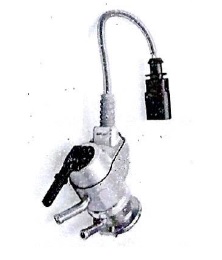
Image-2: Illustrative image of Urea Injector
2.8 Function of Urea Injector:
In Urea Dosing and Injection System, the urea is pumped into the pressure line from the urea tank and the line pressure increases. The pressure sensor in the pressure line is used for feedback control and the controller generates the PWM (Pulse-Width Modulation) signal to control the speed of the Motor. The motor connects to the pump and determine the pump frequency. After the pressure is in steady state, the pumped urea mass equates to the return flow through the throttle based on the mass. balance. Urea is injected into the exhaust pipe when the injection command is sent to the injector by the urea Dosing Control Unit (`DCU’).
Urea injector is a part of Urea Dosing and Injection System. The main function of Urea Injector is dosing/spraying of the precise amount of urea necessary for the SCR reactions with NOx, and mixing urea and ammonia thoroughly with the exhaust gas. Too much urea injection may cause ammonia slip and too little– urea injection may result in low NOx reduction efficiency. Therefore, the injection is very critical for SCR control.
2.9 Applicant’s Interpretation of Law :
i. Applicant has analysed the possible headings under the First Schedule to the Customs Tariff Act,. 1975 [‘Customs Tariff’] for seeking classification of the said Urea Injector as under:
a. 8413-Pumps for liquid, whether or not fitted with- a measuring device; Liquid Elevators
c. 8424- Mechanical appliances.(whether or not hand operated) for projecting, dispersing or spraying liquids or powders: Fire Extinguishers, whether or not charged, Spray guns and similar appliances; steam or sand blasting machines and similar jet projecting machines
d. 8708- parts and accessories of the motor vehicles of heading nos 87.01 to 87.05
ii. Applicant, inter-alia is of the view that the Urea Injector is a connector between Urea loser/Pump and the exhaust pipe. It receives the Urea solution from the pump and air from the air valves and the mix is sprayed into the exhaust chamber. The quantum of aqueous urea that is fed into the injector and the required air flow into the injector arc controlled by an electronic control module. The entire injection system is a part of the exhaust system in a diesel vehicle. So it is clear that injector only does the function of spraying liquid and cannot be called as a ‘pump’. The entire CTI 18413 is for various types of pumps and therefore, HSN 8413 may not be applied here.
iii. The spray nozzles are specifically covered as ‘Parts’ under the Explanatory Notes to CH 8424. Hence, here it can be said that in terms of Rule 3(a) of General Rules of – Interpretation, 8424 9000 provides for the most specific description, being spray nozzles, over general and therefore Urea Injector may be classifiable more appropriately under 8424 90 00.
iv. While the Urea Injector is a part of diesel vehicle itself, Section notes to chapter 87 specifically excludes machines and apparatus of heading 8401 to 8479. Urea Injector being a mechanical appliance captured under 8424 would be excluded from chapter 87. The Applicant submit that by virtue of Note 2(e) to Section XVII the Urea Injector gets excluded from the expression “Parts” and “Parts and Accessories” under HSN 8708 and therefore would not be classifiable under PISN 8708.
v. Separately, since Urea Injector have multiple uses in the industry like marine automotive, power generation etc., specific heading will prevail over general heading in terms of General Rules of Interpretation. Hence the urea injector cannot be classified under CTH 8708.
vi. Based on the above factual and legal position, it is Applicant’s interpretation that such Urea Injector would fall under HSN 84249000 of the First Schedule to the Customs Tariff Act, 1975.
2.10 In view of the above, the Applicant seeks an Advance Ruling on the classification of `Urea Injector’.
3. Port of Import and reply from jurisdictional Commissionerate:
3.1 The applicant in their CAAR-1 indicated that they intend to import the subject goods from Commissioner of Customs (Import), Air Cargo Complex, Sahar Andheri (E), Mumbai-400099. The application was forwarded to . the jurisdictional Commissioner of Customs(Import), Air Cargo Complex, Sahar Andheri (E), Mumbai for their comments on 07.08.2023 & 18.09.2023
3.2 The jurisdictional Commissioner of Customs (Import), Air Cargo Complex, Sahar Andheri (E), Mumbai-400099 sent the comments vide their letter dated 04.10.2023 (received on 30.10.2023) however, inter-alia no comments have been made with regard to the classification of ‘Urea Injector’ for use in manufacturing of Commercial Vehicles.
4. Details of Personal Hearing:
4.1 A personal hearing was held on 23.01.2024 at 03:00 PM. Shri .Gajanan Shanbhag Sr. Manager and Shri Pravin Deshpande General Manager officials of applicant appeared for the hearing. During the PI-I, the representatives of the applicant reiterated the content of submitted in the application submitted before this office. Further, they explained the product in question and contended that the same merit classification under Customs Tariff Subheading 8413/8424. They also relied upon the explanatory note pertaining to Subheading 8413 of `Other Pumps’. They sought two weeks’ time to file additional submission in the support of their contention. Nobody appeared from the department side personal hearing either in person or through e-hearing mode.
5. I have considered all the materials placed before me in respect of the subject goods. I have gone through the submissions made by the applicant during the personal hearing as well as the response received from the Jurisdictional customs Commissionerate, Therefore, I proceed to pronounce a ruling on the basis of information available on record as well as existing legal framework. The issue before me is the classification of ‘Urea Injector’ to be used in Commercial vehicles.
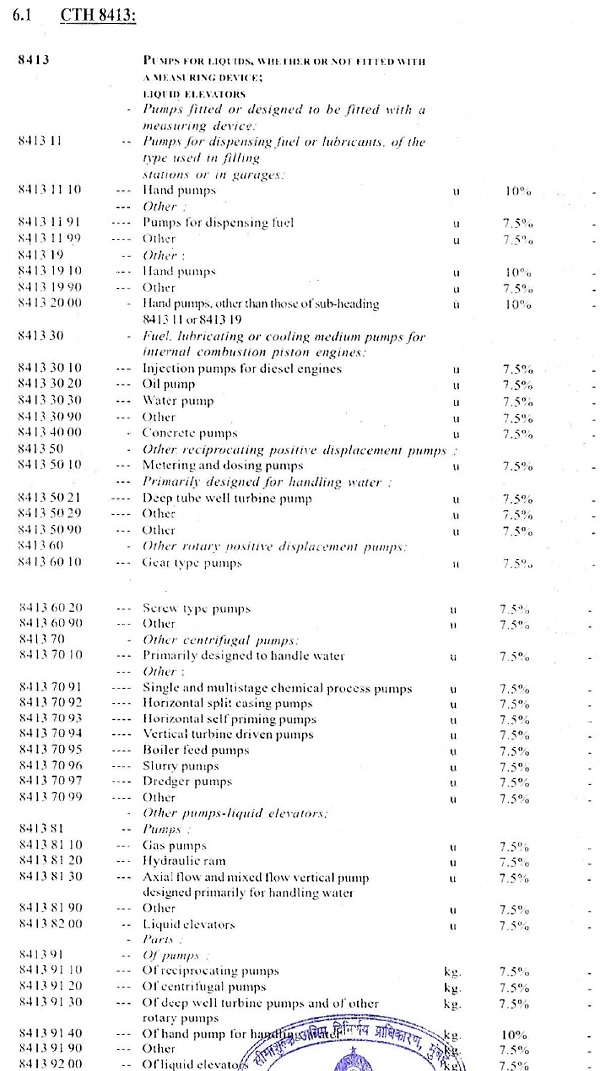
6. Before deciding on the issue, let me deliberate on the legal framework prescribed in Customs Tariff Act, 1975, Chapter/ Section notes along with HSN explanatory notes, Relevant portion of Customs tariff is reproduced here for ease of reference: