In re Narang Machinery Store (CAAR Delhi)
Introduction: The Customs Authority for Advance Rulings (CAAR) in Delhi has delivered an important verdict on the classification of whey protein, addressing the complexities surrounding its importation under the Customs Tariff Act, 1975. This ruling, sought by M/s Narang Machinery Store, provides clarity on how whey protein products, based on their composition and added ingredients, should be classified for customs purposes.
Detailed Analysis
Background and Inquiry: M/s Narang Machinery Store filed an application for an advance ruling on the classification of various whey protein compositions. The queries centered around whether whey protein concentrate (WPC) or whey protein isolate (WPI), with or without additives like sweeteners, flavors, or digestive enzymes, could be classified under specific headings of the Customs Tariff Act.
Whey Protein Composition: Whey protein is derived from milk and is a byproduct of cheese production. It is rich in protein fractions, minerals, and lactose. The process of making whey protein involves several steps including ultrafiltration, diafiltration, and microfiltration, resulting in WPC with protein levels ranging from 30% to 80% and WPI with at least 90% protein content.
Legal Framework for Classification: The classification under the Customs Tariff Act is guided by the General Rules of Interpretation of the Import Tariff and the Harmonized System of Nomenclature (HSN). The ruling sought to classify whey protein products under headings 0404 or 3502, based on their protein content and added ingredients.
CAAR’s Ruling
The CAAR’s ruling addressed three main scenarios:
1. Whey protein (WPC/WPI) without additives: Classified under heading 0404, as it falls within the natural milk constituents category.
2. Whey proteins with up to 80% protein, with additives: Still classified under heading 0404, as the additives do not change the fundamental classification.
3. Whey proteins with more than 80% protein, with additives: Classified under heading 2106, not 3502, as these are considered food preparations rather than pure dairy or albumin products.
This distinction is crucial as it affects how these products are treated for customs and importation purposes, with significant implications for importers and the dairy industry.
Conclusion: The CAAR Delhi’s ruling on the classification of whey protein under the Customs Tariff Act provides much-needed clarity for businesses involved in the importation of whey protein. By delineating the criteria based on protein content and the presence of additives, the ruling helps in streamlining customs processes and ensuring compliance with the law. This decision is a significant reference point for stakeholders in the dairy and nutrition sectors, setting a precedent for future classifications and imports of similar products.
FULL TEXT OF THE ORDER OF CUSTOMS AUTHORITY OF ADVANCE RULING, DELHI
M/s Narang Machinery Store, 65, Shardhanand Marg, G B Road, Delhi North, Delhi 110006, having IEC No. AADPN9360M(`applicant’, in short) has filed an application (CAAR-1) for advance ruling before the Customs Authority for Advance Rulings, New Delhi (CAAR, in short). The said application was received in the Secretariat of the CAAR, New Delhi on 30.11.2023 along with enclosures in terms of Section 28H (1) of the Customs Act, 1962 (hereinafter referred to as the ‘Act’). The applicant has stated that import of ‘whey protein’ is the proposed activity and advance ruling has been sought on classification thereof under the Customs Tarriff Act, 1975 (CTA, in short) by posing questions as below:
(i) Whether whey protein i.e., whey protein concentrate (`WPC’, in short) or whey protein isolate (`WPI’, in short) (irrespective of protein content), whether or not containing sweetener/flavor/digestive enzymes/cocoa, but not a mixture of two or more WPC/WPI, are classifiable under CTH 0404 of the First Schedule to the CTA?;
(ii) Whether whey proteins comprising of two or more WPC and/or WPI, containing protein upto 80% (w/w), whether or not containing sweetener/flavor/digestive enzymes/cocoa, are classifiable under CTH 0404 of First Schedule to the CTA?; and
(iii) Whether whey proteins comprising of two or more WPC and/or WPI and containing protein more than 80% (w/w), whether or not containing sweetener/flavor/digestive enzymes/cocoa, are classifiable under CTH 3502 of First Schedule to CTA?
2.1 The applicant has stated that, they are proposing to import WPC and/or WPI of various compositions. The applicant has explained the goods in question, inter-alia stating that, ‘whey protein’ is a protein derived from milk and is a dairy product; it is a mixture of protein fractions found in whey; curdling of milk results in separation of milk solids and liquid; the liquid material obtained from curdling of milk is called `whey’; generally, ‘whey protein’ is obtained from cow milk; fat is separated from the milk; milk is thereafter pasteurized at a temperature of 70 to 80 degree centigrade and then cooled to 4 degrees centigrade; enzymes (rennet/acids) are added to such milk to separate liquid whey and casein (curds or solid portion) from milk; thus, whey is the soluble liquid part of milk, rich in protein fractions, minerals and lactose; typically, milk comprises of 20% whey and 80% casein; in its raw liquid form, whey is composed of naturally occurring macronutrients i.e., water (93%) protein (0.8%), fat (0.3%), lactose (4.8%) and minerals-referred to as ash (0.5 %); the liquid whey undergoes ultrafiltration process to obtain concentrated whey proteins which contains 30-50% protein on a dry weight basis (w/w); ultra-filtration membranes with varying pore sizes separate whey’s larger molecular weight proteins and residual fats (retentate) from their smaller molecular weight lactose, minerals, soluble salts and non-protein nitrogen are removed with the permeate; this results in reduction of lactose and increase in protein concentrate; in order to further concentrate the whey, the concentrated whey undergoes diafiltration process in which additional lactose and soluble minerals are reduced; the whey protein obtained in this process contains 50-80% protein (w/w); such whey protein undergoes microfiltration to obtain whey protein with 90% (w/w) or more protein content; the liquid whey protein fractions are further concentrated by evaporation in order to improve the physical properties of the powdered whey protein; the liquid whey further undergoes spray-drying to obtain the powdered whey protein; the most important commercial whey protein is WPC with protein levels ranging from 30% to 80% (w/w); WPI contains at least 90% protein (w/w) and contains little fat, lactose and mineral content; the process for manufacturing of whey protein having different levels of protein content is depicted below:
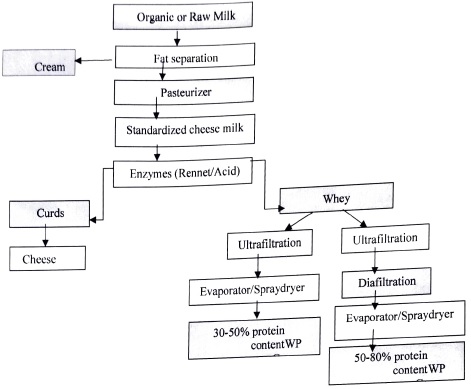
whey protein comprises of approximately 20-22 protein fractions out of which about 7 fractions are pre-dominant, while rest are in miniscule quantity; the individual protein fractions have their own characteristic and properties; whey protein is a combination of all the protein fractions that are naturally found in liquid whey obtained from cow milk; the characteristics and properties of whey protein are different from the characteristic and properties of individual protein fractions; the manufacturers of whey protein produce raw WPI and/or WPC of different protein content or they mix two or more WPI and/or WPC to enhance the taste and make it economical, in which various flavours/cocoa/sweeteners/digestive enzymes are added by mixing or blending in order to enhance the taste and digestibility of the product; details about the products which they propose to import are as below:
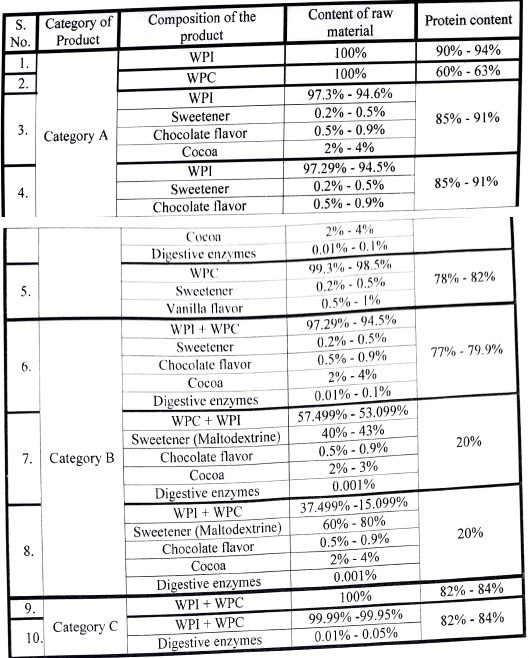
2.2 As regards their interpretation of law and/or facts in respect of the questions on which advance ruling is required, the applicant has inter-alia stated that, the questions raised in the present application are neither pending in the applicant’s case before any officer of customs, the Appellate Tribunal or any Court nor in view of the applicant, identical issue has been decided by the Appellate Tribunal or any Court. It is further stated that as per their understanding,
(i) Category A – Whey Protein i.e., WPC or WPI (irrespective of protein content) whether or not containing sweetener/flavor/cocoa/digestive enzymes is classifiable under Heading 0404 of Schedule-I of the CTA as “Whey, whether or not concentrated or containing added sugar or other sweetening matter; products consisting of natural milk constituents, whether or not containing added sugar or other sweetening matter, not elsewhere specified or included”;
(ii) Category B – Whey Proteins comprising of two or more WPC and/or WPI, containing protein upto 80% (w/w) and whether or not containing sweetener/flavor/cocoa/digestive enzymes is classifiable under Heading 0404 of Schedule-I of the CTA as “Whey, whether or not concentrated or containing added sugar or other sweetening matter; products consisting of natural milk constituents, whether or not containing added sugar or other sweetening matter, not elsewhere specified or included”;
(iii) Category C – Whey Proteins comprising of two or more WPC and/or WPI and containing protein more than 80% (w/w) whether or not containing sweetener/flavor/cocoa/digestive enzymes is classifiable under Heading 3502 of Schedule-I of CTA as “Albumin (including concentrates of two or more whey proteins, containing by weight more than 80% whey proteins, calculated on the dry matter), albuminates and other albumin derivatives”
2.3 The applicant has further stated that, the classification of goods covered under First Schedule of the CTA is to be determined in terms of the General Rules of Interpretation of Import Tariff (‘GRI , in short); rule I of the GRI provides that the classification shall he determined according to the terms of the Heading and any related Section or Chapter Notes; rule 3(a) of GRI further provides that Heading which provides most specific description should be preferred over general Heading; classification schedule adopted under the CTA is based on the Harmonized System of Nomenclature (`HSN’, in short) which is an internationally accepted product coding system formulated under the auspices of General Agreements on Tariffs and Trade (‘GATT’); the international practice of adopting a uniform classification was done to facilitate common understanding of goods across countries and India is a signatory to the same and has undertaken to adopt HSN classification; the World Customs Organization (`WCO’, in short) issues Explanatory Notes to HSN from time to time; HSN Explanatory Notes delineate the ambit of various Chapter Headings and Sub-headings; since CTA is based on HSN, HSN Explanatory Notes have great persuasive value to understand the CTA.
2.4 The applicant has then stated that, HSN Explanatory Notes to Heading 0404 provides that:
“This heading covers whey (i.e., the natural constituents of milk which remain after the fat and casein have been removed) and modified whey (see Subheading Note 1 to this Chapter). These products may be in liquid, paste or solid (including frozen) form, and may be concentrated (e.g., in powder) or preserved.
…
Apart from natural milk constituents and the additives mentioned in the General Explanatory Note to this Chapter, the products of this heading may also contain added sugar or other sweetening matter.
…
The heading does not cover:
(a) ..
(d) Food preparations based on natural milk constituents but containing other substances not allowed in the products of this Chapter (in particular, heading 19.01). “;
thus, bare perusal of Heading 0404 and HSN Explanatory Notes reveals that whey protein either WPC or WPI (irrespective of the content of protein) in which sweetener is added, is covered under Heading 0404; in Category A products, apart from sweeteners, digestive enzymes, flavors, cocoa are added; as per Note 5(c) of Chapter 4 of the CTA, if products are obtained by replacing one or more of its natural constituents by another substance, it is excluded from Chapter 4; in this regard, HSN General Explanatory Notes to Chapter 4 states that: “This Chapter covers:
(I) Dairy products:
…
(D) Whey.
…
The products mentioned at Items (A) to (E) above may contain, in addition to natural milk constituents (e.g., milk enriched in vitamins or mineral salts), small quantities of stabilising agents which serve to maintain the natural consistency of the product during transport in liquid state (disodium phosphate, trisodium citrate and calcium chloride, for instance) as well as very small quantities of anti-oxidants or of vitamins not normally found in the product. Certain of these products may also contain small quantities of chemicals (e.g., sodium bicarbonate) necessary for their processing; products in the form of powder or granules may contain anticaking agents (for example, phospholipids, amorphous silicon dioxide).
For the purposes of Note 4 (b) to this Chapter the expression “butyric fats” means milk fats and the expression “oleic fats” means fats other than milk fats, in particular vegetable fats (e.g., olive oil)
…
This Chapter also excludes, inter alia, the following:
(a) Food preparations based on dairy products (in particular, heading 19.01).
(b) Products obtained from milk by replacing one or more of the natural constituents (e.g., butyric fats) by another substance (e.g., oleic fats) (heading 19.01 or 21.06).”
As per the applicant, from perusal of the above, it is evident that: