IDP Education India Private Limited Vs Additional Director General of Central Excise (CESTAT Delhi)
It is undisputed that the appellant has an agreement only with IDP Australia. The appellant recruits or facilitates students in India, but does not get any remuneration from Australian universities. For the students who are recruited or admitted by the university in Foreign Country, recommended by appellant in India, IDP Australia gets paid by the Australian/Foreign universities. A share of that commission is given to the appellant by IDP Australia. This scheme of arrangement clearly shows that the IDP Australia is providing services to the foreign universities and is receiving consideration for the same. Insofar as recruitment of students in India is concerned, IDP Australia has created the appellant as a fully owned subsidiary, and has sub- contracted this work to the appellant. Nothing has been brought on record in the show cause notice or in the order to show that the appellant has a direct contract with the foreign universities. There is nothing on record to show that the appellant is liasioning or acting as intermediary between the foreign universities and IDP Australia. All that is evident from the records is that the appellant is providing the services which have been subcontracted to it by M/s IDP Australia. As a sub contractor, it is receiving commission from the main contractor for its services. The main contractor – IDP Australia, in turn, is receiving commission from the foreign universities who pay a percentage of the tuition fee to IDP Australia. From the records, we find that Revenue has not established that the appellant is acting as an intermediary between M/s IDP Australia and the foreign universities, as alleged or held in the impugned order and the show cause notice. Hence, we find in favour of the appellant on merits.

We also find that on the exact same services a show cause notice was issued earlier covering the period 1.4.20 12 to 3 1.3.2013 and which was dropped holding that the services rendered by the appellant to IDP Australia, amounted to export of services. All that has changed is that DGCEI has picked up an issue which has already been settled and took a different view and issued the subsequent show cause notice and confirmed the demand. If the DGCEI was aggrieved by the earlier order which was passed, the right course could have been for it to appeal to a higher judicial forum. A show cause notice issued on the same issue which has already been settled, simply because DGCEI holds a different view, is in our considered view not sustainable. On this ground also, the impugned order needs to be set aside.
FULL TEXT OF THE CESTAT DELHI ORDER
This appeal is filed by the appellant assailing the order in original dated 31.5.2016 1 demanding service tax of Rs. 5,92,82,145 for the period 1.4.2014 to 30.9.2015. The show cause notice which led to the issue of impugned order was dated 16.11.2015 covering the extended period of 1.7.2012 to 13.9.2015. In the impugned order, the demand for the extended period has been dropped and, therefore, the same is not in dispute.
2. The appellant is a subsidiary of M/s IDP, Australia and is registered under the Companies Act and has its corporate office in Gurgaon. Australian universities/institutions are treated as “Education Service Providers” under the Australian law and have to follow the National Code and the “universities Australia Code of practice”. In order to meet these requirements, the universities have to recruit students of high quality. Therefore, the universities entered into an agreement with M/s IDP, Australia and they pay a percentage of the tuition fee which they receive from the students to IDP Australia for its services. IDP Australia, in turn, has entered into “Student Recruitment Services Agreement” with the appellant to help recruit students from India. The duties of the appellant include:
(i) Providing information and advice to students;
(ii) Helping in their application processes;
(iii) Pre-departure student assistance with respect to Visa, health insurance, etc.
(iv) Providing information with respect to the various programmes;
(v) Providing information on course types.
For these services the appellant receives as commission from IDP Australia, 77% of the application processing fee received by IDP Australia from the universities. Earlier, a show cause notice dated 6.5.2014 was issued to the appellant by the Commissionerate demanding service tax on this commission, which was subsequently dropped holding the services as export of services. Thereafter, on the same issue DGCEI initiated investigation, studied the documents, recorded statements, and came to the conclusion that the student recruitment service is misnomer and the appellant was, in fact, acting as an ‘intermediary’ between the foreign service providers, IDP Australia and the students. Para 6.2 and 6.3 of the show cause notice reads as follows:
“6.2 During the course of investigation, M/s IDP India vide their letter dated 6.8.2015, submitted that they were providing support services to M/s IDP Australia. On going through the said agreement between M/s IDP Australia and M/s IDP India, and the nature of activities carried out by M/s IDP India, it is clear that support service used as nomenclature for describing the said agreement, is a misnomer. Though the said agreement defines Recruitment Services, Office Services and also the commissions for both these services, it is but obvious that M/s IDP India were promoting the business of ‘Foreign Education Service Providers’ while facilitating activity of student recruitment, in India. In fact, the activity of arranging or facilitating recruitment of student in India, is the essential character of the said agreement. The nomenclature and definitions in the said agreement cannot alter the very nature of the activities performed by M/s IDP India and the essence of the said agreement which is arranging and facilitating recruitment of student in India, as an intermediary between Foreign Education Service Providers, M/s IDP Australia and the students.
6.3 Since the various services, namely recruitment services, office services etc. shown under the said agreement, are naturally bundled in the ordinary course of business, the taxability of service under the said agreement, is to be determined on the basis of service of facilitating recruitment of students (the essential character of the bundle of services covered under the said agreement), in terms of clause (a) of Section 66F(3) of the Finance Act, 1994.”
3. The show cause notice also invoked extended period of limitation, which has been dropped in the impugned order, and hence is no longer in dispute. The show cause notice also proposed imposition of penalties under Section 77 and 78 of the Finance Act on the appellant. The appellant contested the demand both on merits and on limitation. After following due process, the learned Additional Director General has, in the impugned order, confirmed the demand only for the normal period of limitation along with interest and also imposed penalty of Rs. 50 lakhs under Section 76 and Rs. 10,000/- under Section 77 upon the appellant. Hence this appeal.
4. Learned Counsel for the appellant takes us through the contractual agreement, consideration flow and communications which is as follows :
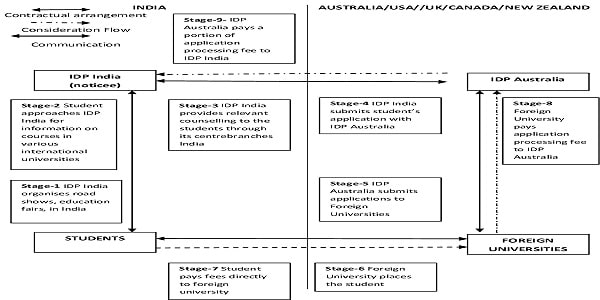
5. He asserts that the appellant does not qualify as an ‘intermediary’ since the conditions enumerated under the definition of intermediary in Rule 2(l) of Place of Provision of Services Rules, 2012, because;
(a) The appellant is neither ‘broker’ nor an ‘agent’ of IDP Australia.
(b) The appellant is not arranging or facilitating provision of ‘student recruitment services’ but is providing the “student recruitment services” on its own account to its principal, who, in turn, provide the services to the universities
(c) An ‘intermediary’, typically arranges or facilitates the provision of a service by arranging for a third party to provide the service, which is not at all the situation here.
(d) The appellant has no privity of contract with the foreign universities, it only has a contract with IDP Australia
(e) IDP Australia has a contract with the foreign universities for getting the students, and receives a percentage of the fees paid by the students as commission.
(f) the appellant is a sub-contractor of IDP Australia and, therefore, has a contract only with the IDP Australia. For the services it renders, the appellant receives consideration only from IDP Australia. In view of the above, allegation that the appellant is acting as an intermediary between “IDP Australia” and the “foreign university”, is not borne out by facts. Therefore, the entire demand needs to be set aside.
6. Learned Counsel also argued that it is not open for the Department or DGCEI to start taking a different view on the same issue which has been raised and settled by the Department itself for the earlier period. This is hit by the principle of res adjudicata and therefore the demand needs to fail on this ground also. Lastly, he submits, since the demand itself is not sustainable, the interest and penalties cannot sustain either.
7. Learned Departmental Representative supports the impugned order. He further submits as follows: