The FADA Conundrum- Striking a Balance in Revenue Interests and Taxpayer Confidence
Abstract
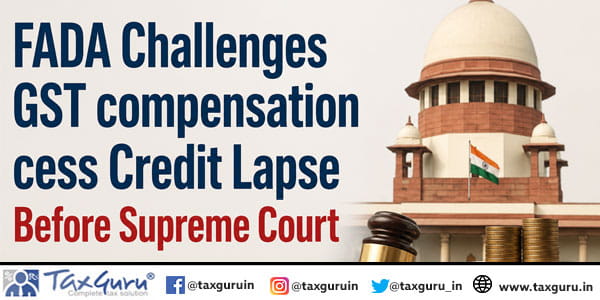
In December 2025, the Supreme Court admitted a petition filed by the Federation of Automobile Dealers Association (FADA) challenging the legality and validity of the notification passed by the central government, which seeks to lift GST compensation cess (GST cess) levied on motor vehicles. The item was listed in the erstwhile notification (passed in 2017), which provided for items taxed along with cess against the varied cess rates. The petition challenges the non-transition of accumulated cess credits following the nil-rating of cess rates, an action that was not dignified by a definite methodology for utilising the credits, either by way of refund (as requested), or any other measure considering the staggering amount of credits that sit idle. The petition reveals a largely unsettled issue of lawful appropriation of accumulated tax and cess credits, a position that has remained mechanically unaddressed, since the regime of taxation that precedes the current one.
In this backdrop, the author will dissect the decisions that have shaped the discourse on cess credit litigation and will contribute to it, positing few recommendations for a beneficial legal outline, post cess(ation) in the GST 2.0 era.
The Statutory Stance- Forms and Facets of a Credit
The GST (Compensation to States) Act, was enacted in 2017 to levy compensation cess for providing compensation to the States for the loss of revenue arising on account of implementation of the goods and services tax. The rates of cess to be levied on such supplies of goods and services will be specified in the notifications passed by the Central Board for Indirect Taxes and Customs (CBIC). Similar to Input Tax Credits (ITC), the cess paid on inputs over and above GST, can be claimed as a credit over the cess to be paid on output goods and services, to avoid the cascading of cess liability. This principle was established in the earlier regime of indirect taxation, represented prominently by central excise duty and value added tax (VAT) and was reinforced when the modified VAT (MODVAT) was introduced. Those manufacturers who were dependent on the raw materials from the others were granted excise credit on all raw materials. For instance, a manufacturer purchasing inputs from another manufacturer could avail credit of the excise duty paid on such inputs, since the supplier would have already discharged duty on the goods cleared. This input duty credit could then be set off against the excise liability on the purchaser’s final products, ensuring that duty was effectively levied only on the value addition at each stage of manufacture. The statutory framework governing this mechanism was contained in rules 57A to 57U of the Central Excise Rules of 1944, issued by the central government as per the section 37 of the Excise Act of 1944.
It bears note that the lapse of unutilized credits can be traced back to the time, when rule 57-F (4-A) was introduced in 1997. This rule stated that all credits lying unutilised with manufactures of tractors on a record date, would extinguish without exception. The apex court, in Eicher motors and Anr v. UOI on on 28 January, 1999 examined the claims of aggrieved taxpayers, and highlighted the stage at which the MODVAT credit transforms into a legally-vested entitlement. It held that once excise duty is paid on inputs and the corresponding credit is duly recorded in the manufacturer’s account, the entitlement to utilise such credit is ascribed the status of being “as good as tax paid”. This entitlement crystallises upon the inputs entering the manufacturing stream and continues until it is legitimately set off against the duty payable on the end product, and ought to be preserved. Here, it is praiseworthy that the court drew a comparison of a credit utilized to the very tax to be deducted, fortifying the statutory contours of a credit, be it in any form.
This is further established, when the Supreme Court justified the period of limitation delineated for utilizing MODVAT credits in Osram Surya (P) Ltd. v. Commissioner Of Central Excise, Indore on 2 May, 2002 by stating that while the Eicher case involved the abolition of a substantive right, the current scenario dealt with a procedural limitation on the exercise of an existing right. The Apex Court in Osram Surya (P) Ltd. v. Commissioner Of Central Excise, Indore, decided by the Supreme Court of India on May 2, 2002 held that the proviso imposed a restraint on the timeframe within which manufacturers could exercise their credit rights but did not abrogate the substantive rights accrued (by way of credits) before its enactment. This timeframe is similar to the one stipulated for utilizing ITC under section 16(4) of the CGST act of 2017. Another example of honouring a credit, was the matter of Collector of Central Execise, Pune and others v., Dai Ichi on on 11 August, 1999 in which, the Supreme Court stressed on considering the “cost of production” of raw materials (post deduction of MODVAT credit) for the valuation of any intermediate products produced, and not the original cost, thereby laying emphasis on the principle held in Eicher motors. The above decisions prove that a credit of any form, be it ITC, or MODVAT or cess deserves legal recognition and protection against an unreasonable statute driven action.
Dealing with Credit Lapses- The Guiding Lights of Samtel India and Cellulor Operators
While on one hand, tax credits are given importance, cess credits on the other hand have been addressed inadequately. In its plea, the FADA has requested the apex court to direct the government, by notice to:
- Allow carry-forward or offset of these credits against other GST liabilities, or
- Permit a refund mechanism for the cess credits accrued under the earlier system.
This was evident in Eicher motors, when the question of preservation was not answered with any actual solution, as it gives rise to any of the above two remedies itself. In the case of Samtel India Ltd v. Commissioner of Income Tax, Jaipur on 12 March, 2003 the apex court did permit a time bound refund of MODVAT credits of manufacturers of black and white tubes, owing to rule 57-F(17) of the central excise rules, that provided for the expiry of credits availed by them. However, a similar stance was not taken by the Delhi High Court in the matter of Cellulor Operators Association of India And others , when a writ petition was filed seeking the court to strike down a notification passed in 2015, that edged out the “education cess” (EC) and the “secondary and higher education cess” (SHE), resulting in unutilised CENVAT (central VAT) cess credits. The plea was to seek appropriation of the credits, for payment of excise duty and service tax (cross utilization). However, the court held that this was not legally possible, as per the scheme of the cess levy, as credits of EC and SHE must be used solely against EC and SHE liabilities. Surprisingly, the court did not provide a solution as to the credits that remain untouched, unlike the Samtel India case. This is worrisome as, subordinate courts must derive its analysis in substantial part, from the decisions of the Supreme Court, to avoid depriving credits of its future usage.
Such differing decisions can imperil the legality of credits that was once upheld by the apex court. It is imperative, that courts understand the underlying intent and purpose of providing credits to taxpayers, and though there may be changes necessary to be made in the tax structure, the indefeasible nature of a credit must be respected.
Recommendations and Concluding Remarks
The notification contended by FADA is one of the many, issued by the government in its path to reform the GST regime, especially with the outcome of the 56th council meeting that recommends several measures in this direction. Although, the objective heralds a restructured regime, it is necessary to iron out the creases too. Situations where legitimately earned cess credits become unusable after a levy is abolished can be reduced, when the CBIC builds a clear and practical mechanism. When a cess is withdrawn, the notification should expressly clarify what will happen to the accumulated credit. Where cross-utilisation is not feasible, a structured time bound refund process with appropriate safeguards such as verification and unjust enrichment checks, would ensure fairness while protecting interests of the revenue. The CBIC may also consider permitting both, by allowing cross utilization upto a specific timeframe (say 12-15 months) as per the sector of business, from the date of the notification, and post the same, the remaining unappropriated credits can be refunded via a separate scheme/window. This would also not cause a sudden revenue impact for the exchequer. Another measure would be to allow transfer of credit within entities under the same PAN to reduce stranded balances. Importantly, before abolishing any levy, a formal assessment of the quantum of accumulated credit and its sectoral impact should be undertaken. Such measured steps would preserve the core principle of seamless credit, reduce litigation, and increase taxpayer confidence in the structure.