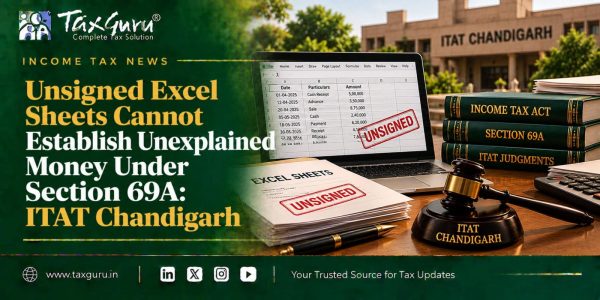
ITAT Mumbai deletes Section 69 additions holding that third-party excel sheets and statements without corroborative evidence lack evidentiary value. Reopening based on unverified data and denial of cross-examination violates natural justice; entire additions quashed.
The Court held that once a revised return is filed, the original return stands obliterated. Ignoring the revised return was treated as a legal error, leading to remand for fresh assessment.
The case examines whether penalty applies when a deduction claim is disallowed. ITAT held that full disclosure and bona fide claim prevent penalty under Section 271(1)(c).
The High Court observed that personal penalties on directors cannot be imposed without independent proceedings. It emphasized the need for separate registration and proper procedure.
Karnataka High Court held that pigmy agents employed by the Bank can never be treated as business facilitators and qualifies as employees of the Bank and hence commission paid to pigmy agents is clearly exempt from levy of GST in terms of Sl.No.1 of Schedule III. Accordingly, writ petition is allowed.
The Tribunal held that reopening an assessment on identical material already examined is invalid. It ruled that reassessment cannot be used to revisit concluded issues without fresh evidence.
The case examined whether minor valuation differences can trigger taxation under Section 56(2)(x). ITAT held that differences within 10% fall within permissible tolerance. The ruling protects genuine transactions from arbitrary additions.
The case addressed whether income can be corrected without filing a revised return. ITAT held that genuine computational errors can be rectified through revised computation during assessment. The ruling prioritizes accurate income over procedural technicalities.
The case examined whether CSR expenses can qualify for deduction despite Section 37 disallowance. ITAT held that Section 80G operates independently and allows deduction for eligible donations. The ruling clarifies dual treatment of CSR spending.
The case examined whether old share capital can be taxed due to ROC strike-off of a shareholder. ITAT held that Section 68 applies only to credits in the relevant year. The ruling clarifies that historical transactions remain valid.