Income Tax : Learn how taxpayers can set off losses against taxable income and carry forward unadjusted losses under the Income-tax Act. The FA...
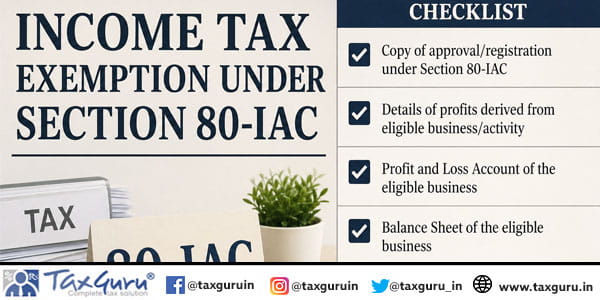
Income Tax : This guide explains eligibility, documentation, and application steps for claiming tax exemption under Section 80-IAC. It highligh...
Income Tax : The eligibility period for startup tax exemption has been extended to March 31, 2030. Startups must meet DPIIT and compliance cond...
Income Tax : Eligible Indian startups can get 100% income tax exemption for 3 years under Section 80-IAC. Learn eligibility, DPIIT recognition,...
Income Tax : Indian startups can claim 100% income tax exemption for three consecutive years within their first decade. Learn about DPIIT recog...
Income Tax : On August 5, 2024, it was clarified in the Lok Sabha that there are no specific tax incentives or waivers currently in place for t...
Income Tax : 4 Major Tax Exemptions to Startups includes Income Tax Exemption on profits under Section 80-IAC of Income Tax (IT) Act, Tax Exemp...
Income Tax : The Finance Act, 2017 amended section 79 to provide that where a change in shareholding has taken place in a previous year in the ...
Income Tax : The ITAT Pune held that Section 80-IAC does not require startups to complete three years before claiming the deduction. It directe...
Income Tax : The ITAT Delhi ruled that reimbursement of software costs to foreign AEs on a cost-to-cost basis could not be treated as a profit-...
Income Tax : The Tribunal held that non-filing of Form 10CCB along with return is a curable defect. A genuine start-up cannot be denied deducti...
Income Tax : ITAT Delhi rules that delay in uploading Form 10CCB is procedural, not substantive. Start-ups can claim 80IAC deduction if the aud...
Income Tax : ITAT Pune rules in favor of Roshan A Kudalkar, rejecting tax additions based on closing stock discrepancies and allowing the claim...
Income Tax : The Central Board of Direct Taxes (CBDT) has clarified today that small start-ups with turnover upto Rs. 25 crore will continue to...
Learn how taxpayers can set off losses against taxable income and carry forward unadjusted losses under the Income-tax Act. The FAQs explain eligibility, restrictions, and timelines for different categories of losses.
The ITAT Pune held that Section 80-IAC does not require startups to complete three years before claiming the deduction. It directed the Assessing Officer to allow the deduction from the first eligible assessment year.
The ITAT Delhi ruled that reimbursement of software costs to foreign AEs on a cost-to-cost basis could not be treated as a profit-generating intra-group service. The Tribunal deleted the transfer pricing adjustment after finding the benchmarking method adopted by the TPO unjustified.
This guide explains eligibility, documentation, and application steps for claiming tax exemption under Section 80-IAC. It highlights that only DPIIT-recognized startups meeting strict criteria can avail the benefit.
The eligibility period for startup tax exemption has been extended to March 31, 2030. Startups must meet DPIIT and compliance conditions to claim benefits.
The Tribunal held that non-filing of Form 10CCB along with return is a curable defect. A genuine start-up cannot be denied deduction under Section 80-IAC merely on procedural grounds.
ITAT Delhi rules that delay in uploading Form 10CCB is procedural, not substantive. Start-ups can claim 80IAC deduction if the audit is completed on time and filed before assessment completion.
Eligible Indian startups can get 100% income tax exemption for 3 years under Section 80-IAC. Learn eligibility, DPIIT recognition, and application process.
Indian startups can claim 100% income tax exemption for three consecutive years within their first decade. Learn about DPIIT recognition, eligibility, application process, and additional benefits for early-stage growth.
DPIIT’s Startup Recognition Program offers benefits like tax exemptions (80IAC), funding access, IP protection, and compliance ease to Indian startups.