Introduction
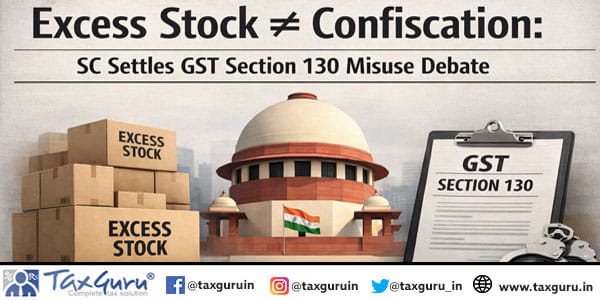
The Supreme Court, by its order dated 04 April 2025 in Additional Commissioner Grade-2 v. Vijay Trading Company, dismissed the Special Leave Petition filed by the Department and declined to interfere with the judgment of the Allahabad High Court. The High Court had held that mere detection of excess stock during inspection/search does not justify initiation of confiscation proceedings under Section 130 of the CGST Act, 2017, and that the correct statutory route is Section 35(6) read with Sections 73/74.¹
This order reinforces the settled legal position that confiscation cannot be used as a substitute for assessment and adjudication under the Act.
2. Facts in Brief
An inspection/search under Section 67 of the CGST Act was conducted at the business premises of the assessee. The stock was assessed allegedly on eye-measurement basis, and excess stock was found. On this basis, the Department initiated proceedings under Section 130 of the Act. The assessee challenged the action before the Allahabad High Court, which quashed the confiscation proceedings. The Department carried the matter to the Supreme Court by way of SLP, which came to be dismissed.²
3. Statutory Framework
3.1 Section 35(6) of the CGST Act
Section 35(6) provides that where a registered person fails to account for goods in accordance with Section 35(1), the proper officer shall determine the tax payable on such goods as if such goods had been supplied, and the provisions of Sections 73 or 74 shall apply mutatis mutandis.
3.2 Sections 73 and 74
Sections 73 and 74 are the machinery provisions for the determination of tax, with Section 74 applying where non-payment/short payment is by reason of fraud, wilful misstatement or suppression of facts.
3.3 Section 130
Section 130 is a penal provision dealing with confiscation of goods and conveyances where specified contraventions are committed with intent to evade tax.
The statutory scheme clearly demarcates assessment and adjudication from confiscation.
4. Decision of the Allahabad High Court
The Allahabad High Couxrt, in 2024 (8) TMI 1039, held:
“The law is clear on the subject that the proceedings under section 130 of the GST Act cannot be put to service if excess stock is found at the time of survey.”³
The Court further held that if excess stock is found, proceedings under Sections 73/74 should be pressed into service and not Section 130, and accordingly quashed the impugned orders passed by the authorities.⁴
The Court relied upon its earlier judgments in:
- Metenere Ltd. v. Union of India (2020)
- Maa Mahamaya Alloys Pvt. Ltd. v. State of U.P. (2023)
- Shree Om Steels v. Additional Commissioner (2024)
- Dinesh Kumar Pradeep Kumar v. Additional Commissioner (2024)
all of which consistently held that tax can be determined only under Sections 73/74 and not under Section 130.
5. Order of the Supreme Court
The Supreme Court, while dismissing the SLP, observed:
“We are not inclined to interfere with the impugned judgment(s); hence, the present special leave petitions are dismissed.”⁵
The Court further clarified:
“The impugned judgment(s) and the dismissal of the present special leave petitions will not come in the way of the petitioners in taking recourse to appropriate remedies in accordance with law.”⁶
Although the order is non-speaking, it confers strong persuasive finality on the ratio laid down by the Allahabad High Court.
6. Analysis
6.1 Section 35(6) as the Governing Provision
The High Court, following Metenere Ltd., analysed Section 35(6) and held that:
- unaccounted goods are deemed supplies;
- tax must be determined and quantified strictly under Sections 73/74; and
- confiscation proceedings cannot replace assessment proceedings.⁷
This makes Section 35(6) a complete code for dealing with cases of excess or unaccounted stock.
6.2 Requirement of “Intent to Evade” under Section 130
In Maa Mahamaya Alloys Pvt. Ltd. (as quoted by the High Court), it was held that:
- Section 130(1)(iv) can be invoked only where there is contravention coupled with intent to evade tax;
- mere excess stock does not establish such intent; and
- tax liability arises at the time of supply, not merely on storage.⁸
Therefore, mechanical invocation of Section 130 on the basis of excess stock is legally unsustainable.
7. Practical Implications
7.1 For Taxpayers
- Strong legal basis to challenge confiscation proceedings under Section 130 where the sole allegation is excess stock.
- Entitlement to full adjudicatory safeguards under Sections 73/74.
- Confiscation orders in such cases are liable to be quashed.
7.2 For the Department
- Cases of excess stock must be routed through Section 35(6) read with Sections 73/74.
- Section 130 should be invoked only where independent evidence of evasion and intent is established.
8. Conclusion
The Supreme Court’s dismissal of the SLP in Additional Commissioner Grade-2 v. Vijay Trading Company has effectively affirmed the settled legal position that excess stock detected during inspection/search is a matter of assessment under Section 35(6) read with Sections 73/74 and not a trigger for confiscation under Section 130. The decision strengthens statutory discipline and curtails the misuse of confiscatory powers under the GST regime.
Footnotes
1. Additional Commissioner Grade-2 & Anr. v. M/s Vijay Trading Company, 2025 (4) TMI 1644 (SC).
2. Ibid.
3. M/s Vijay Trading Company v. Additional Commissioner Grade-2 & Anr., 2024 (8) TMI 1039 (All.).
4. Ibid.
5. Additional Commissioner Grade-2 & Anr. v. M/s Vijay Trading Company, 2025 (4) TMI 1644 (SC).
6. Ibid.
7. Metenere Ltd. v. Union of India, 2020 (12) TMI 790 (All.), as quoted in 2024 (8) TMI 1039 (All.).
8. Maa Mahamaya Alloys Pvt. Ltd. v. State of U.P., 2023 (3) TMI 1358 (All.), as quoted in 2024 (8) TMI 1039 (All.).