#AD
Whether large-scale or small scale, running a business in India is considered successful only if it complies with GST norms and guidelines. As of 2026, GST compliance has evolved far beyond just filing on time. Businesses have entered an era of data precision. Today, if the tax department finds even a minor decimal mismatch, it can trigger an automated notice.
Hence, GST registration is not the last resort. There are some minor and major criticalities that need special attention to avoid frozen credits, hefty interest, or damaged vendor relationships. In this blog, you will learn about expensive compliance traps and how SME businesses can avoid them.
- What is GST Compliance and Its Penalties?
- 5 GST Compliance Problems Business Owners Must Avoid
- 1. Mismanagement of Input Tax Credit (ITC) Reconciliation
- 2. Delayed Response to Automated GST Notices
- 3. Missing or Delaying GST Return Filing
- 4. Neglecting E-Invoicing & Real-Time Reporting
- 5. Not Verifying Vendor Compliance
- Conclusion
What is GST Compliance and Its Penalties?
Before moving to common pitfalls, let’s understand the basics.
GST Compliance is the ongoing legal obligation of a business to adhere to the rules set by the GST Act. This includes
- Timely registration once turnover thresholds are met
- Issuing standardized tax invoices
- Maintaining accurate digital records
- Filing periodic returns (like GSTR-1 and GSTR-3B) and paying taxes by the 20th of each month
If the business does not comply with the GST norms, like tax evasion, late filing and more, they can face serious legal implications and fines.
| Offence Category | Specific Default | Penalty / Fee Amount |
|---|---|---|
| Delay in Filing | Late filing of GSTR-1 or GSTR-3B | ₹50/day (₹25 CGST + ₹25 SGST) Nil Returns: ₹20/day |
| Tax Payment | Delay in paying the tax due | 18% interest p.a. on the net tax liability |
| Wrongful Credit | Wrongly claiming/utilizing Input Tax Credit (ITC) | 100% of the tax (min. ₹10,000) + 24% interest |
| Invoicing Errors | Issuing incorrect or false invoices | ₹25,000 per instance |
| Registration | Not registering despite meeting threshold | 10% of tax due or ₹10,000 (whichever is higher) |
| Aiding Fraud | Assisting someone in committing GST fraud | Up to ₹25,000 |
| Tax Evasion | Evading tax for a certain time | ● Imprisonment of 1 year for tax evasion between ₹1 to ₹2 crore.
● Three years imprisonment for tax evasion of between ₹2 crore to ₹5 crore. ● Five years of jail time for tax evasion of over ₹5 crore. |
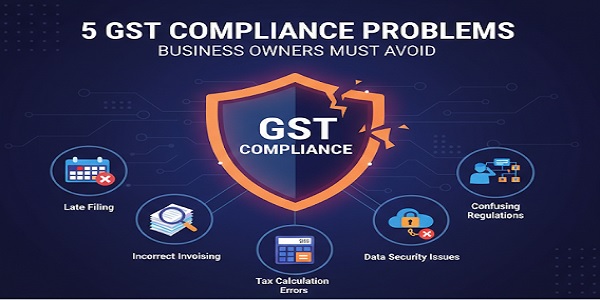
5 GST Compliance Problems Business Owners Must Avoid
To ensure that you do not run into these hefty penalties and jail time, you must look out for the following problems.
1. Mismanagement of Input Tax Credit (ITC) Reconciliation
The Problem: Many business owners mistakenly claim Input Tax Credit based solely on their internal purchase register. In 2026, the GST portal has moved to a hard validation system.
This means if your supplier fails to upload an invoice or makes a typo in your GSTIN, that invoice will not appear in your GSTR-2B. This is the only document the government recognizes for eligible credit.
The Consequence: Claiming unmatched or wrongful ITC is a high-risk move. When the system detects a mismatch between your claim & the supplier’s filing, it triggers an automated demand for mandatory reversal. You won’t just lose the credit but you will be liable to pay it back with punishing interest rates, often ranging from 18% to 24%, depending on whether the error is classified as a delay or wrongful utilization.
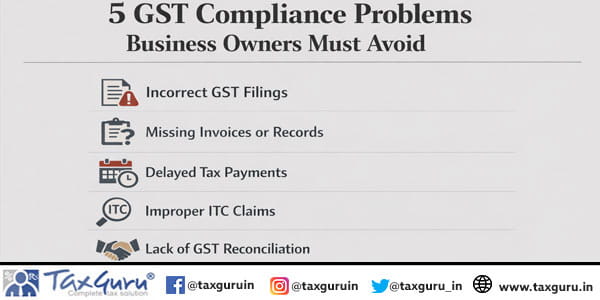
2. Delayed Response to Automated GST Notices
The Problem: As of today, many business owners still treat a GST notice like a piece of mail that is not urgent or that can be handled during the next filing cycle. This casual approach can be dangerous. Today, the GST portal generates automated notices (such as the DRC-01A for tax differences) based on algorithmic discrepancies between your returns.
The Consequence: Modern GST notices come with a ticking clock and a strict response window, often as short as 7 to 15 days. If you miss this deadline, the system can automatically trigger a suspension of your GSTIN, thereby preventing you from issuing invoices or generating e-way bills.
Worst case, it may lead to a best judgment assessment, which is a scenario where a tax officer determines your liability based on available data without your input. This often results in much higher tax demands & non-negotiable penalties.
3. Missing or Delaying GST Return Filing
The Problem: Many business owners fall into the this trap, delaying their monthly or quarterly filings due to temporary cash flow issues, missing team or incomplete data. In 2026, a missed deadline is no longer just a minor administrative lapse, it is a trigger for a high-speed domino effect of penalties.
The Consequence: The moment the clock strikes midnight on the due date, the GST portal’s automated systems kick in. Here are the consequences.
- Sequential Blocking: You are now barred from filing any future returns until the oldest pending return is cleared.
- Automatic Interest Accumulation: Under the revised 2026 formula, the system auto-calculates interest at 18% p.a. on your net tax liability. This value is now system-locked into your GSTR-3B and cannot be manually lowered.
- The 3-Year Hard Stop: As of January 2026, the GST portal has implemented a strict three-year limit. If a return remains unfiled for over 36 months, it is permanently blocked.
4. Neglecting E-Invoicing & Real-Time Reporting
The Problem: A common and dangerous misconception among business owners is that e-invoicing is a burden reserved only for multi-national corporations. In 2026, the government has progressively lowered the aggregate turnover thresholds (₹5 Crore or more), pulling thousands of MSMEs into the mandatory e-invoicing net.
Many businesses continue to issue traditional paper or digital invoices, unaware that they have crossed the threshold and are now technically non-compliant overnight.
The Consequence: Under GST law, if you are required to generate an e-invoice but fail to do so, your invoice is considered legally invalid. It is treated as if no invoice was ever issued. This has a devastating ripple effect.
Your B2B customers will be unable to claim Input Tax Credit (ITC) on your supplies. When your customers realize they are losing money because of your paperwork error, it leads to payment delays, strained trust, and the potential loss of major contracts.
5. Not Verifying Vendor Compliance
The Problem: In the interconnected ecosystem of 2026, your business is only as compliant as the weakest link in your supply chain. Many owners assume that once a payment is made and an invoice is received, their job is done. However, failing to vet your vendor’s filing habits before transacting is a massive financial gamble.
The Consequence: Under the 2026 Invoice Management System (IMS), your Input Tax Credit (ITC) is essentially held hostage by your supplier’s behavior. If a vendor collects tax from you but fails to deposit it or ghosts their GSTR-1 filings, the GST portal will flag your ITC as ineligible.
Conclusion
As we move through 2026, GST compliance has transitioned from a periodic task to a real-time responsibility. The government’s shift toward trust-based compliance highlighted in the 2026 Union Budget comes with a caveat. While honest errors are easier to rectify via new schemes and revised return windows, intentional or repetitive mismatches are met with swift, automated system blocks.
To stay ahead and maintain a high GST compliance rating, business owners should adopt some modern tax disciplines, such as
- Setting a filing reminder
- Continuous reconciliation
- Vendor follow-up
- Notice tracking
- Frequent GST auditing
And more!