
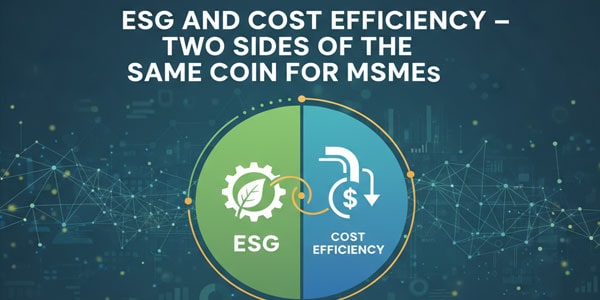
Summary: Many Micro, Small, and Medium Enterprises (MSMEs) view Environmental, Social, and Governance (ESG) practices as complex and costly corporate initiatives, yet they fundamentally align with core cost efficiency objectives. Both ESG and cost-efficiency aim to optimize resource utilization, eliminate waste, and achieve sustainable profitability. For MSMEs, integrating ESG means practical steps like reducing energy and water consumption, which directly lowers utility bills (Environmental); ensuring employee welfare and training, which boosts productivity and reduces turnover (Social); and maintaining transparent records and compliance, which prevents penalties and strengthens accountability (Governance). Common MSME problems, such as unmonitored utility use, poor waste management, and unsafe work conditions, are hidden management inefficiencies that result in higher costs. By implementing simple ESG measures—like installing LED lights, segregating waste for better recycling value, and prioritizing worker safety—companies can achieve significant, measurable savings, improved staff retention, and gain a competitive edge with large buyers who prioritize ESG compliance. Ultimately, good costing practices, which involve monitoring and analyzing resource use, are the simplest pathway for MSMEs to meet ESG targets, proving that effective management and good costing are synonymous with following the ESG way.
ESG and Cost—Two Ways to Reach the Same Goal
| ESG Objective | Cost Efficiency Objective | Common Outcome |
|---|---|---|
| Reduce energy, fuel, and water consumption | Minimize utility costs | Lower production expenses |
| Ensure employee welfare and training | Improve productivity and reduce labour turnover | Better output and reduced re-hiring costs |
| Maintain transparent documentation and monitoring | Strengthen internal control and cost records | Accurate costing and compliance |
| Manage waste through recycling | Reduce material loss and improve yield | Higher resource utilization |
| Adhere to ethical and governance standards | Maintain efficiency and accountability | Sustainable business growth |
In other words, good ESG is synonymous with good costing practice. Both facilitate the smooth running of a business, it earns trust, and remains competitive.
What does ESG mean in Real Terms?
To view it from a simple perspective, let’s do some explaining:
E – Environmental:
The use of resources has to be wise. The saving of electricity, water, and fuel is necessary. Recycling of waste is a must wherever feasible.
For example: Reduced consumption translates into reduced cost.
S – Social:
The treatment of workers should be good. There should be a safe working environment, equitable salaries, and opportunities for skill enhancement.
For example: An employee, who is content and trained renders better service, stays longer,
G – Governance:
Properly record expenses, power consumption, and daily operations. Honesty is the best policy when it comes to rules and compliance.
For example: Good documentation keeps penalties at bay and fosters good relationships with clients, banks, and auditors.
Problems Commonly Faced by MSMEs
In reality, the majority of MSMEs have hidden inefficiencies as their biggest problem while they are unaware of it:
- Outdated machines lead to high electricity and fuel bills
- Water and energy usage not monitored at all
- Waste mixed up and sold as scrap instead of recycling
- No safety or health measures for workers
- Poor bookkeeping or lack of internal controls
- Lost tenders because of non-compliance with ESG requirements
These do not sound like cost issues; they rather look like management inefficiencies. But once the issues are handled, they’re going to be cost-saving and productivity-enhancing.
Real-Life Case: Slight Actions, Significant Effects
Let’s take the case of Ravi Tools Pvt. Ltd., a micro auto-parts manufacturer in Kanpur.
Prior to ESG Integration:
- Electricity bills of about ₹2 lakh each month
- Equipment break-downs and consequently, delays happened often
- Unsafe conditions at work leading to high staff turnover
- Metal scrap sold at the lowest price possible
After the improvement by adopting ESG practices:
- LED lights were installed, and the equipment underwent regular preventive maintenance.
- Metal scrap was sorted and sold straight to recyclers (incomes of ₹20,000/month)
- The company made people’s safety a priority and provided training as well
- They began measuring their energy and water consumption
Outcome in the first six months:
- 18% decrease in electricity bills
- Annual savings in the amount of ₹4 lakhs due to recycling
- 25% increase in the number of retained employees
- A large buyer gave priority to the company because of its ESG compliance
Small steps yield big results.
That is the advantage of cost-effective solutions through ESG.
Why ESG Is the Future for MSMEs
Government agencies, banks, and large corporates are increasingly considering ESG performance before awarding contracts or loans. Hence, ESG is not a burden — it’s a gateway to new business opportunities.
MSMEs can start with small:
- Track their energy and water usage
- Implement waste segregation and recycling
- Take care of their team’s welfare
- Maintain transparent financial and operational records
So we can say that “Where ESG outlines the way, Costing sets up the path.”
Through the implementation of cost accounting concepts, that is, monitoring of resources, analysis of variances, the scrutiny of efficiency, and the evaluation of performance, an MSME can synchronize itself with ESG targets in a hassle-free manner.
Therefore, when it is said that ESG is restricted to big companies only, make it known that —
“Every company that applies good costing and effective management is indeed following the ESG way”
Costing realizes the goals of ESG — it converts accountability into success and eco-friendliness into profit.







very informative