Smt. Renu Mittal w/o Mool Chand Mittal Vs Anant Raj Ltd. (NAA)
The brief facts of the Report are that the Applicant No. 1 had filed application before the Standing Committee on Anti-profiteering, under Rule 128 (1) of the CGST Rules, 2017 and submitted that she had purchased flat in the Respondent No. l’s Project “Maceo” but the Respondent No. 1 had not passed on the benefit of Input Tax Credit (ITC) to her by way of commensurate reduction in prices of the flats, in terms of Section 171 (1) of the CGST Act, 2017. The above reference was examined by the Standing Committee on Anti-profiteering and upon being prima facie satisfied that the Respondent No. 1 had not passed on the benefit of ITC had forwarded the application of Applicant No. 1 with its recommendation to the DGAP for detailed investigation under Rule 129 (1) of the CGST Rules, 2017.
This Authority has carefully considered all the Reports filed by the DGAP, submissions of the Respondents and all other material placed on record. On examining the record, the observations of this Authority are as follows:-
a. The National Company Law Tribunal (NCLT) vide its Order dated 24.08.2020 has sanctioned the demerger of the Respondent No. 1 (Demerged Company) and the Respondent No. 2 (Resulting Company) and the subject project i.e. ‘MACEO’ of the Respondent No. 1, against which complaint regarding non-passing on the benefit of ITC was made by the Applicant No. 1, was transferred to the Respondent No. 2.
b. The Respondent No. 1 during personal hearing via video conferencing held on 10.09.2020 requested to allow him to submit the details of his final ITC. Further, the Respondent No. 1 vide his emails dated 28.09.2020 and 13.10.2020 has stated that the actual figures of the reversal of ITC could not be produced because the corporate restructuring through demerger of the Respondent No. l’s company was underway. The details of the reversal of ITC could only be produced post registration of the new entity and subsequent transfer of ITC from the erstwhile entity to the demerged entity. Though the Respondent No. 1 was provided adequate opportunities to submit the actual figures of ITC vide this Authority’s Order dated 25.09.2020, 12.10.2020, 23.10.2020, 04.12.2020, 18.12.2020, 15.01.2021 and 12.02.2021, however, till date the Respondent No. 1 has not submitted the complete details of ITC. If the Respondent No. 1 or the Respondent No. 2 submits the correct details of ITC, the profiteered amount may change. Therefore, there is need to verify the above claim of the Respondent No. 1 or Respondent No. 2 to arrive at the correct findings on the above issue. Accordingly, the DGAP is directed to further investigate it and submit Report on the same.
c. The Respondent No. 1 & No. 2 have further contended that the ITC of Service Tax reflected in Tran-1 should be deducted from the figure of total ITC under GST. They have further claimed that while arriving at the profiteering percentage of 7.81%, and while applying the turnover method, the DGAP in his investigation report dated 23.03.2020 had taken Rs. 16,52,14,920/- as ITC in the GST regime. It was claimed that the aforesaid amount of Rs. 16,52,14,920/- included carried forward transitional CENVAT credit of pre-GST regime amounting to Rs. 1,43,78,603/- and the same had already been included in the calculation pertaining to the pre-GST period. The aforesaid amount of Rs. 1,43,78,603/- being inadvertently added, as claimed by the Respondent No. 1 & No. 2, in the total amount of the ITC under GST of Rs. 16,52,14,920/- had resulted into distorted profiteering percentage. Therefore, the aforesaid amount of Rs. 1,43,78,603/- be deducted from the total amount of ITC under GST so as to determine the correct ratio of profiteering. After excluding the amount of Rs. 1,43,78,603/- from total ITC under GST, the correct percentage of profiteering would work out at 6.87%, as against 7.81% considered in the Report of the DGAP. Upon perusal of the Report of the DGAP, we observe that the Report of the DGAP is silent on the above issue raised by the Respondent No. 1 & No. 2. Therefore, the above claim of the Respondent No. 1 & No. 2 is also required to be further investigated and findings be submitted to this Authority.
d. The Respondent No. 1 has contended that out of the total instalments, the Applicant No. 1 has paid 10 instalments in the pre-GST regime and the remaining instalments were paid in the post-GST regime. However, as per the Report of the DGAP dated 23.03.2020, it has been claimed by the DGAP that out of the total instalments, 13 instalments were paid by the Applicant No. 1 in pre-GST era and rest were paid in post-GST period. It is apparent from the above that there is dispute over the instalments paid by the Applicant No. 1 during the pre and the post GST periods which needs to be further investigated and correct figures be submitted to this Authority.
e. The Respondent No. 1 vide submissions dated 01.07.2020 has stated that out of 16 towers (A to R), he has received Occupancy Certificate for 12 towers i.e. ‘3″K”G’ and ‘H’ on 07.06.2019 and for towers ‘A”C”D”E”F”L’ and ‘N’ on 28.11.2019, and the ITC in respect of these flats had already been passed on to the respective flat buyers. However, there is no documentary evidence to verify that the above Respondent has passed on the benefit of ITC in respect of above mentioned 12 towers i.e. ‘3″K”G’ `H”A”C”D”E”F”L”M’ and ‘N’ to the flat buyers. Accordingly, the claim of the above Respondent be verified by the DGAP and report be submitted.
f. The Respondent No. 2 has submitted his own calculations of ratio of ITC to Turnover for the pre and post GST period and claimed that the ratios are 7.58% and 1.52% respectively and thus, as per his calculations, the revised profiteered amount came to Rs. (-5,26,90,777/-), which is also required to be verified by the DGAP.
g. For the reasons mentioned in Para 26(f) supra, it appears that there is a huge difference between the ‘ratio of ITC to Turnover’ and ‘Profiteered Amount’ calculated by the Respondent No. 2 as compared with the ‘ratio of ITC to Turnover’ and ‘Profiteered Amount’ calculated by the DGAP. Therefore, it appears to this Authority that there is a need to verify the above claim of the Respondent No. 2 to arrive at the correct ‘ratio of ITC to Turnover’ and ‘Profiteered Amount’. Accordingly, the DGAP is directed to further investigate it and submit Report on the same.
Therefore, without going into the merits and the other submissions made by the Respondents and the Applicants at this stage, we find that this case merits re-investigation by the DGAP based on the above observations of this Authority. Thus, we direct the DGAP to reinvestigate the matter as per the provisions of Rule 133(4) of the CGST Rules 2017 and submit his report before this Authority. On his part, the Respondents are directed to fully cooperate with the DGAP in the process of reinvestigation which includes submission of the requisite documents/details/information pertaining to his supplies.
FULL TEXT OF ORDER OF NATIONAL ANTI-PROFITEERING AUTHORITY
1. A Report dated 23.03.2020 has been received from the Applicant No. 2 i.e. the Director General of Anti-Profiteering (DGAP) on 16.04.2020 after detailed investigation under Rule 129 (6) of the Central Goods & Services Tax (CGST) Rules, 2017. The brief facts of the Report are that the Applicant No. 1 had filed application before the Standing Committee on Anti-profiteering, under Rule 128 (1) of the CGST Rules, 2017 and submitted that she had purchased flat in the Respondent No. l’s Project “Maceo” but the Respondent No. 1 had not passed on the benefit of Input Tax Credit (ITC) to her by way of commensurate reduction in prices of the flats, in terms of Section 171 (1) of the CGST Act, 2017. The above reference was examined by the Standing Committee on Anti-profiteering and upon being prima facie satisfied that the Respondent No. 1 had not passed on the benefit of ITC had forwarded the application of Applicant No. 1 with its recommendation to the DGAP for detailed investigation under Rule 129 (1) of the CGST Rules, 2017.
2. The DGAP has mentioned that the Applicant had submitted the following documents along with her application:-
a. Copy of publication page of the paper “Hindustan”, Delhi dated 16.09.2019.
b. Application dated 16.08.2018 of the Applicant No. 1.
3. After perusal of the said application, the DGAP has stated that the Applicant had booked flat in the Respondent No. l’s project “Maceo”, on 19.08.2011, i.e., in the pre-GST era. In terms of the instalment plan agreed upon, the Applicant No. 1 was to pay the consideration in 14 instalments each linked with different stages of construction of the flat. Prior to GST the Applicant No. 1 had already paid 13 instalments. As per the agreement, the Respondent No. 1 issued demand letters for last instalment without providing any benefit of additional ITC in the post-GST era.
4. The DGAP on receipt of the application and supporting documents from the Standing Committee on Anti-profiteering had issued notice under Rule 129 (3) of the CGST Rules, 2017 on 09.07.2019 calling upon the Respondent No. 1 to reply as to whether he admitted that the benefit of ITC had not been passed on to the above Applicant No. 1 by way of commensurate reduction in prices charged from her and if so, to suo moto determine the quantum thereof and indicate the same in his reply to the notice as well as furnish all supporting documents. Vide the above mentioned notice dated 09.07.2019, the Respondent No. 1 was also given opportunity to inspect the non-confidential evidence/information furnished by the Applicant No. 1 during the period from 17.07.2019 to 19.07.2019, which he had not availed. Vide e-mail dated 27.02.2020, the Applicant No. 1 was also given an opportunity to inspect the non-confidential documents/replies furnished by the Respondent No. 1 on 28.02.2020 or 02.03.2020, which was not availed of by the Applicant No. 1.
5. The DGAP has reported that the time limit to complete the investigation was extended up to 26.03.2020 from 27.12.2019 by this Authority, vide its order dated 24.12.2019 in terms of Rule 129(6) of the CGST Rules, 2017 and the period of current investigation was from 01.07.2017 to 30.06.2019.
6. The DGAP has further reported that the Respondent No. 1 had submitted his replies vide letters dated 18.07.2019, 26.07.2019, 13.08.2019, 05.11.2019, 13.11.2019, 06.12.2019, 25.02.2020, 04.03.2020, 12.03.2020 vide which he had stated:-
a. That on the demands raised in respect of fresh bookings made on or after 1st July, 2017 (Post GST) anti-profiteering provisions did not apply.
b. That amount of ITC availed of Rs. 16,52,14,970/- post GST mentioned in his letter dated 13.08.2019 also included the amount which was availed by him towards the fresh bookings of units made on or after 01.07.2017. Therefore, ITC availed of Rs. 16,52,14,970/- should have been accordingly reduced in proportion to demand raised for the units booked prior to GST for which demand was raised after GST and demand raised for units booked after GST which should have been as such.
7. The DGAP in his Report has also stated that the above application, the various replies of the Respondent No. 1 and the documents/evidence on record had been carefully examined. The main issues for investigation were:-
i) Whether there was benefit of reduction in rate of tax or benefit of ITC on the supply of Construction Service by the Respondent No. 1 after the introduction of GST w.e.f. 01.07.2017 and if so,
ii) Whether such benefit was passed on to the recipients in terms of Section 171 of the CGST Tax Act, 2017 by the Respondent No. 1?
8. The DGAP has further reported that the present case pertained to supply of Construction Service and the investigation was limited to one project i.e. “Maceo” only, in which the Applicant No. 1 booked her unit. Upon analysis of the home-buyer’s data submitted by the Respondent No. 1, it was observed that the Respondent No. l’s project “Maceo” included different categories of towers i.e. (A to R). The Respondent No. 1 vide submissions dated 13.08.2019 submitted Cenvat/ITC register for the project “Maceo” reconciled with VAT, ST-3 and GSTR-3B Returns for the period as being covered in the investigation.
9. The DGAP has also submitted that vide letter dated 06.12.2019, the Respondent No. 1 had informed that he had not passed on any benefit of ITC to the customers in respect of the project “Maceo”.
10. It has also been reported by the DGAP that prior to 01.07.2017, i.e., before GST was introduced, the Respondent No. 1 was eligible to avail CENVAT credit of Service Tax paid on input services. However, CENVAT credit of the Central Excise duty paid on inputs was not admissible as per the CENVAT Credit Rules, 2004, which was in force at the material time. Further, post-GST, the Respondent No. 1 could avail the ITC of GST paid on all the inputs and input services including the sub-contracts. The Respondent No. 1 vide his email dated 06.12.2019 submitted the home-buyer’s data and other documents /information for the period April, 2016 to June, 2019, the details of the ITCs availed by him with respect to the impugned project, his turnovers from the project namely “Maceo” and the ratios of ITCs to the turnovers, during the pre-GST (April, 2016 to June, 2017) and post-GST (July, 2017 to June, 2019) periods have been furnished by the DGAP in table ‘A’ below:-
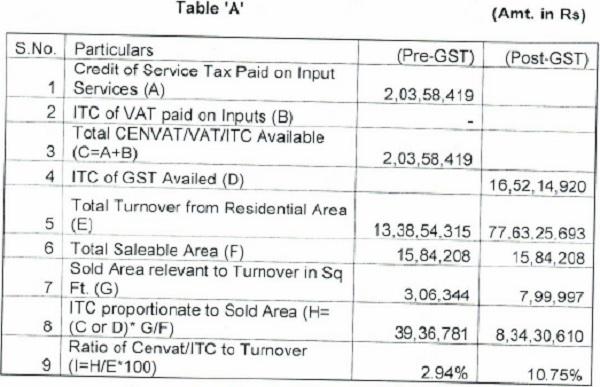
11. It has also been stated by the DGAP that as per the above Table-A, it was clear that the ITC as a percentage of the turnover that was available to the Respondent No. 1 during the pre-GST period (April, 2016 to June, 2017) was 2.94% and during the post-GST period (July, 2017 to June, 2019), was 10.75% which indicated that post-GST, the Respondent No. 1 had benefited from additional ITC to the tune of 7.81% [10.75% (-) 2.94%] of the turnover.
12. The DGAP further stated that the Central Government, on the recommendation of the GST Council, had levied 18% GST on Construction Service (after one third abatement towards value of land, effective GST rate was 12% on the gross value), vide Notification No. 11/2017-Central Tax (Rate) dated 28.06.2017. Accordingly, the profiteering had been examined by comparing the applicable tax rate and ITC available to the Respondent No. 1 during the pre-GST period (April, 2016 to June, 2017) when Service Tax was @ 4.5% rate with the post-GST period (July, 2017 to June, 2019) when the effective GST rate was 12% on the gross value. On the basis of the figures contained in Table ‘A’ above, the comparative figures of ITCs availed/available as a percentage of the turnovers in the pre-GST and post-GST periods, the recalibrated basic price as well as the excess collection (profiteering) during the post-GST period have been furnished by the DGAP in Table-‘B’ below:-
Table-B (Amount in Rs.)