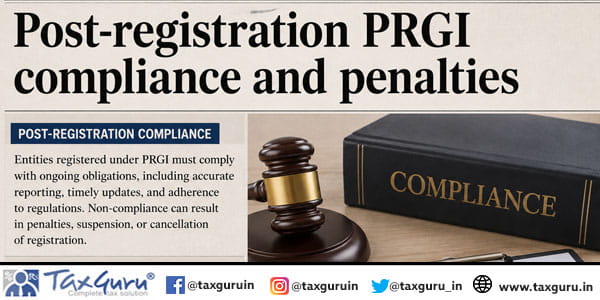
Post-registration compliance under PRGI is an important legal responsibility for every publisher of a registered newspaper, magazine, journal, or periodical in India. After receiving the Certificate of Registration from the Press Registrar General of India, the publisher must continue to follow all legal requirements prescribed under the Press and Registration of Periodicals Act, 2023 and the Press and Registration of Periodicals Rules, 2024.
The new legal context replaced the old Press and Registration of Books Act, 1867. Under the new system, the earlier Registrar of Newspapers for India is now known as the Press Registrar General of India, and most compliances are handled through the digital Press Sewa Portal. Therefore, registration is not the final step. It is only the beginning of regular legal compliance for publishers.
Meaning of PRGI Post-Registration Compliance
PRGI post-registration compliance means all legal duties that a publisher must complete after obtaining registration for a periodical. These duties include starting publication within the prescribed time, filing annual statements, delivering copies of published issues, reporting changes in registered particulars, maintaining circulation records, responding to notices, and informing PRGI if the publication is discontinued.
The purpose of these compliances is to maintain transparency in the publishing sector. PRGI keeps official records of registered periodicals, circulation details, ownership information, printing details, and publication status. These records help the government monitor the print media sector and ensure that only legally registered publications continue to operate.
Legal Context for Post-Registration Compliance
The main law governing post-registration compliance is the Press and Registration of Periodicals Act, 2023. This Act applies to periodicals that contain public news or comments on public news. A “periodical” generally includes newspapers, magazines, journals, newsletters, or similar publications published at regular intervals.
The practical filing process, forms, timelines, and online procedures are governed by the Press and Registration of Periodicals Rules, 2024. These Rules support the Act and provide the procedural context for registration, annual filing, delivery of copies, and other compliance requirements.
Together, the Act and Rules create a modern digital compliance system for publishers. The law focuses on ease of doing business, online filing, proper record keeping, and strict action against false information or non-compliance.
Commencement of Publication After Registration
After receiving the certificate of registration, the publisher must start publication within the prescribed time. Under the PRP Act, if a publisher fails to publish the periodical within 12 months from the end of the month in which the certificate of registration was issued, the registration may be cancelled and the title may be withdrawn.
This provision is very important because many publishers complete registration but delay actual publication due to financial, printing, editorial, or operational reasons. However, once the certificate is issued, the publisher must take timely steps to print and circulate the publication.
For example, if a certificate of registration is issued in April 2026, the publisher should ensure that the publication starts within the legally permitted period. Failure to do so may result in cancellation of registration. Therefore, publishers should plan content, printing arrangements, staff, distribution, and compliance before or immediately after registration.
Annual Statement Filing
The annual statement is one of the most important post-registration compliances under PRGI. Every registered publisher is required to furnish an annual statement to the Press Registrar General in the prescribed form, manner, and timeline.
The annual statement generally contains important details such as the name of the publication, registration number, language, periodicity, place of publication, printer details, publisher details, owner details, circulation figures, and other information required by the authority.
This filing helps PRGI maintain updated records of active publications in India. It also helps in preparing official reports relating to newspapers and periodicals. Therefore, publishers must ensure that the annual statement is filed accurately and within the prescribed due date.
Due Date for Annual Statement
Generally, registered publications are required to file the annual statement by 31 May for the preceding financial year. For example, for the financial year 2025-26, the annual statement is generally required to be filed in the following calendar year within the notified timeline.
However, PRGI may issue advisories or extensions from time to time. Publishers should regularly check official updates and ensure that the filing is completed within the allowed time. Delayed filing may attract monetary penalties, suspension, or other regulatory action.
Recent Updates on Annual Statement Filing
In recent times, PRGI has increased focus on digital compliance and timely filing through the Press Sewa Portal. For FY 2025-26, PRGI issued advisories relating to annual statement filing, e-filing window opening, warnings for non-compliance, and extension of the last date.
These updates show that PRGI is actively monitoring annual compliance. Publishers who fail to submit annual statements may receive notices and may face penalties or cancellation-related action. Therefore, annual statement filing should be treated as a priority compliance every year.
Delivery of Copies of Newspapers and Periodicals
Another important post-registration compliance is the delivery of copies of the publication. Every publisher of a newspaper is required to deliver copies of each issue as prescribed under the Act and Rules.
The purpose of this requirement is to maintain an official record of published issues. It also helps authorities verify whether the publication is being printed and circulated as per the registered particulars. Publishers should maintain proof of dispatch, submission, or delivery of such copies.
If a publisher fails to deliver copies regularly, it may create compliance issues during inspection, verification, or renewal-related examination. Therefore, every publisher should maintain a proper monthly system for delivery of required copies to the concerned authority.
Correct and Truthful Information
A publisher must ensure that all information submitted to PRGI is true, complete, and updated. Details given in registration records, annual statements, circulation declarations, printer information, ownership records, and publication details should match actual business records.
Filing incorrect details may lead to suspension or cancellation of registration. Wrong circulation figures, incorrect ownership information, false publication status, or mismatch in printing details can create serious legal consequences.
Therefore, before filing annual statements or any application for revision, the publisher should verify all records internally. Circulation numbers should be supported by printing invoices, sales records, subscription data, distribution reports, and other relevant documents.
Revision of Registered Particulars
After registration, if there is any change in the registered particulars of the periodical, the publisher must apply for revision. Such changes may include change in title, language, periodicity, place of publication, printer, publisher, owner, printing press, or other registered details.
The publisher should not continue publication with changed details without proper intimation or approval. The certificate of registration reflects the legal identity of the publication. Therefore, if the actual publication details differ from the registered details, it may lead to compliance risk.
For example, if a weekly newspaper is converted into a monthly magazine, or if the place of publication is changed from one city to another, the publisher should file the required application for revision of particulars. Continuing without approval may be treated as non-compliance.
Change in Ownership
Change in ownership is a sensitive compliance matter. If the ownership of a registered periodical changes due to sale, transfer, succession, merger, business restructuring, or any other reason, the publisher must follow the prescribed procedure for updating records.
Ownership records are important because the liability for compliance generally rests on the owner and publisher. If ownership changes but PRGI records are not updated, future notices, penalties, or legal obligations may still be linked to the earlier records.
Therefore, any ownership transfer should be supported by proper documents such as agreement, board resolution, authorisation letter, legal heir documents, partnership deed, LLP agreement, or company records, as applicable.
Change in Printer or Printing Press
If the publication changes its printer or printing press after registration, the change should be reported as per the prescribed process. Printing details are important because they identify where the publication is physically printed.
A mismatch between registered printing details and actual printing arrangements may create compliance issues. During verification, PRGI may ask for printing records, invoices, declaration from printer, or other supporting documents. Therefore, publishers should keep printing agreements and invoices properly maintained.
Change in Periodicity
Periodicity means the frequency of publication, such as daily, weekly, fortnightly, monthly, quarterly, or annual. If the publication is registered as a weekly newspaper, it should be published according to that frequency.
If the publisher wants to change the periodicity, proper revision should be obtained. Publishing irregularly or changing the frequency without updating records may affect the legal status of the publication. It may also create doubt about whether the publication is active.
Discontinuation of Publication
If the owner decides to discontinue a registered periodical, the discontinuation must be intimated to PRGI within the prescribed time. A publisher should not simply stop publication without formal intimation.
The law provides that when a periodical is discontinued, the owner must inform PRGI and the concerned authority within the prescribed period. After receiving such intimation, the certificate of registration may be cancelled.
This compliance is important because inactive publications may still remain in official records unless properly discontinued. If the publisher does not inform PRGI, annual filing defaults and future penalties may arise.
Maintenance of Records
Every publisher should maintain proper records after registration. These records may include copies of all published issues, printing bills, circulation records, subscription records, sales invoices, distribution details, ownership documents, annual statement acknowledgements, delivery proof, and PRGI correspondence.
Record maintenance is especially important where circulation verification is required. PRGI may call for documents or seek clarification regarding circulation figures. If the publisher cannot support the figures mentioned in annual statements, it may lead to legal issues.
Good record keeping also helps in responding to notices, applying for government advertisement eligibility, proving publication continuity, and defending against penalty proceedings.
Circulation Verification
PRGI has the power to verify circulation figures of certain categories of periodicals. Circulation verification may become relevant where a publication claims high circulation or seeks benefits such as government advertisement empanelment.
During circulation verification, the publisher may be required to submit documents such as printing bills, newsprint purchase records, sales statements, agency records, subscription records, unsold return details, bank records, and distribution evidence.
Therefore, circulation figures should never be inflated or filed without supporting documents. Incorrect circulation reporting may lead to penalty, suspension, cancellation, or rejection of claims before other government authorities.
Compliance with PRGI Notices
If PRGI issues any notice, direction, or communication, the publisher must respond within the given timeline. Ignoring PRGI notices can worsen the matter and may lead to penalty or cancellation.
A proper reply should explain the facts clearly, attach supporting documents, and request condonation or regularisation wherever required. If the notice relates to non-filing of annual statement, wrong details, non-publication, or discontinuation, the publisher should take immediate corrective steps.
Penalty for Publishing Without Registration
Publishing a periodical without obtaining the certificate of registration is a serious violation. Under the PRP Act, PRGI may impose penalty if a periodical is published without registration.
The penalty may extend up to Rs. 5 lakh. PRGI may also issue a direction to stop publication of the unregistered periodical. This provision is important because title approval or application filing alone does not give the right to start publication. Actual publication should begin only after registration is granted.
Penalty for Failure to File Annual Statement
Failure to file the annual statement can attract monetary penalty. If a publisher does not furnish the annual statement within the prescribed time and continues default, PRGI may initiate penalty action after giving an opportunity of being heard.
For the first default, the penalty shall not be less than Rs. 10,000 and may extend up to Rs. 20,000. For subsequent defaults, the penalty may be enhanced and may reach up to Rs. 2 lakh, depending on the nature and repetition of default. This makes annual statement filing one of the most important yearly compliances for every registered publisher.
Penalty for Wrong Details
Submitting wrong or false details to PRGI may lead to serious consequences. If the publisher files incorrect information in annual statements, registration records, circulation details, or other forms, PRGI may suspend the registration.
If the publisher fails to correct the records or continues non-compliance, the registration may be cancelled. Therefore, publishers should not file details casually or based on assumptions. Every figure and statement should be supported by records.
Suspension of Registration
Suspension of registration may occur where the publisher fails to comply with post-registration duties, files wrong details, does not furnish required information, or commits repeated defaults.
Suspension affects the legal status and credibility of the publication. During suspension, the publisher may face difficulty in claiming benefits, advertisement eligibility, or official recognition. Therefore, any situation leading to suspension should be addressed quickly.
The publisher should file pending annual statements, correct wrong particulars, submit required documents, and request regularisation wherever possible.
Cancellation of Registration
Cancellation is the most serious consequence under PRGI compliance. Registration may be cancelled if the publisher fails to commence publication within the prescribed time, discontinues publication, files wrong details, does not regularise defaults after suspension, or falls under other grounds mentioned in the Act.
Once registration is cancelled, the publisher may lose the legal right to publish under that registered title. The title may also be withdrawn. Therefore, publishers should avoid any long-term default and should maintain active compliance.
Imprisonment for Continued Unregistered Publication
In serious cases, if a publisher continues publication even after being directed to stop by PRGI, criminal consequences may arise. If the publisher does not stop publication within the prescribed period after direction, or starts another periodical without registration, imprisonment up to six months may apply.
This provision shows that the law does not treat unregistered publication lightly. Monetary penalty is not the only consequence. Continued violation may result in prosecution and imprisonment.
Opportunity of Being Heard
Before imposing penalty, PRGI is generally required to provide an opportunity of being heard. This means the publisher gets a chance to explain the default, submit documents, correct mistakes, or request relief.
This is an important legal safeguard. Publishers should use this opportunity properly by filing a detailed reply. The reply should be factual, polite, legally structured, and supported by documentary evidence.
Appeal Against PRGI Orders
If a publisher is aggrieved by certain orders passed by PRGI, the law provides an appellate remedy. The publisher may approach the prescribed appellate authority within the permitted time.
Appeal may be relevant in cases involving refusal, cancellation, penalty, or other adverse orders. However, before filing an appeal, the publisher should carefully review the order, limitation period, documents, grounds of appeal, and legal position.
Best Practices for PRGI Compliance
Every publisher should maintain a proper compliance calendar. Annual statement filing should be completed before the due date. Copies of issues should be delivered regularly. Any change in title, owner, printer, publisher, place of publication, or periodicity should be reported immediately.
The publisher should preserve all publication records, circulation documents, printing bills, and PRGI acknowledgements. Notices should be answered within time. Portal credentials should be safely maintained. Internal responsibility should be assigned to one person or team for PRGI compliance. These practices reduce the risk of penalties, suspension, cancellation, and legal disputes.
Conclusion
Post-registration PRGI compliance is not a one-time formality after obtaining the Certificate of Registration. It is a continuous legal responsibility for every registered publisher in India. Once a newspaper, magazine, journal, or periodical is registered, the publisher must regularly follow all obligations prescribed under the Press and Registration of Periodicals Act, 2023. These include filing annual statements, delivering copies of published issues, reporting correct publication details, updating any change in title, ownership, printer, publisher, place of publication or periodicity, and maintaining proper records. Publishers must also respond to any notice or direction issued by PRGI within the prescribed time.
The new PRGI framework has made the compliance system more digital, transparent, and strict. Non-compliance may lead to penalties, suspension of registration, cancellation of certificate, withdrawal of title, and in serious cases, imprisonment. Therefore, publishers should treat PRGI compliance as an annual legal duty to protect their publication’s validity and credibility. For professional assistance in PRGI registration, annual statement filing, post-registration compliance, and legal advisory, you may contact Compliance Calendar LLP at [email protected] or call 9988424211.
Frequently Asked Questions (FAQs)
Q1. What is PRGI post-registration compliance?
Ans. PRGI post-registration compliance means the legal duties that a publisher must follow after obtaining registration. It includes annual statement filing, delivery of copies, updating registered particulars, maintaining records, and responding to PRGI notices.
Q2. Is annual statement filing mandatory after PRGI registration?
Ans. Yes. Every registered publication must file the annual statement in the prescribed form and manner. It is one of the most important annual compliances for publishers.
Q3. What is the penalty for not filing the annual statement?
Ans. For the first default, the penalty may range from Rs. 10,000 to Rs. 20,000. For repeated defaults, the penalty may increase and may extend up to Rs. 2 lakh.
Q4. Can PRGI cancel the registration of a publication?
Ans. Yes. PRGI may cancel registration in cases such as failure to start publication, discontinuation, wrong details, repeated non-compliance, or other grounds under the Act.
Q5. Can a periodical be published without PRGI registration?
Ans. No. A periodical covered under the PRP Act should not be published without registration. Publishing without registration may attract penalty up to Rs. 5 lakh and direction to stop publication.
Q6. What should a publisher do if publication is discontinued?
Ans. The publisher should formally inform PRGI and the concerned authority within the prescribed time. This helps avoid future annual filing defaults and compliance issues.