Disallowance under Section 14A of Income TAx Act, 1961
Income Tax : The issue was whether exempt dividend income could be taxed by overriding Rule 8D. The ITAT held that additions beyond the Section...
Income Tax : The Tribunal clarified that disallowance under Section 14A is not warranted when sufficient interest-free own funds are available,...
Income Tax : The ruling confirms that notional disallowances under Section 14A cannot be added while computing book profits under the MAT regim...
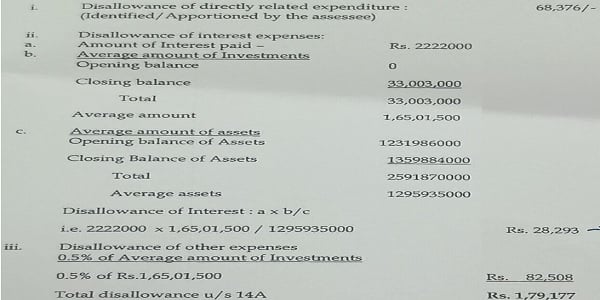
Income Tax : Section 14A disallows expenses related to tax-exempt income. Rule 8D provides the formula, ensuring only taxable-income-related ex...
Income Tax : Tribunal confirms that detailed AO dissatisfaction justifies invoking Rule 8D, ensuring proper disallowance of expenses related to...
Income Tax : Bombay Chartered Accountants' Society has made a Representation on 'Suggestions for Amendments in the Income Tax Act', on 24th May...
Income Tax : The mechanical disallowance u/s 14A r.w. Rule 8D is also being added to the book profit by the AO irrespective of the fact whethe...
Income Tax : 1. IMPLEMENTATION OF IND-AS AND THEIR IMPACT ON TAXABLE INCOME IND-AS (Indian version of IFRS) accounting standards are being impl...
Income Tax : Amendments to Section 14A to provide that (i) dividend received after suffering dividend-distribution tax and share income from fi...
Income Tax : As earlier intimated to you, Writ Petition bearing No. 50 of 2010 (Indian Exporters Grievances Forum & Other vs. CIT) challenging ...
Income Tax : Court held that penalty under Section 270A cannot apply where assessed income does not exceed processed income. Key takeaway: stat...
Income Tax : The case examined whether interest earned from co-operative banks qualifies for deduction under Section 80P(2)(d). The Tribunal he...
Income Tax : Consistency over technicalities: ITAT Mumbai allowed actuarial pension provision as an ascertained liability, rejected mechanical ...
Income Tax : A taxpayer could submit a revised return u/s 139(5) only when it discovered a bona fide omission or incorrect statement in the ori...
Income Tax : The Tribunal set aside additions to book profit after ruling that MAT provisions do not apply to banks established under a special...
Income Tax : 2) The expenditure in relation to income which does not form part of the total income shall be the aggregate of following amounts,...
Income Tax : Circular No. 5/2014-Income Tax Central Board of Direct Taxes, in exercise of its powers under section 119 of the Act hereby clari...
Income Tax : INCOME TAX NOTIFICATION NO-45/2008, DT: March 24, 2008 Method for determining amount of expenditure in relation to income not incl...
Income Tax : The provisions of Sections 144-A and 144-B of the Income-tax Act have come into force with effect from 1st January 1976. Instructi...
The Court held that Explanation 1(f) to Section 115JB does not expressly permit addition of Section 14A disallowance, leading to dismissal of the Revenue s appeal.
ITAT Mumbai held that disallowance of interest expenditure under Rule 8D(2)(ii) of the Income Tax Rules is not sustainable since the assessee’s own interest-free funds were substantially higher than the investment. Accordingly, appeal of revenue dismissed and order of CIT(A) upheld.
The Tribunal held that club expenses of a corporate assessee cannot be disallowed on estimation or presumption. Entire addition was deleted as the expenditure was held to be wholly allowable.
The Tribunal affirmed restricting Section 14A disallowance to the actual exempt income earned. It also held the Finance Act, 2022 explanation to be prospective, protecting taxpayers for earlier years.
The case addressed addition of a large gift treated as unexplained cash credit. The Tribunal remanded the matter after admitting additional evidence showing the donor’s identity, relationship, and financial capacity.
The issue was whether revision under section 263 could be invoked when the Assessing Officer had accepted a legally possible view. The Tribunal held that where two views exist and the AO adopts one, the order is neither erroneous nor prejudicial.
Professional fees and foreign branch expenses incurred by a strategic investment company were allowable under Section 37(1) in the absence of any finding that the expenditure was excessive, unreasonable
The tribunal held that assessments selected for limited scrutiny cannot include additions on unrelated issues without formal conversion to complete scrutiny. All such additions were set aside as being without jurisdiction.
The issue was whether commercial usage converts agricultural or residential Lal Dora land into commercial property for stamp duty valuation. The Tribunal ruled that unless revenue records are amended, the original land classification prevails.
The ruling explains the procedural outcome when a section 263 order is set aside. Original assessment appeals are restored, while appeals from consequential orders are dismissed as infructuous.