Mrinalini Jayant Puranik Vs ITO (ITAT Pune)
Under-Reporting Penalty- AO Didn’t Decide Form 68 in Time: ITAT Deletes 270A Penalty
Pine Tribunal examined penalty u/s 270A upheld by CIT(A)/NFAC. Assessee had not filed return originally, though TDS statements reflected income of Rs.2.63 crore. On reopening u/s 147, Assessee filed return declaring Rs.70,13,970/-, which AO accepted. AO nevertheless levied penalty of Rs.10,96,347/- for under-reporting, rejecting explanations & refusing immunity.
Before Tribunal, Assessee argued that 90% of tax was already deducted at source (page 6) & that Form 68 seeking immunity u/s 270AA was filed on 29.02.2024. As per sec.270AA(4), AO must pass an order—accepting or rejecting—within one month from end of month of application. Tribunal noted that no such mandatory order had been passed by AO.
Tribunal relied on Delhi High Court rulings in Nirman Overseas Pvt Ltd & Ultimate Infratech Pvt Ltd (page 11), holding that (i) immunity cannot be denied where penalty is for “under-reporting” & not “misreporting”, (ii) tax is paid, (iii) no appeal is filed, & (iv) assessee cannot be prejudiced by inaction of AO. Tribunal held that Assessee acquired a statutory right to immunity once conditions of section 270AA(1) were fulfilled & AO failed to act within statutory time.
Accordingly, Tribunal set aside the penalty order, directed AO to grant immunity u/s 270AA, & deleted penalty levied u/s 270A. Assessee’s appeal was allowed.
FULL TEXT OF THE ORDER OF ITAT PUNE
This appeal filed by the assessee is directed against the order dated 23.05.2025 of the Ld. CIT(A) / NFAC, Delhi relating to assessment year 2019-20.
2. Although a number of grounds have been raised by the assessee, however, these all relate to the order of the Ld. CIT(A) / NFAC in confirming the penalty of Rs.10,96,347/- levied by the Assessing Officer u/s 270A of the Income Tax Act, 1961 (hereinafter referred to as ‘the Act’).
3. Facts of the case, in brief, are that the assessee is an individual and has not filed her return of income for the impugned assessment year. Since as per the TDS statement the assessee has received various income to the tune of Rs.2,63,15,529/-, the Assessing Officer, after recording reasons, issued notice to reopen the assessment as per provisions of section 147 of the Act and accordingly notice u/s 148 of the Act was issued. The assessee in response to the same filed the return declaring total income at Rs.70,13,970/-. the Assessing Officer issued notices u/s 142(1) and 143(2) of the Act to the assessee in response to which the assessee filed the requisite details from time to time. Thereafter, the Assessing Officer accepted the returned income. However, the Assessing Officer initiated penalty proceedings u/s 270A of the Act for under-reporting of income. Accordingly, a show cause notice u/s 274 r.w.s. 270A of the Act was issued and served on the assessee in response to which the assessee made her submissions. She also filed an application for grant of immunity in Form No.68. The assessee filed a copy of challan evidencing the payment of such tax.
4. However, the Assessing Officer was not satisfied with the submissions of the assessee. He noted that although the Assessing Officer has accepted the returned income declaring total income of Rs.70,13,970/-, however, the assessment proceedings in this case were completed u/s 147 r.w.s. 144B of the Act. The income declared by the assessee is more than the maximum amount chargeable to tax. Rejecting the various explanations given by the assessee, the Assessing Officer levied penalty of Rs.10,96,347/- being the penalty @ 50% of tax payable for under-reporting of income as per provisions of section 270A of the Act.
5. In appeal, the Ld. CIT(A) / NFAC upheld the action of the Assessing Officer by observing as under:
6. I have carefully considered the facts of the case, statement of facts submitted by the appellant and written submissions of the appellant as against the observations/findings of the AO in the order.
The assessee is an individual. No return of income was filed by the assessee for A.Y. 2019-20.In this case specific information of earning of taxable income was available with the Id. A.O. as mentioned in para 1 of the assessment order. The information is regarding large transaction of Rs. 2,63,15,529/- done by the assessee during the F.Y.2018-19 relevant to A.Y.2019-20. The assessee has not filed any return of income for A.Y.2019-20 but has entered into a huge transaction n but has not filed return of income. In view of the non filing of the return of income, the income received as salary and the income earned as interest escaped assessment and the source of funds for investment in time deposit remained unexplained. In the return of income filed in response to notice under section 148 of the Act, the appellant disclosed the income of Rs. 70,13,970. It is surprising that despite of having such a large income the appellant did not file the return of income and was a non filer and appellant took a calculated risk and waited till the notice was issued under section 148 of the Act. the appellant filed the return of income and declared the income after that.
In the penalty proceedings as well as in the present appeal proceedings the main contention of the appellant has been that when the notices were issued to the appellant due compliance of the same was done and the tax was paid after the assessment proceedings and that the appellant had applied for the immunity under section 270AA of the Act. However the appellant has not filed a copy of immunity order under section 270AA of the Act and such immunity cannot be available in the present appeal proceedings. The proceedings of the immunity under section 270AA of the Act are separate proceedings. The complete details are to be filed with the competent authorities and are to be verified by them and on satisfaction the decision to grant the immunity or reject the application is to be taken by the competent authority. In case the relevant valid immunity is received by the appellant then the impugned penalty is liable to be deleted.
The appellant has not made any cogent and verifiable submissions along with supporting evidences as to why the return income was not filed originally even when the huge taxable income was earned by the appellant.
Clause (b) of the Section 270A(2) clearly provides that there is under reporting of income where –(b) the income assessed is greater than the maximum amount not chargeable to tax, where no return of income has been furnished or where return has been furnished for the first time under section 148;”
The appellant was a non-filer and did not file the return of income despite of having large income under different heads of income and only disclosed the income and filed the return of income only after the reopening notice under section 148 of the Act was issued and served. No bona fide and compelling and genuine reasons have been furnished along with supporting documents and verifiable material to prove that the appellant was prevented by external reasons beyond her control from filing the return of income u/s 139 of the Act..
The onus to show “reasonable cause” (refer section 273B) lay entirely on the assessee. In AIR 1989 Supreme Court 973 [Gujarat Water Supply & Sewerage Board v. Unique Erectors (Gujarat) (P) Ltd.], in Para 11, the Hon’ble Supreme Court was pleased to hold inter alia as under.-
‘It is difficult to give an exact definition of the word, ‘reasonable’. Reason varies in its conclusions according to the idiosyncrasy of the individual and the times and the circumstances of which the actor, called upon to act reasonably, knows or ought to know.”
In AIR 1996 Patna 58 (Commissioner of Wealth-tax v. Jagdish Prasad Choudhary), full bench of the Hon’ble Patna High Court, in Paragraph 31, inter alia held as under:-
“Therefore. in the context of penalty provision, the word, ‘reasonable cause’ would mean a cause which beyond the control of the as-sessee. ‘Reasonable cause’ obviously means a cause which prevents a reasonable man of an ordinary prudence acting under normal circumstances, without negligence or inaction or want of bona fide from furnishing the return in time.”
The assesse is required to “prove” the reasonable cause. This onus has not been discharged by the assessee by leading any cogent evidence. It is evidently clear that the assessee failed to furnish any evidence supported explanation substantiating and justifying the circumstances and reasons leading to not filing of return of income Las 139 of the Act.
In [2002] 255 ITR 258 (SC) Assistant Director of Inspection v. Kum. A.B. Shanthi, regarding the onus on the assesse to “prove” the reasonable cause, the Hon’ble Supreme Court has held as under –
19. It is important to note that another provision, namely, section 2738 of the Act was also incorporated which provides that notwithstanding anything contained in the provisions of section 271D, no penalty shall be imposable on the person or the assessee, as the case may be, for any failure referred to in the said provision if he proves that there was reasonable cause for such failure and if the assessee proves that there was reasonable cause for failure to take a loan otherwise than by account payee cheque or account payee demand draft, then the penalty may not be levied.
By not filing the return of income originally under section 139 of the Act, it was the claim of the appellant that notaxable income was earned. However this claim was found to be incorrect.
If assessee makes a claim which is not only incorrect in law. but is also wholly without any basis and explanation furnished by him for making such a claim is not found to be bona fide, Explanation-1 to section 271(1)(c) would come into play and assessee will be liable to penalty. [CIT v Zoom Communication (P) Ltd, 327 ITR 510(Del)]. . Further, if the assessee is not able to substantiate his explanation and such explanation is not bonafide. then also deeming provision of concealment will come into picture.
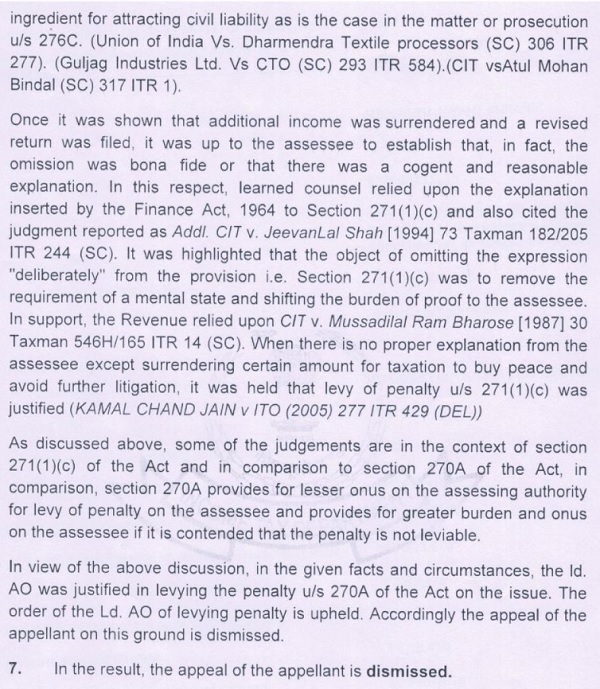
Mensrea not essential for civil liability of penalty- penalties under fiscal statues are for breach of civil liabilities- willful concealment is not an essential
6. Aggrieved with such order of the Ld. CIT(A) / NFAC the assessee is in appeal before the Tribunal.
7. The Ld. Counsel for the assessee at the outset submitted that 90% of tax has been deducted from the various income declared by the assessee. Further, the returned income was accepted by the Assessing Officer. Referring to page 7 of the paper book, the Ld. Counsel for the assessee drew the attention of the Bench to Form No.68 filed by the assessee for grant of immunity. Referring to the provisions of section 270AA(4) of the Act, he submitted that since the assessee had filed Form No.68 on 29.02.2024, therefore, the Assessing Officer was required to pass an order either granting or rejecting the immunity within a period of one month from the end of the month in which the immunity application was filed by the assessee u/s 270AA(1) of the Act. However, the Assessing Officer in the instant case has not passed any such order. Therefore, the assessee cannot be held responsible.
8. Referring to the decision of Hon’ble Delhi High Court in the case of Nirman Overseas Pvt. Ltd. Vs. NFAC vide W.P(C) No.5839/2022 & CM Appls.17517-17518/2022, order dated 08.04.2022, he submitted that under identical circumstances the Hon’ble High Court has directed the Assessing Officer to grant immunity u/s 270AA of the Act to the petitioner and the penalty so levied was directed to be deleted.
9. Referring to the decision of Hon’ble Delhi High Court in the case of Ultimate Infratech Pvt. Ltd. Vs. NFAC & Anr. vide W.P(C) No.6305/2022 & CM Appls.18990-18991/2022, order dated 20.04.2022, he submitted that the Hon’ble High Court following the earlier decision has directed the Assessing Officer to grant immunity u/s 270AA of the Act. He also relied on various other decisions filed in the paper book.
10. The Ld. DR on the other hand heavily relied on the orders of the Assessing Officer and the Ld. CIT(A) / NFAC.
11. We have heard the rival arguments made by both the sides, perused the orders of the Assessing Officer and Ld. CIT(A) / NFAC and the paper book filed on behalf of the assessee. We have also considered the various decisions cited before us. We find due to non-filing of the return, the Assessing Officer reopened the assessment as per provisions of section 147 of the Act and issued notice u/s 148 of the Act, in response to which the assessee filed her return of income declaring total income of Rs.70,13,970/-. We find the Assessing Officer accepted the returned income but initiated penalty proceedings u/s 270A of the Act and levied penalty of Rs.10,96,347/- being the penalty @ 50% of tax payable for under-reporting of income as per provisions of section 270A of the Act. We find the Ld. CIT(A) / NFAC confirmed the penalty levied by the Assessing Officer, the reasons of which have already been reproduced in the preceding paragraphs. It is the submission of the Ld. Counsel for the assessee that 90% of tax has already been deducted from the income so declared by the assessee. Further, during the course of assessment proceedings the assessee has filed Form No.68 on 29.02.2024. We find the provisions of section 270AA of the Act read as under:
“Immunity from imposition of penalty, etc.
270AA. (1) An assessee may make an application to the Assessing Officer to grant immunity from imposition of penalty under section 270A and initiation of proceedings under section 276C or section 276CC, if he fulfils the following conditions, namely:—
(a) the tax and interest payable as per the order of assessment or reassessment under sub-section (3) of section 143or section 147, as the case may be, has been paid within the period specified in such notice of demand; and
(b) no appeal against the order referred to in clause (a) has been filed.
(2) An application referred to in sub-section (1) shall be made within one month from the end of the month in which the order referred to in clause (a) of sub-section (1) has been received and shall be made in such form and verified in such manner as may be prescribed.
(3) The Assessing Officer shall, subject to fulfilment of the conditions specified in sub-section (1) and after the expiry of the period of filing the appeal as specified in clause (b) of sub-section (2) of section 249,grant immunity from imposition of penalty under section 270A and initiation of proceedings under section 276C or section 276CC, where the proceedings for penalty under section 270A has not been initiated under the circumstances referred to in sub-section (9) of the said section 270A.
(4) The Assessing Officer shall, within a period of one month from the end of the month in which the application under sub-section (1) is received, pass an order accepting or rejecting such application:
Provided that no order rejecting the application shall be passed unless the assessee has been given an opportunity of being heard.
(5) The order made under sub-section (4) shall be final.
(6) No appeal under section 246Aor an application for revision under section 264 shall be admissible against the order of assessment or reassessment, referred to in clause (a) of sub-section (1), in a case where an order under sub-section (4) has been made accepting the application.”
12. We find although the assessee has filed Form No.68 as per sub-section (1) of section 270AA of the Act, however, the Assessing Officer has not passed any order accepting or rejecting such application which he was supposed to pass as per provisions of sub-section (4) of section 270AA of the Act.
13. We find an identical issue had come up before the Hon’ble Delhi High Court in the case of Nirman Overseas Pvt. Ltd. Vs. NFAC (supra). We find the Hon’ble High Court relying on various decisions has directed the Revenue to grant immunity u/s 270AA of the Act to the assessee by observing as under:
“4 Having heard learned counsel for the petitioner, this Court is of the view that it is only in cases where proceedings for levy of penalty have been initiated on account of alleged misreporting of income that an assessee is prohibited from applying and availing the benefit of immunity from penalty and prosecution under Section 270AA.
5. In fact, the statutory scheme for grant of immunity is based on satisfaction of three fundamental conditions, namely, (i) payment of tax demand; (ii) non-institution of appeal, and (iii) initiation of penalty on account of underreporting of income and not on account of misreporting of Income.
6. This Court is also of the view that the petitioner cannot be prejudiced by the inaction of the Assessing Officer in passing an order under Section 270AA of the Act within the statutory time limit as it is settled law that no prejudice can be caused to any assessee on account of delay/default on the part of the Revenue.
7. In the present case, the petitioner has satisfied the aforesaid conditions, inasmuch as, (i) the tax has been paid on the additions, (ii) appeal has undisputedly not been filed; and (iii) penalty (as would be evident from the penalty notice) has been initiated on account of “under-reporting” of income.
8. Consequently, this Court is of the view that the petitioner acquired a right to be granted immunity under Section 270AA of the Act. In fact, this Court, in Schneider Electric South East Asia (HQ) Pte Ltd. Vs. Asst. Commissioner of Income Tax International Taxation Circle 3(1)(2), New Delhi and Ors., WP(C) 5111/2022, has held, “This Court is further of the view that the impugned action of Respondent No. 1 is contrary to the avowed Legislative intent of Section 270AA of the Act to encourage/incentivize a taxpayer to (i) fast-track settlement of issue, (ii) recover tax demand, and (iii) reduce protracted litigation”.
9. Consequently, the impugned order under Section 270A of the Act is set aside and the respondent is directed to grant immunity under Section 270AA of the Act to the petitioner.
10. With the aforesaid directions, the present writ petition along with pending applications stands disposed of.”
14. We find, following the above decision the Hon’ble Delhi High Court in the case of Ultimate INfratech Pvt. Ltd. Vs. NFAC & Anr. (supra), has also taken the similar view. The various other decisions relied on by the Ld. Counsel for the assessee in the paper book also supports his case to the above proposition. Since the assessee in the instant case has filed the requisite Form No.68 before the Assessing Officer on 29.02.2024 but the Assessing Officer has failed to pass any order either accepting or rejecting such an application which he was supposed to do as per provisions of sub-section (4) of section 270AA of the Act, therefore, respectfully following the decisions of Hon’ble Delhi High Court cited (supra), we direct the Assessing Officer to grant immunity from penalty to the assessee. Accordingly the order of the Ld. CIT(A) / NFAC is set aside and the Assessing Officer is directed to cancel the penalty levied u/s 270A of the Act. The grounds raised by the assessee are accordingly allowed.
15. In the result, the appeal filed by the assessee is allowed.
Order pronounced in the open Court on 28thNovember, 2025.