
How Does Income Tax Act Classify Your Earnings? A Simple Guide to Five Heads of Income
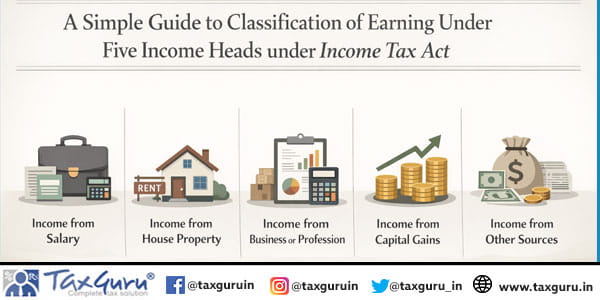
Imagine this: you are a software engineer with a monthly salary, you rent out a spare flat, and you sell some inherited shares at a profit. Which part of your income is taxed as salary, which as rent, and which as capital gains? The Indian Income Tax Act, 1961, lays down that every rupee of your earnings must be slotted into one of five categories (heads) of income. These five heads – Salaries; House Property; Profits & Gains of Business or Profession; Capital Gains; and Income from Other Sources – are mutually exclusive categories that together cover all taxable income.
Why is this classification important? Each head has its own rules for deductions and tax rates. For instance, allowances like HRA and standard salary deductions apply only under Salaries, while the 30% standard deduction on rental income is unique to House Property. Misclassifying income can lead to the wrong tax calculation and even penalties or audits. As the Supreme Court explained, the “distinct heads” of income are exclusive – if income falls under one head, it must be taxed under that head and not under another. In short, understanding these heads is the first step to correctly computing your tax liability.
Below, we unpack each of the five heads in simple language, with examples and case law, to show what kinds of earnings go where and why it matters. This overview will help students and taxpayers alike see the forest (tax law) through the trees of technical rules.
1. Income from Salary
If you work for an employer, your pay is taxed under the head “Salaries.” Legally, “salary” doesn’t just mean the monthly pay-slip; it includes wages, allowances, perquisites and benefits provided by the employer. In fact, Section 15 of the IT Act treats any salary due or paid by an employer as income under this head. For example:
- Basic Pay: The fixed monthly pay your contract promises.
- Allowances: House Rent Allowance (HRA), transport allowance, dearness allowance, etc. (Note: HRA has special exemption rules under Section 10(13A)).
- Perquisites: Company-provided benefits like a car, rent-free accommodation, or club membership.
- Bonus and Commission: Even if you earn commission or bonus based on performance, it counts as salary if paid by your employer.
- Provident Fund Contributions: Employer’s contributions to retirement funds are treated as salary (up to certain limits).
In Commissioner of Income-Tax v. L.W. Russel (Kerala High Court, 1964), the court held that to tax income as salary, there must be an employer–employee (master–servant) relationship. Remuneration paid without such an employment contract (for example, a consultant’s fee or a freelancer’s pay) would not fall under the salary head. In other words, if you are an independent consultant working on projects, your earnings are not “salary” (they would be business/professional income or other sources, as we’ll see).
Example:
An employee earns a monthly salary of ₹50,000. The company also pays ₹10,000 per month as HRA and ₹5,000 per month as transport allowance. For tax, all these (₹65,000 total) are treated under Income from Salary. He can claim deductions specific to salary income (e.g. the standard ₹50,000 deduction or HRA exemption), but he cannot claim home loan interest against salary income – that deduction comes under House Property.
Legal Note:
Section 17 of the Income Tax Act provides an inclusive definition of salary, listing all the components above. Judicial decisions like Gestetner Duplicators v. CIT have emphasized that anything flowing from the employment contract is salary, regardless of how it is labeled.
2. Income from House Property
If you own a building or land and let it out (rent it), the rent you receive falls under Income from House Property. Even if you do not actually rent it out, the law assumes a “notional” rent (called the Annual Value) on a second home – meaning you pay tax on a notional rental income from your own house, after deductions.
The key conditions for this head (from Section 22) are:
- Ownership: You must own the property (or be a “deemed owner” under Section 27, e.g. if you transferred it to your spouse).
- Building or land attached: Income from the building itself and its appurtenant land (like a yard) are taxed here.
- Not used in business: If the property is used for your own business or profession, its income is not taxed as house property (it would be business income instead).
Under this head, only rent income is taxable (or the notional rent). You cannot include, say, parking fees separately (those are taxed as “other sources” if not covered).
Once you have gross rental value, you deduct municipal taxes and arrive at the Net Annual Value (NAV). From NAV, a standard 30% deduction is allowed (for maintenance) under Section 24(a), plus any actual interest paid on a home loan under Section 24(b). The balance is your taxable house property income. For example:
Illustration: You rent out a flat. Gross rent received (or reasonable expected rent) is ₹5,00,000/year. You paid ₹20,000 in municipal taxes. The Net Annual Value is ₹4,80,000. Then you deduct 30% of ₹4,80,000 (₹1,44,000) and your home loan interest ₹1,00,000. Your taxable income from house property becomes ₹2,36,000.
If you live in the house yourself and do not let it out, its Gross Annual Value is taken as zero (self-occupied). You can still deduct up to ₹2 lakh of home loan interest (for a house under construction, rules apply). Any loss in this head can be adjusted against other income up to ₹2 lakh and carried forward further.
Case Example:
In East India Housing & Land Development Trust Ltd. v. CIT (1961, SC), a company formed to develop markets was receiving rent from shops it built. The company argued this rent should be “business income” since its business was market development. The Supreme Court rejected that, holding the rent as income from property (Section 22). The fact that the owner was in the business of developing property did not change the character of rent: distinct heads are mutually exclusive.
In practice, remember: one flat rented = House Property income; but running a hotel or mall is Business income.
3. Profits and Gains of Business or Profession
This head (often abbreviated PGBP) covers all the income from any business or professional activity. If you run a shop, a factory, or practise as a lawyer/doctor/consultant, the profits (or losses) from that trade or practice are taxed here.
What counts as business/profession?
– Business: Trading goods, manufacturing, running factories, or any profit-oriented commercial activity.
– Profession: Any vocation requiring skill, such as law, medicine, engineering, accountancy, or freelancing.
Section 28 and following sections (28–44) define what kinds of receipts are taxed here. It includes not just sales or service revenue, but also things like rent or interest if the business owns and uses the asset, insurance claims, etc. (For instance, if a company’s warehouse burns down, insurance payout for stock goes under this head as “insurance claim”.)
A few key points and examples:
- Revenue vs. Capital Expenditure: Only business-related expenses are deductible. Day-to-day costs (electricity, salaries, rent for office) reduce business income. Capital expenditures (buying machinery, land) are not deducted fully; instead you can claim depreciation over several years. Example: A tailor buying a sewing machine for ₹1 lakh can’t deduct ₹1 lakh in one year. He will claim depreciation on the machine’s cost each year under Section 32.
- Revenue vs. Capital Receipt: Sometimes you receive a large sum from selling a business asset (like machinery or goodwill). That is a capital receipt (often treated as capital gain, see next section). In Rai Bahadur Jairam Valji v. CIT (1959), the Supreme Court held that a ₹2.5 lakh payment received by ending a long-term supply contract was a revenue receipt, because the contract was an enduring part of the business. (But had the sum been for surrender of an incidental right, it might be capital; this area often requires detailed legal tests.)
- Case on “Business” Definition: In Narain Swadeshi Weaving Mills (1955, SC), it was held that the test of business is “intention to make profit” and continuity of activities, even if a one-time contract. The business head captures all profits from such activity.
- Allowable Deductions: You subtract all incurred expenses wholly and exclusively for the business (salaries, rent, cost of goods sold, etc.). Interest on business loans and depreciation (for wear and tear of assets) are key deductions.
Example:
A freelance web designer earns ₹12 lakh in a year. She has ₹2 lakh of phone and internet bills, ₹3 lakh of computer and software costs, and ₹1 lakh as office rent. Her business income is ₹12 lakh minus these expenses (₹6 lakh total) = ₹6 lakh. If she had also sold her old computer (a used capital asset) for ₹20,000, that ₹20K sale might be taxed under Capital Gains (see next) rather than business income.
Capital Receipts in Business:
Not all receipts of a business are treated as profit. For example, loans or capital contributions are not income. However, compensation received for loss of business assets (like the Jairam Valji case above) can be either business profit or capital gain, depending on the facts (enduring or incidental). As a rule, frequent or operating revenues are business income, while one-time gains from selling a fixed asset are usually capital gain (taxed separately).
4. Capital Gains
When you sell or transfer a capital asset and make a profit, that profit is taxed as Capital Gains. A capital asset broadly includes property (land, house, jewellery), shares, mutual funds, intangible property, etc,. Under Section 45(1), any gain from such transfer is charged under this head (with many exemptions under Sections 54–54H).
The computation of capital gains is specialized:
- Sale Consideration: The price for which you sold the asset.
- Cost of Acquisition: What you originally paid for it (plus improvements). For inherited assets, “cost” is usually the value on the date of inheritance.
- Indexed Cost: For long-term assets, purchase price is indexed to inflation.
- Expenses of Sale: Brokerage or transfer charges get deducted.
Formula: Capital Gain = Sale Price – (Indexed Cost of Acquisition + Expenses). (Indexation effectively increases the cost, reducing the taxable gain for long-term assets.).
- Short-Term vs Long-Term: If an asset is held for less than 24–36 months (depending on asset type), gains are short-term; otherwise, long-term. Short-term capital gains (STCG) are generally taxed at slab rate or special rate (like 15% for listed shares up to 2023, now 10% after 2023 update), while long-term capital gains (LTCG) have preferential rates or exemptions.
Example:
You bought a plot of land in 2010 for ₹5 lakh and sold it in 2025 for ₹20 lakh. Since land is long-term (held >2 years), you compute indexed cost. Suppose indexed cost is ₹10 lakh. Selling expenses were ₹50,000. Capital gain = ₹20 lakh – (₹10 lakh + ₹0.5 lakh) = ₹9.5 lakh (long-term capital gain). A portion might be exempt if you reinvest in a new home (Section 54F), etc.
Case Note:
In CIT v. B.C. Srinivasa Setty (1981), the Supreme Court famously held that if the cost of acquisition is indeterminable, no capital gain can be charged under Section 48. This arose because the assessee claimed shares or assets with no clear recorded purchase price. Thus the tax was struck down. (This was later addressed by legislative amendments, but it shows the importance of concrete cost records.)
5. Income from Other Sources
This is the “catch-all” or residual head for any income not covered by the first four heads. Section 56 and following list specific categories, but in practice common examples are:
- Interest Income: Interest on savings bank accounts, fixed deposits, recurring deposits, etc. (unless interest arises from business).
- Dividends: Dividend from shares (though post-2020, dividends are taxed in your hands under this head after removing DDT).
- Windfalls and Casual Income: Lottery and gambling winnings, prize money, casual salary (if not from regular employment), etc.
- Gifts: If you receive gifts above the exempt limit (₹50,000 per year from non-relatives), that excess is taxable here.
- Family Pension: Pension received by a family member after another family member’s death.
- Compensation: Some compensations, if not part of business, fall here (e.g., royalty or insurance claims not otherwise taxed).
In CIT v. Govinda Choudhury & Sons, the Supreme Court aptly described Other Sources as a “safe net” ensuring no taxable income escapes simply because it doesn’t fit any other head. However, one should first check if an income can be more logically linked to another head. For instance, interest earned in normal course by a bank is business income of the bank, not “other sources.”
Example:
A school teacher has salary ₹7 lakh. She also has ₹1 lakh interest from a bank FD and ₹60,000 dividend from shares. The ₹7 lakh is under Salaries, and the ₹1.6 lakh from interest/dividend is under Other Sources.
Another example: If that same teacher played and won a small lottery of ₹50,000, that prize is also taxable under Other Sources (lottery winnings are specifically taxable there). If she received a gift of ₹1 lakh from a cousin (non-relative for tax law), ₹50,000 (exempt) is free but ₹50,000 is taxed as “other source” income.
Lexical resources note that any casual or residual income falls here. As a Lex note explains, “even casual incomes can fall here if they do not fit elsewhere”.
Summary of Examples under Other Sources:
- Interest/Fd: ₹ from bank deposits.
- Dividends: from companies or mutual funds.
- Lottery/Gambling winnings: prizes won.
- Gifts: cash or property gifts beyond ₹50,000 limit.
These are all expressly mentioned by law as taxable under Section 56.
Why Proper Classification Matters
We’ve seen that the Income Tax Act rigorously categorizes income. There is no miscellaneous head outside the five. You could indeed have income in all five heads in one year. For example, “a salaried employee might also earn interest from bank deposits (Other Sources), receive rent from a property (House Property), and sell some land for profit (Capital Gains)” Each part is added to compute total income.
Getting the classification right is crucial:
- Accurate Tax Computation: Each head has separate rules for deductions and tax rates. You only get the deductions allowed in that head. For instance, claim of HRA or professional expenses is only in Salaries or PGBP respectively, not in Other Sources.
- Avoidance of Disputes: Misclassification can trigger audits or disputes. The law explicitly warns that misclassifying (say treating interest income as business income or vice versa) “can lead to incorrect tax liability, penalties, fines, or an audit”.
- Legal Compliance: Section 14’s scheme leaves no room for “miscellaneous” income. Everything must find a head.
In short, when you plan your taxes (or fill your ITR), always ask: What is the nature of this income? Which category does it truly fit? That way you apply the right deductions. For example, borrowing a home loan gives deductions under House Property – if someone mistakenly tried to set it off against Salary, it would be disallowed.
Conclusion
The five heads of income under the Income Tax Act – Salaries, House Property, Business/Profession, Capital Gains and Other Sources – form the foundation of tax computation in India. They ensure that each type of earning is taxed appropriately with its own rules. By classifying income correctly, taxpayers can legitimately minimize taxes through the deductions allowed under each head and avoid legal troubles.
For students and taxpayers, understanding these heads is the key to financial literacy in taxation. The Supreme Court and many cases have emphasized that the taxable character of income depends on its true nature, not just its form. Thus, a one-time capital gain isn’t smeared into business profits, and an independent contractor’s fee isn’t shoehorned into salary.
In practice, simply listing your sources of income and asking which head they belong to can clarify most cases. The Income Tax Act’s exhaustive structure means there’s a “place” for everything taxable. And that empowers you, the taxpayer, to compute income confidently and take advantage of the specific allowances and exemptions each head provides.




