
Abstract
Input Tax Credit (ITC) is a substantive right granted under Section 16 of the CGST Act, 2017. With the increasing reliance on auto-generated statements such as GSTR-2B, instances have arisen where ITC is flagged as “ineligible” solely due to Place of Supply (PoS) being different from the recipient State, even though tax is correctly charged as per the IGST Act.
This article analyses the legal framework governing ITC and Place of Supply, explains how GSTR-2B logic results in denial of ITC in genuine cases, highlights the inconsistency between portal validation and statutory provisions, and suggests practical remedies for taxpayers facing audit and departmental scrutiny.
- 1. Introduction
- 2. Legal Framework Governing ITC
- 2.1 Section 16 of the CGST Act – Eligibility of ITC
- 3. Place of Supply Provisions under the IGST Act
- 3.1 Goods – Section 10(1)(a) of IGST Act
- 3.2 Services – Section 12(1) of IGST Act
- 4. How GSTR-2B Flags ITC as Ineligible
- 5. Common Situations of Conflict
- 6. Section 77 of CGST Act and Its Limited Applicability
- 7. Conflict Between Portal Logic and Statutory Law
- 8. Practical Remedies for Taxpayers
- 9. Conclusion
1. Introduction
Input Tax Credit (ITC) forms the backbone of the GST framework and is governed primarily by Section 16 of the CGST Act, 2017. The introduction of system-generated statements such as GSTR-2B has significantly influenced ITC availment and verification.
While GSTR-2B is intended to be a facilitation and compliance tool, certain system validations relating to Place of Supply (PoS) mismatch with the recipient State have resulted in automatic tagging of ITC as “ineligible” in several genuine business transactions. Such tagging often appears inconsistent with the statutory provisions of the CGST and IGST Acts.
2. Legal Framework Governing ITC
2.1 Section 16 of the CGST Act – Eligibility of ITC
Section 16(1) of the CGST Act entitles a registered person to take credit of input tax charged on supplies used in the course or furtherance of business, subject to prescribed conditions.
Notably, Section 16 does not provide that ITC shall be denied merely because the Place of Supply is different from the recipient’s State of registration. Denial of ITC is specifically governed by Section 17(5) and certain procedural conditions under the Rules.
Thus, ITC eligibility flows from:
- Correct levy of tax,
- Possession of valid tax invoice,
- Receipt of goods or services,
- Tax paid to the Government, and
- Use in the course or furtherance of business.
3. Place of Supply Provisions under the IGST Act
3.1 Goods – Section 10(1)(a) of IGST Act
Section 10(1)(a) provides that the Place of Supply of goods shall be the place where the movement of goods terminates for delivery to the recipient.
In cases such as Delivery at place contracts, delivery is completed at the destination as per the contract or instructions from the recipient. That delivery place could be within the state of the Supplier even if the Recipient is in another state. In such case CGST+SGST may be charged by the Supplier.
At times, delivery could be in another state whereas the Recipient is in some other state where IGST is charged.
Hence, the Place of Supply becomes the vital point for the levy of GST irrespective of where the recipient actually present.
3.2 Services – Section 12(1) of IGST Act
Section 12(1) provides that the Place of Supply of services shall generally be the location of the recipient.
However, in practice, many services are physically rendered in a State different from the recipient’s registration State, such as:
- Hotel accommodation,
- Training programs,
- Event management services,
- Repairs and maintenance at site.
In the above cases, Suppliers may charge CGST+SGST (since the services are terminated at that premises/state) even though the billing recipient is in different state.
Just because of PoS condition these Services cannot be determined as Ineligible.
These transactions are legally valid and eligible for ITC when tax is correctly charged in accordance with law.
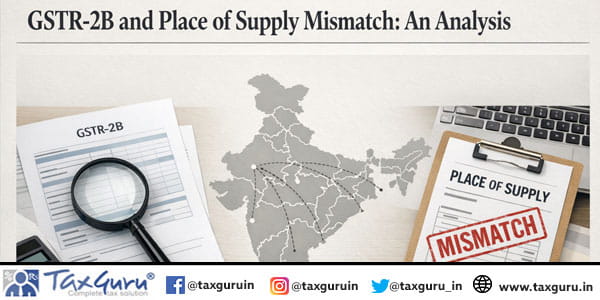
4. How GSTR-2B Flags ITC as Ineligible
GSTR-2B uses a system-driven validation logic based on:
- Recipient GSTIN State,
- Place of Supply declared by supplier in GSTR-1,
- Type of tax charged (CGST/SGST or IGST).
Where:
- Place of Supply differs from recipient State, and
- CGST + SGST is charged,
the system marks such ITC as:
“Ineligible – Place of Supply different from recipient State”.
This logic does not consider:
- Contractual delivery terms,
- Nature of services,
- Legal permissibility under Sections 10 and 12 of the IGST Act.
As a result, even legally valid transactions appear as ineligible in GSTR-2B.
5. Common Situations of Conflict
Such conflicts typically arise in the following cases:
- Third party delivery supplies where delivery occurs at a different place other than the recipient place.
- Hotel and accommodation services availed by companies for employees/business travels in other States.
- Training and event services provided in a State different from the recipient’s registration State.
In all these cases, tax may be correctly charged under law, yet ITC is blocked in GSTR-2B.
6. Section 77 of CGST Act and Its Limited Applicability
Section 77 of the CGST Act (read with Section 19 of the IGST Act) provides a mechanism when tax is wrongly paid due to incorrect determination of Place of Supply.
However:
- Section 77 applies only where tax is wrongly paid.
- It does not apply where tax is correctly charged as per Sections 10 or 12 of the IGST Act.
Treating every PoS mismatch as a wrong-tax scenario and denying ITC on that basis is legally unsustainable.
7. Conflict Between Portal Logic and Statutory Law
GSTR-2B is an auto-generated facilitation statement intended to assist compliance with Rule 36(4). It is not a statutory authority for determining eligibility of ITC.
Rule 36(4) is procedural in nature and cannot override the substantive right granted under Section 16 of the CGST Act. Denial of ITC solely on the basis of GSTR-2B tagging, without examining the legal nature of the transaction, leads to unintended hardship and avoidable disputes.
8. Practical Remedies for Taxpayers
To address audit queries and defend ITC claims, taxpayers should maintain:
- Contractual documents such as purchase orders and agreements indicating delivery or service terms.
- Logistics and delivery proof including e-way bills, delivery challans duly acknowledged by the recipient/his representative with official seal and transport related records.
- Correct tax invoices issued in accordance with Place of Supply provisions.
- Internal legal notes citing Section 10(1)(a) or Section 12(1) of the IGST Act and Section 16 of the CGST Act.
During audits, transaction-wise legal explanations supported by documentation should be furnished instead of relying solely on GSTR-2B status.
9. Conclusion
GSTR-2B is an important compliance facilitation tool but cannot override the provisions of the CGST and IGST Acts. When tax is correctly charged in accordance with Place of Supply provisions and the conditions of Section 16 are fulfilled, ITC remains a statutory right.
A balanced approach – where portal data is verified against statutory provisions and supported by proper documentation – will help reduce disputes and ensure that legitimate credits are not denied due to technical mismatches.








The debate on whether GSTR-2B logic can override Parliamentary Law (Section 16 of the CGST Act) often misses a fundamental constitutional cornerstone: The Destination-Based Consumption Principle.
The post argues that Section 16 “nowhere denies ITC based on PoS mismatch,” this view overlooks the mechanical and constitutional necessity of Place of Supply (PoS) in a federal structure like India.
• Federal Autonomy (Article 246A): India is a federal nation. Under Articles 246 and 246-A, States have the autonomy to levy and collect taxes. SGST belongs to the State where the Place of Supply is identified.
• The Consumption Principle: The heart of GST is that tax follows the goods/services to the consuming state. If a taxpayer in State A pays SGST to State B (because the PoS was in State B), State A cannot legally grant Input Tax Credit (ITC) for taxes it never received.
• The Role of IGST: Sections 10 and 12 of the IGST Act are not just “procedural” rules; they are the engines that settle tax between the Origin State and the Consuming State.
• Misclassification is a Substantive Error: If an interstate transaction is incorrectly treated as intrastate (charging CGST+SGST of the supplier’s state), the “wrong tax” has indeed been paid. In such cases, the credit is not “legally” available in the recipient’s home state because that state’s treasury has not received the tax component.
The GSTR-2B “Ineligible” flag isn’t just an arbitrary portal validation; it is a systemic safeguard ensuring that ITC is only claimed in the State where the revenue has actually flowed. While Section 16 grants the right to credit, that right is subject to the legal correctness of the tax paid under the IGST/CGST framework.
We aren’t just practicing “System-Driven Taxation”—we are practicing “Constitutionally-Aligned Taxation.” An error in PoS is not a mere technicality; it is a disruption of the federal tax settlement.