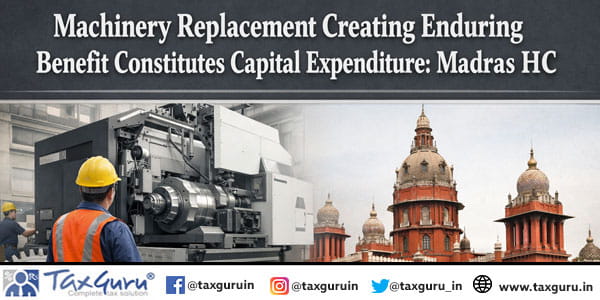
The case of CIT Vs Super Spinning Mills Ltd. (Madras High Court) concerns whether expenditure on replacement of machinery qualifies as revenue expenditure under “current repairs” or constitutes capital expenditure. The assessee claimed deduction for machinery replacement, which the Assessing Officer and CIT(A) treated as capital expenditure on the ground that the replaced machinery were independent units resulting in improved capacity and enduring benefit. The ITAT allowed the claim relying on an earlier High Court judgment. However, the Madras High Court held that the ITAT erred in relying on a judgment that had been subsequently overruled by the Supreme Court of India. It clarified that each machine is an independent asset and replacement leading to new or enhanced capability cannot be treated as “current repairs.” Such expenditure results in capital assets and must be treated as capital expenditure. The Court set aside the ITAT order and remanded the matter for fresh adjudication in line with settled legal principles.
Core Issue: Whether, the expenditure incurred on replacement of machinery is allowable as revenue expenditure under the head “current repairs” or is to be treated as capital expenditure, particularly where the replacement results in installation of independent machinery, and whether reliance on a judicial precedent which has subsequently been overruled can sustain the claim of the assessee.
In the case of CIT vs Super Spinning Mills Ltd. (Tax Case Appeal Nos. 459 & 460 of 2009, order dated 09.04.2026), the assessee, engaged in manufacturing of cotton yarn, had incurred substantial expenditure on replacement of machinery and claimed the same as revenue expenditure. The Assessing Officer held that the machinery replaced were independent and capable of higher production, and therefore such expenditure resulted in creation of new assets and enduring benefit, and accordingly treated the same as capital expenditure, allowing only depreciation.
Findings of AO / CIT(A): The Assessing Officer concluded that replacement of entire machinery or substantial parts thereof amounts to acquisition of new assets and cannot be treated as “current repairs”. The Ld. CIT(A) upheld the action of the AO by observing that the replaced machinery were independent functional units and not mere replacement of worn-out parts. It was held that such replacement leads to improvement in efficiency and production capacity and therefore constitutes capital expenditure. However, relief was granted only in respect of minor spare parts which were found to be in the nature of repairs.
Findings of ITAT: The ITAT allowed the claim of the assessee by relying on the decision of the jurisdictional High Court in CIT vs Janakiraman Mills Ltd., holding that replacement of machinery can be treated as current repairs and allowable as revenue expenditure.
Findings of Hon’ble High Court:-The Hon’ble Madras High Court held that the ITAT erred in allowing the claim solely on the basis of a judgment which had subsequently been overruled by the Hon’ble Supreme Court. It was observed that reliance on an overruled judgment renders the order unsustainable in law. The Court further clarified the legal position that each machine in a textile mill is an independent unit, and replacement of such independent machinery cannot be regarded as mere repairs.
The Court held that for an expenditure to qualify as “current repairs”, it must not result in creation of a new asset or enduring advantage. Replacement of substantial machinery resulting in improved capacity, efficiency or new advantage is to be treated as capital expenditure. The matter was accordingly remanded back to the appellate authority to re-examine the issue in light of the correct legal principles laid down by the Hon’ble Supreme Court.
The Hon’ble High Court held that the order of the ITAT was unsustainable as it relied on an overruled judgment and accordingly set aside the order and remanded the matter back to the appellate authority for fresh adjudication in accordance with the law laid down by the Hon’ble Supreme Court.
Gist of Cases Relied Upon
1. CIT vs Janakiraman Mills Ltd. (2005) 275 ITR 403 (Mad.)-The Hon’ble Madras High Court held that replacement of worn-out machinery in a textile mill could be treated as revenue expenditure under the concept of “current repairs”, if such expenditure is incurred wholly and exclusively for the purpose of business and does not result in creation of a new independent asset. (Note: This judgment was later overruled by the Hon’ble Supreme Court.)
2. Aruna Mills Ltd. vs CIT (Gujarat High Court) The Hon’ble Gujarat High Court held that spindles and similar components constitute independent machinery, and when such components are replaced, it may amount to replacement of machinery itself rather than mere repairs. The decision supports the proposition that independent functional units, when replaced, give rise to capital expenditure.
3. CIT vs Southern Petrochemical Industries Corporation Ltd. (No.2) (1998) 233 ITR 400 (Mad.)The Hon’ble Madras High Court held that allowance of depreciation is mandatory, and the Assessing Officer is duty bound to compute correct income in accordance with law. It was further held that assessee cannot exercise discretion to treat capital expenditure as revenue expenditure, and statutory provisions governing allowability must prevail over the assessee’s claim.
4. CIT vs Saravana Spinning Mills Pvt. Ltd. (2007) 293 ITR 201 (SC)- TheHon’ble Supreme Court held that replacement of entire machinery or independent parts thereof cannot be treated as “current repairs”. Each machine is an independent asset and replacement thereof results in capital expenditure, not allowable as revenue.
5. CIT vs Ramaraju Surgical Cotton Mills (2008) 166 Taxman 356 (SC)
The Hon’ble Supreme Court reiterated that expenditure resulting in enduring benefit or acquisition of new advantage is capital in nature. Replacement of substantial machinery leading to improved efficiency cannot be treated as revenue expenditure.
6. CIT vs Sri Mangayarkarasi Mills Pvt. Ltd. (2009) 182 Taxman 141 (SC) TheHon’ble Supreme Court held that textile machinery cannot be treated as a single composite asset, and replacement of individual machines constitutes capital expenditure, unless it is shown to be mere preservation of existing asset.
7. CIT vs Mahalakshmi Textile Mills Ltd. (1967) 66 ITR 710 (SC)The Hon’ble Supreme Court held that to qualify as “current repairs”, the expenditure must be incurred for preserving and maintaining an existing asset, and not for bringing into existence a new asset or advantage.