

Composite / Mixed Supply under GST vs Bundled Performance Obligations under IFRS 15 / Ind AS 115
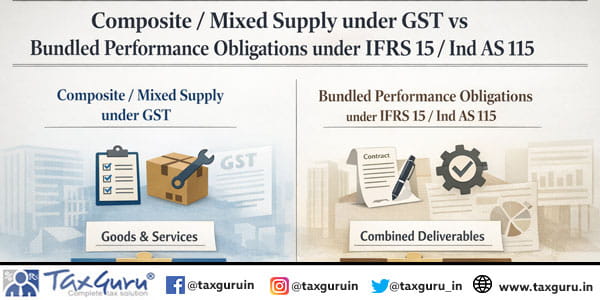
The treatment of multiple goods or services supplied together differs under GST law and IFRS 15 / Ind AS 115 because the two frameworks pursue different objectives. GST provisions focus on determining the applicable tax rate when multiple items are supplied together, while IFRS 15 focuses on determining how and when revenue should be recognised. Under GST, supplies may be classified as composite supply or mixed supply. A composite supply exists when goods or services are naturally bundled and supplied together in the ordinary course of business, with one principal supply and other ancillary supplies, and the GST rate of the principal supply applies to the entire bundle. A mixed supply arises when two or more independent goods or services are supplied together for a single price without meeting the conditions of composite supply, and the highest applicable GST rate applies to the entire supply. In contrast, IFRS 15 requires entities to determine whether promised goods or services in a contract are distinct performance obligations. If goods or services are not distinct, they are treated as a bundled performance obligation. Although the concept of bundling under IFRS 15 resembles the GST notion of naturally bundled supplies, IFRS 15 does not require identification of a principal supply, and the scope for bundling may therefore be wider.
(A) Composite / Mixed Supply
The issue of two or more goods or services (hereinafter referred to as “items”) supplied together has been addressed both under GST law and IFRS 15. However, the objective of the provisions in the two frameworks is different.
Under GST law, the focus is on determining the applicable tax rate when multiple goods or services are supplied together, as the individual items may attract different GST rates.
Under IFRS 15, the focus is on determining the timing and amount of revenue recognition, as revenue from different goods or services may need to be recognized in different accounting periods depending on whether they constitute separate performance obligations.
The provisions under GST and IFRS 15 are summarized below.
GST Provisions
(i) Composite Supply {Section 2(30)}
A supply shall qualify as a composite supply when all of the following conditions are satisfied:
- There are two or more goods and/or services supplied together.
- The goods and/or services are naturally bundled.
- The goods and/or services are supplied in conjunction with each other in the ordinary course of business.
- One supply is the principal supply, while the others are ancillary or incidental to the principal supply.
In the case of a composite supply, the GST rate applicable to the principal supply is applied to the entire bundle.
(ii) Mixed Supply {Section 2(74)}
A supply shall qualify as a mixed supply when all of the following conditions are satisfied:
- The supply does not qualify as a composite supply.
- It consists of two or more independent goods and/or services.
- The items are supplied together for a single price.
In the case of a mixed supply, the highest GST rate applicable to any of the items in the bundle is applied to the entire supply.
IFRS 15 Provisions
While GST law determines whether supplies constitute composite or mixed supply, IFRS 15 focuses on determining whether goods or services promised in a contract are distinct performance obligations.
Therefore, the decision framework under GST and IFRS 15 works in opposite directions, as illustrated below:
GST Approach
Identify whether goods/services constitute a composite or mixed supply.
If yes → Apply composite or mixed supply provisions.
IFRS 15 Approach
Identify whether goods/services in the contract are distinct.
If not distinct → They are treated as a bundled performance obligation.
Distinct Goods or Services under IFRS 15
IFRS 15 (para 22 read with para 27–29) requires an entity to determine whether goods or services promised in a contract are distinct. A good or service is considered distinct only if both of the following conditions are satisfied:
i. Capable of being distinct
The customer can benefit from the good or service either:
-
- on its own, or
- together with other readily available resources.
For example, if the entity regularly sells a good or service separately, this would generally indicate that the customer can benefit from it independently.
ii. Distinct within the context of the contract
The promise to transfer the good or service is separately identifiable from other promises in the contract.
The objective is to determine whether the nature of the promise in the contract is:
-
- to transfer each good or service individually, or
- to transfer a combined output for which the goods or services are inputs.
If the goods or services are not distinct, they are treated as a single bundled performance obligation.
Comparison with GST Composite Supply
The IFRS 15 criteria are conceptually similar to the GST concept of naturally bundled supplies, where goods and services are provided together in the ordinary course of business. However, GST provides a clearer requirement that one supply must be the principal supply, with other supplies being ancillary.
The comparison can be summarized as follows:
| Requirement | IFRS 15 (Bundled Supply) | Composite Supply (GST) | Mixed Supply (GST) |
| Goods/services are naturally bundled or represent a combined output | Required | Required | Not required |
| One supply is principal and others are ancillary | Not necessary | Required | Not required |
| Supply made for a single price | Not required | Not required | Required |
Conclusion
From the above discussion, it can be observed that the requirements under IFRS 15 are broadly similar to the concept of composite supply under GST, particularly in relation to goods or services that are naturally bundled.
However, a key distinction is that under GST composite supply, one supply must clearly be the principal supply, with the remaining supplies being ancillary.
Under IFRS 15, if two or more goods or services are highly integrated or together form a single combined output, they may still be treated as a single performance obligation, even if none of them can clearly be identified as the principal supply.
Therefore, the scope of bundling under IFRS 15 is wider compared to the concept of composite supply under GST.

Author Bio



sir,
please keep posting. This is so useful.