In re Volvo Auto India Private Limited (CAAR Mumbai)
CAAR held that Electric Vehicle kits, as described by Volvo Auto India Private Limited in the disassembled state and presented together as a kit merits classification under heading 8703 and are covered under S.No.526A(1)(a) of notification No. 50/2017-Cus. dated 30.06.2017 and therefore presently eligible for 15 percent rate of BCD applicable thereon.
FULL TEXT OF THE ORDER OF CUSTOMS AUTHORITY OF ADVANCE RULING, MUMBAI
1. M/s Volvo Auto India Private Limited, having IEC No. 0509035621 and PAN-AADCV0346E, have filed an application dated 26.04.2022, received in this office on 27.04.2022, seeking advance ruling under section 28-H of the Customs Act, 1962 before the Customs Authority for Advance Rulings, New Delhi (CAAR, New Delhi in short). On scrutiny, the application was found to be in order as per CAAR Regulations, 2021 and accordingly the application was registered under serial No. 09/2022 dated 27.04.2022.
2. The applicant, vide the aforesaid application, has sought ruling by CAAR, New Delhi on the question of classification of ‘IMPORTED ELECTRIC VEHICLE KITS’ and eligibility of the import for S.No. 526A(1)(a) of the mega exemption notification, thereby qualifying for 15% BCD rate for the kits”.
3. The details of the proposed business model of the applicant is as below:
3.1 The applicant plans to import Volvo passenger Electric Vehicle (EV) in knocked down condition from overseas manufacturing plant of Volvo Group. Different models of electric vehicle kits may be imported by the them, from time to time, which include front-wheel drive as well as all-wheel drive variants, along with rear-wheel drive variants that may be imported in due course of time. All major parts/sub-assemblies constituting one electric vehicle kit would be imported from a single plant.
3.2 Prior to import into India, the vehicles would be semi-assembled at Volvo plants located outside India for quality check purpose. However, the assembly is not completed at the said plant as certain parts and final operating software are not installed in the vehicle. Therefore, the vehicle remains unfinished and is not marketable and road worthy. Post quality check, the vehicles would be disassembled into various sub-assemblies for import into India. Thereafter, these disassembled vehicle kits comprising of various sub-assemblies would be shipped to India.
3.3 Completely Knocked Down Kits will consist of various separately identifiable parts, components and sub-assemblies. The electric vehicle kit comprising of different parts or subassemblies would be imported in a single consignment or in proximity to each other. Certain liquids and small replacement hardware i.e. nuts and bolts will be imported as separate unit loads.
3.4 Post import to India, the applicant would undertake assembly of knocked down kits of electric vehicles into complete vehicles through a contract manufacturer. The locally assembled vehicles will thereafter be sold to customers.
4. The applicant has detailed out the disassembly operations of the vehicle outside India, manner of import and re-assembly operations in India, which are described in the following paragraphs:
4.1 In order to ensure the highest standards of quality and to avoid any manufacturing defect, these vehicles will be semi-assembled at Volvo Group plants (outside India at their respective manufacturing location). At the assembly site, the essential components are assembled and thereafter, various car-systems are verified to avoid any manufacturing defect. However, the assembly of vehicle will not be completed at the said site as parts namely, rear seats, rear bumper will not be assembled at the site. Further, final operating software is also not installed in the vehicle. These semi-assembled vehicles are unfinished and hence, not marketable and road worthy.
4.2 After thorough verification and testing, once all quality parameters of Volvo India are satisfied, the semi-assembled vehicles would be disassembled into various sub-assemblies. The photograph of the level of disassembly for specific Volvo electric vehicle model, XC 40 BEV, for import into India is attached as under as Exhibit A.
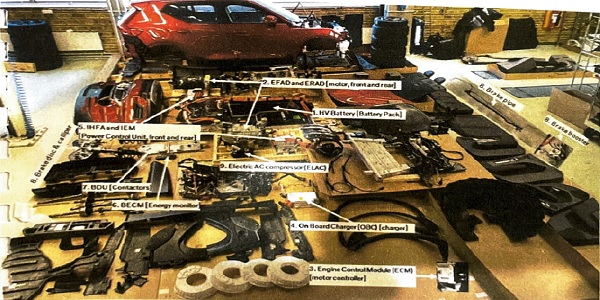
4.3 Disassembled parts of the vehicle are shipped as CKD kits to India consisting of various identifiable parts, components, and sub-assemblies. The vehicle would be broken down into approximately 105 parts/sub-assemblies, which are standalone and not attached to each other or any other parts, components or assembly. Going forward, the number of parts in which the vehicle is broken could increase. The details of these sub-assemblies are captured below: