In re Vastrakala Exports Pvt. Ltd. (CAAR Mumbai)
In In re Vastrakala Exports Pvt. Ltd., the Customs Authority for Advance Ruling, Mumbai examined the correct customs tariff classification of “dyed ornamental bird feathers” proposed to be imported by the applicant under the Customs Tariff Act, 1975. The applicant, a 100% Export Oriented Unit engaged in embroidery and embellishment work for luxury fashion brands, sought an advance ruling on whether such feathers should be classified under tariff entry 0505 10 90 or 6701 00 90. The application was filed under Section 28H(1) of the Customs Act, 1962 and was admitted as it squarely related to classification of goods.
The applicant explained that the feathers are sourced internationally, plucked from captive birds without slaughter, and sent to France where they undergo washing, steam-drying, and dyeing. These processed feathers are then exported to India for job work, including embroidery and embellishment, before being re-exported as components of fashion accessories. At the time of export from France, the feathers are classified under HSN 6701. However, while attempting to import them into India, the National Single Window System automatically reclassified the goods under Heading 0505, triggering Sanitary Import Permit conditions applicable to unworked or merely preserved feathers.
The applicant contended that Heading 0505 applies only to feathers that are unworked or subjected merely to cleaning, disinfection, or preservation, whereas the imported feathers had undergone dyeing, which is a process expressly excluded from Heading 0505. Relying on the General Rules for Interpretation (GRI), Chapter Notes, and HSN Explanatory Notes, the applicant argued that dyed feathers fall under Heading 6701, specifically tariff item 6701 00 90. Several judicial precedents were cited to emphasize that classification must be determined by the condition of the goods at the time of import and that HSN Explanatory Notes have persuasive value in India.
The Authority undertook a detailed analysis of Chapter 05 and Chapter 67 of the Customs Tariff Act. It noted that Heading 0505 covers feathers “not further worked than cleaned, disinfected or treated for preservation.” In contrast, Heading 6701 covers feathers and parts of feathers that have undergone processes beyond such minimal treatment, including bleaching, dyeing, curling, or waving. The HSN Explanatory Notes explicitly state that dyed feathers are excluded from Heading 0505 and fall under Heading 6701.
The Authority observed that the applicant’s feathers were washed, steam-dried, and dyed before importation, and were intended for ornamental and decorative use in the fashion industry rather than for stuffing purposes. These processes constituted “working” beyond what is permitted under Heading 0505. Applying GRI 1, read with the relevant headings, chapter notes, and HSN Explanatory Notes, the Authority found that there was no classification conflict once the goods were identified as dyed feathers. As such, resort to GRI 3 was not necessary.
The Authority further noted that dyeing is specifically mentioned in the HSN Explanatory Notes as a process that removes feathers from the scope of Heading 0505. The intended use of the goods—embellishment and embroidery for luxury fashion accessories—also aligned with the description of goods under Heading 6701. The job work undertaken in India did not alter the fact that, at the time of import, the feathers were already processed and suitable for ornamental use.
Accordingly, the Customs Authority for Advance Ruling, Mumbai ruled under Section 28I of the Customs Act, 1962 that ornamental bird feathers which are washed, steam-dried, and dyed prior to importation are classifiable under Heading 6701, specifically tariff item 6701 00 90, of the First Schedule to the Customs Tariff Act, 1975. Such goods cannot be classified under Heading 0505, as they have undergone processing beyond cleaning, disinfection, or preservation. The Authority clarified that it had not examined import policy or sanitary conditions, leaving those aspects to the jurisdictional authorities as per applicable law.
FULL TEXT OF THE ORDER OF CUSTOMS AUTHORITY OF ADVANCE RULING, MUMBAI
M/s: Vastrakala Exports Private. Ltd (IEC No.: 0499008847) (hereinafter referred to as ‘the Applicant’) filed an application (CAAR-1) for advance ruling in the Office of Secretary, Customs Authority for Advance Ruling (CAAR) Mumbai. The said application was received in the secretariat of the CAAR, Mumbai on 27.10.25 along with_ its enclosures in terms Of Section 2811 (1) of the Customs Act, 1962 (hereinafter referred to as the ‘Act also’). The Applicant is seeking advance ruling on the issue of classification of “Dyed Bird Feathers” proposed to be imported under CTI 6701 00 90 of the First Schedule of the Customs Tariff Act, 1975.
2. Applicant’s Submissions: –
2.1 Mis. Vastrakala Exports Private. Ltd. is an embroidery unit located in a 100% EOU in Chennai, and is engaged in the design, development., and execution of embroidery work on embellishments intended for use in furnishings, decorative items, and fashion accessories. As part of its operations, the Applicant imports dyed bird feathers from a feather crafting unit located in France These feathers serve as raw materials for the creation of fashion accessories, such as brooches and ready-to-wear items, which are ultimately supplied to luxury brands.
2.2 These feathers arc originally sourced froth different countries, where they are plucked from captive birds without slaughter and.then imported into France. In France, the feathers arc washed, steam-dried, and dyed before being exported to India for job work.
2.3 Based on the nature, characteristics, and activities undertaken on these feathers, the feathers are classified under HSN code 6701 00 at the time- of. export from France. The Applicant proposes to import these ornamental bird feathers that arc washed, steam dried, and dyed before being exported to India from France under USN code 6701 00 90. For one of the sample imports, the Applicant was unable to classify feathers under tariff item 6701 00 90 on the National Single Window System (“NSWS”) portal, as the system automatically reclassified them under heading 0505 based on the product type and description entered as feathers, leading to application of conditions related to 0505 in the Sanitary Import Permit (SIP).
2.4 The SIP included a condition that consignments classified under IISN Code 0505 10 90 must be accompanied by an official Sanitary Certificate issued by the competent authority in the country of origin. This requirement is based on the understanding that feathers falling under heading 0505 may not have undergone washing and steam-drying, and therefore necessitate certification to ensure compliance with disease control protocols – specifically declarations concerning the absence of highly pathogenic avian influenza in accordance with the Terrestrial Animal I-Tealth Code of the World Organisation for Animal Health (“OIE”).
2.5. However, given that the feathers are washed, steam-dried and dyed before importation, in the opinion of the Applicant the correct customs tariff classification is 6701 00 90 (covering ornamental feathers subjected to processing beyond mere cleaning or disinfectioxi).,
APPLICANT’S INTERPRETATION
- Whether ornamental bird feathers that are washed, steam-dried, and dyed are classifiable under customs tariff entry 0505 10 90 or 6701 00 90 under the First Schedule to the Customs Tariff Act, 1975.
3. It is the Applicant’s case that dyed bird feathers imported by them ought to he classified under tariff item 6701 00 90, rather than 0505 10 90. It is a well-settled position under the Customs law that the tariff classification of an item must be determined in accordance with the General Rules ‘for the Interpretation (“GRI”) to the First Schedule (Import Tariff) as set out under the Customs Tariff Act, 1975 (“CTA”).
4. The GRI of the. First Schedule to the CIA governs the classification of goods under the CTA. The relevant provisions of the GRI are set out below:
1. The titles of Sections, Chapters and Sub-Chapters are provided.* ease of reference only: ,for legal purposes, classification shall be determined according to the terms of the headings and any relative Section or Chapter Notes and, provided such headings or Notes do .not otherwise require, according to the following provisions:
2. (a) Any reference in a heading to-an article shall be taken to include a reference to that article incomplete or unfinished, provided that, as presented, the incomplete or unfinished article .has the essential character of the complete or finished article. It shall also be taken to include a reference to that article.complete or finished (or falling to be classified as complete or finished by virtue of this rule), presented unassembled or disassembled.
(b) Any reference in a heading to a material or substance shall be taken to include a reference to mixtures or combinations of that material or substance with other materials or substances. Any reference to goods of a given material or substance shall be taken to include a reference to goods consisting wholly or partly of such material or substance. The classification of goods’ consisting of more than one material or substance shall be according to the principles of rule 3.
3. When by application of rule 2 (b) or for any other reason, goods are, prima oracle, classifiable under two or more headings, classification shall be effected as follows:
(a) the heading which provides the most specific description shall be preferred to headings providing a more general description. However, when two or more headings each refer to part only of the materials or substances contained in mixed or composite goods or to part only of the items in a set put up fin- retail ,sale, those heading,. ore to be regarded as equal ty specific in relation to those goods, even if one of them gives a more complete or precise description of the goods.
b. composite goods consisting of different materials or made up of different components, and goods put up in sets for retail sale. which cannot be classified by reference to (a), shall be classified as if they consisted of the material or component which gives them their essential character, insofar as this criterion is applicable.
c. when goods cannot be classified by reference to (a) or (b), they shall he classified under the heading which occurs last in numerical order among those which equally merit consideration.
4. Goods which cannot be classified in accordance with the above rules shall be classified under the heading appropriate to the goods to which they are most akin.
……
6. For legal purposes, the classification of goods in the sub-headings of a heading shall be determined according to the terms ofthose subheadings and any related sub-heading Notes and, inutatis mutandis. to the above rules, on the understanding that only subheadings at the same level are comparable. For the purposes of thiS rule the relative Section and Chapter Notes also apply, unless the context otherwise requires.
5. The applicant has relied the following cases: –
a. The case of Commissioner of Customs, Amritsar v. D. L. Steels–(381). ELT 289 (SC), the Supreme Court of India.
b. The case of CCE Nagpur v. Simplex Mills Co Ltd. 2005 (181) ELT 345 SC, the Supreme Court of India.
c. And the case of B. K Bio Corp Pvt. Ltd. v. Commissioner of Customs (NS-I) (2025) 26 Ccntax 283 (Tri. -Born),
d. In B. V. Bio Corp Private I.td. (supra), the Tribunal case.
e. Tribunal in Commissioner of Customs, Chennai v. KB Autosys India Pvt Ltd [2025] 28 Centax 438 (CESTAT (Tri-Mad)
f. In Ram Nant Co Pvt Ltd v. Commissioner of Customs, Chennai—II Commissionerate [2025] (7) TMI 1345 (CESTAT Chennai), the Tribunal.
g. Ftextronics Technology India Pvt Ltd v. Commissioner of Customs, Chennai VII Commissionerate [2025] (3) TMI 695 (CESTAT Chennai)
h. Principal Commissioner of Customs (ICD TKD), New Delhi v. Sun N Sand Exim (1) Pvt Ltd [20241 10 TMI 158 (CESTAT New Delhi).
i. Glanbia Performance Nutrition v. Commissioner of Customs—Mundra [2023] 9 TMI 419 (CESTAT Ahmedabad).
j. Bright Performance Nutrition Pvt Ltd v. Commissioner of Customs, Mundra [2025] 2 TMI 146 (CESTAT Ahmedabad).
6. It is evident from the foregoing that the headings and the relevant Section or Chapter Notes must be meticulously examined to determine. the classification of • a. product. If a classification conflict persists after applying Rule 1 of the GRI, the subsequent.rules must be invoked. This underscores the significance of headings, Section Notes, and Chapter Notes in determining classification. Furthermore, the condition of the goods at the time of importation into India remains a determinative factor in the classification process.
7. In view of the foregoing, it is imperative to examine the following to determine the appropriate customs classification of ornamental bird feathers:
i. Relevant Section or Chapter Note of Headings 0505 and 6701 (tariff entry 0505 1090 and tariff entry 6701 00 90) under the First Schedule to the CTA..
ii. Any conflict in the customs classification of dyed ostrich or bird feathers after the application of Rule 1 of the GRI.
8. Chapter 5 of the CTA covers products of animal origin, not elsewhere specified or included. Heading 0505 of the CTA provides as follows:
“Skins and Other Parts of Birds, With Their Feathers or Down, Feathers and Parts of Feathers Whether or Not with Trimmed Edges) And Down,.Not Further Worked Than Cleaned, Disinfected or Treated for Preservation; Powder and Waste of Feathers or Parts of Feathers”..
9. Heading 6701 of the CIA provides as follows:
‘Skins and Other Parts of Birds with Their Feathers or Down, Feathers, Parts of Feathers, Down and Articles Thereof (Other Than Goods of Heading 0505 And Worked Quins and Scrapes)”
10. A plain reading of Headings 0505 and 6701 of the CTA suggests the following in relation to the classification of feathers under these headings:
i. Heading 0505 encompasses feathers, parts of feathers (whether or not with trimmed edges), and down, provided they have not undergone any processing beyond cleaning, disinfection, or treatment for preservation.
ii. Heading 6701 applies to feathers, parts of feathers and down that have been subjected to -processes beyond mere cleaning,. disinfection, or treatment, for preservation. Notably, feathers classifiable under leading 0505 are expressly excluded from this heading.
11. Under the CTA, heading 6701 encompasses the following tariff items:
670100 . -Skins and other parts of birds with their feathers or down, feathers, parts of feathers, down and articles thereof (other than goods of heading 0505 and worked, quins and scrapes)
67010010 Feather dusters
6701 00 90 Other”
12. The distinction between the categories of feathers covered under headings 0505 and
6701 has also been–elucidated in the IISN Explanatory.Notes published by-the World Customs Organisation. The relevant excerpts from the Explanatory Notes arc as follows:
05.05 — Skins and other parts of birds, with their feathers ‘or down, feathers and parts of feathers (whether or not with trimmed edges) and down, not further worked than cleaned, disinfected or treated for preservation; poWder and waste of feathers or parts of feathers.
0505.10–– • Feathers of a kind used for stuffing, down
0505.90 — Other
This heading covers:
1. Skins and other parts of birds (e.g., heads,- wings).with their feathers or down, and
2. Feathers and parts of feathers (whether or not with trimmed edges), and down.
provided they are either unworked, or merely cleaned, disinfected or treated for preservation, but not otherwise worked or mounted.
13. This heading excludes skins and other parts of birds, feathers and parts of feathers which have undergone working other than that permitted in this heading (e.g., bleaching, dyeing, curling or waving), or which have been mounted, and articles of feathers, etc; these are generally classified in heading 67.01 (see the Explanatory Note thereto). Worked quilts, and articles made from quilts, however, are classified according to ‘their character (e.g., -angling floats — heading 95.07, toothpicks heading 96.01).
“67.01 — Skins and other parts of birds with their feathers or down, .feathers, parts of feathers, down and articles thereof (other than goods of heading 05.05 and worked quilts and scrapes)
As per the Explanatory Notes to Chapter 6701, this heading covers:
A. Skins and other parts of birds with their feathers or down, feathers and down, and part’s of feathers. which though not yet constituting made up articles, have undergone a process other than a simple treatment of cleaning, disinfection or preservation (see Explanatory Note to heading_ 05.05); the goods of this heading may, for example, be bleached, dyed, curled or
B. Articles made of skins or of other parts of birds with their feathers or down, articles made of feathers, or down or of parts of feathers, even if the feathers or down, etc., are unworked or merely cleaned but not including articles. made of scapes or quilts. This heading therefore includes:
(1) Single feathers the quilts ofwhich have been wired or bound for use as, for example, millinery mounts, and also single composite –feathers assembled from different elements.
2. Feathers assembled in the form of clusters, and feathers or down assembled by glueing or fixing on textile fabric or other base.
3. Trimming made of birds, parts of birds, of feathers or down, for hats, boas, collars, capes or other articles of apparel or clothing accessories.
4. Fans made of ornamental feathers, with frames of any material. However, fans with frames of precious metal are classified in heading 71. 13.
This heading does not, however, include articles of apparel and clothing accessories in which feathers or down constitute no more than mere trimmings or paddings”.
14. Based on the description provided in the Explanatory Notes published by the WCO, it is evident that feathers classified under Heading 0505 must be either unworked or merely cleaned, disinfected or treated for preservation. Conversely, feathers that have undergone a process beyond cleaning, disinfection, or preservation treatment fall under Heading 6701. Feathers classified under the heading 6701 may have been subjected to bleaching, dyeing, curling, or similar treatments. Accordingly, the HSN Explanatory Notes, which guide the interpretation of the CTA, explicitly exclude feathers that have undergone any processing beyond cleaning, disinfection, or preservation treatment (such as dyeing) from classification under I leading 0505.
15. It is pertinent to note that the I ISN Explanatory Notes hold significant persuasive value • in India for resolving disputes related to tariff classification. Indian courts, including the Supreme Court, have consistently held that the ITSN Explanatory Notes serve as a reliable guide in ascertaining the true meaning of terms used in the CTA.
16. In this regard, reliance is on the following judgments also:
i. Commissioner of Central Excise Delhi v. Uni Products India Ltd., 2020 (372) ELT 465 SC.
ii. Polaris India Ltd v. Commissioner of Customs, 2017 0) Gsn, I 11.
iii. M. L. Ltd. v. Commissioner of Customs, 2010 (258) E.L. T. 321.
iv. Collector of Central Excise, Shillong v. Wood Crafts Products Ltd. reported in (1995) 3 SCC 454.
v. CCE v. Bakelite 1-lylam Ltd., 1997 (91) E.L. ‘F. 13
vi. Collector of Customs v. Business Forms 1,td.,2002(142) ELT. 1 3
vii. Collector of Central Excise, Shillong v. Wood Craft Products Limited [1995 (77) E.L.T. 23] has said: •
viii. Holostick India Ltd. v. CCE:, 2015 (318) E.L.T. 529
17. From the foregoing, it is evident that items classified under Heading 6701, except for feather dusters, fall under tariff item 6701 00 90. Therefore, based on the application of Rule 1 of the GRI, read in conjunction with the HSN Explanatory Notes, bird feathers cannot be clasSified under Heading 0505. Instead,” a plain reading of Heading 6701 confirms that bird feathers are appropriately classifiable under Heading 6701. Accordingly, the appropriate customs tariff classification for ornamental bird feathers that are dyed is tariff item 6701 00 90. The Feathers Imported by the Applicant have Undergone’Processing:Beyond Simple Cleaning, Disinfection, or Preservation.
18. It is further submitted that the Applicant imports bird feathers that have undergone processing beyond mere cleaning, disinfection, or preservation. At the time of importation, the feathers are not raw or untreated. Specifically, the feathers imported by the Applicant are washed, steam-dried, and dyed in France before importation into India. These steps impart significant value and transformation, rendering the feathers suitable for decorative and other purposes.
19. Upon importation into India, the Applicant undertakes intricate job-work activities, including embroidery on the ornamental feathers and creation of embellishments. The processes undertaken by the Applicant are intended to tailor the feathers according to the specific design requirements of luxury brands. The embellished feathers are re-exported to France and are incorporated into fashion accessories such as brooches and ready-to wear items for global luxury markets.
20. The imported bird feathers have already been dyed and subjected to significant processing before importation into India, beyond basic treatment measures. At the time of importation, dyed bird feathers may be used in decorative applications such as jewellery, props, and accessories. The Applicant’s activities in India only-enhance the use of dyed bird feathers to tailor specific requirements and do not change the fact that the feathers arc already processed items that can be used as raw materials in the fashion industry.
21. The job-work activities undertaken by the Applicant on feathers in India is liniited to value addition in the form of embroidery and embellishments aimed at fdlfilling specific design requirements of luxury brands. This does not alter the fact that the feathers, at the time of import, are already processed and suitable for use as raw materials.
22. In light of the above, it is submitted that the imported feathers meet the essential characteristics of products classifiable under heading 6701 that covers “feathers and down, prepared and articles made of feathers or of down,” rather than heading 0505, which is limited to unworked feathers or feathers that are merely cleaned, disinfected, or preserved. The feathers imported by the Applicant are not in their natural or raw state but have undergone substantial preparation and processing to become ornamental items intended for use by the fashion industry. A photograph of the as Appendix 1.
appendix-1
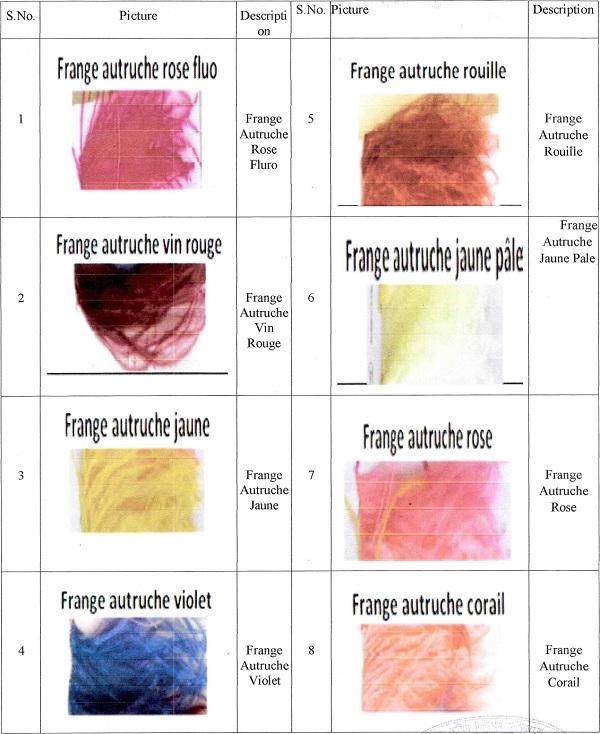
–
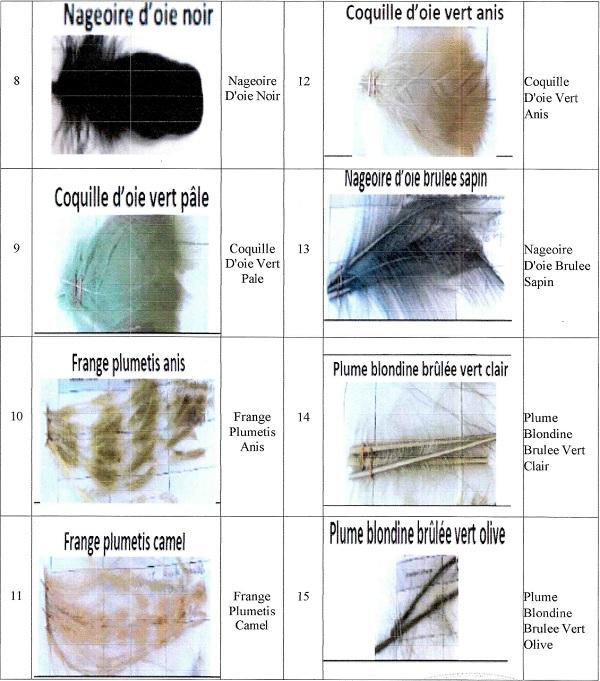
–
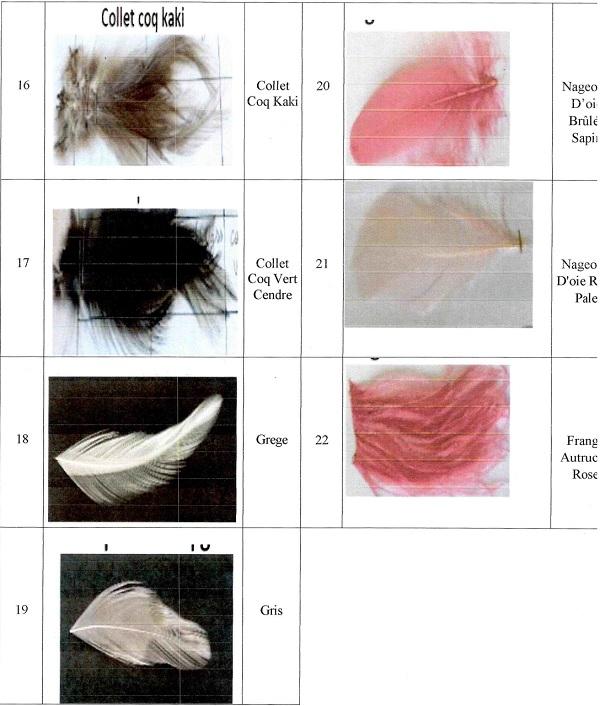
Additional Points Supporting Classification Under Heading 6701.
23. The Applicant submits that the dyeing process carried out on the feathers outside India, combined with washing and steam-drying, fundamentally alters the character of the feathers, transforming them from raw materials suitable for stuffing (as contemplated under Heading 0505) to processed ornamental items intended for use in the fashion industry. This transformation aligns with the HSN Explanatory Notes to Heading 6701, which explicitly include feathers that have undergone processes such as dyeing, bleaching, curling, or waving, thereby distinguishing them from the unworkcd or minimally processed feathers covered under I leading 0505.
24. The Applicant further submits that the classification under tariff item 6701 00 90 is supported by the principle of specificity under Rule 3(a) of the GRI. Heading 6701 provides a more specific description for feathers that have undergone advanced processing, such as dyeing, compared to the more general description under heading 0505, which is limited to feathers used for stuffing or down with minimal processing. Pursuant to Rule 3(a), the heading with the most specific description needs to be preferred, reinforcing the classification of dyed bird feathers under heading 6701.
25.It is reiterated that the bird feathers imported by the Applicant arc washed, steam-dried, and dyed in France before importation, making them suitable for decorative or aesthetic use. The processing undertaken on the feathers before importation distinguishes them from raw or minimally processed feathers and supports their classification under tariff item 6701 00 90.
26. It is important to note that the HSN Explanatory Notes explicitly exclude feathers that have been dyed or similarly processed from heading 0505, and classify them under heading 6701. The persuasive authority of the HSN Explanatory Notes — repeatedly affirmed by the Supreme Court and Tribunals — reinforces the role of the HSN Explanatory Notes as a reliable and internationally recognised guide for tariff classification in India. Relying on IISN Explanatory Notes ensures consistency with global standards and justifies the classification of imported feathers under heading 6701.
27. The Applicant asserts that the use of the imported feathers in high-value fashion accessories, such as brooches and ready-to-wear items for luxury brands, further supports their classification under Heading 6701. The IISN Explanatory Notes to Heading 6701 include feathers • intended for millinery mounts, clusters, or trimmings for apparel, which aligns .with the Applicant’s use of the feathers in the fashion industry, as opposed to the utilitarian purpose of stuffing associated with Heading 0505.
Port of Import and reply from jurisdictional Commissioner, Chennai.
28. The applicant in their CAAR-I indicated that they intend to import the subject goods from the jurisdiction of Office of the Principal Commissioner, Chennai Air Cargo Commissionerate, Meenambakkam, Chennai. “1’he application was,forwarded.t6 the Office of the Principal Commissioner, Chennai Air Cargo Commissionerate, Meenambakkam, Chennai for their comments on 30.10.2025 and 28.11.2025, however, no reply has been received in this regard.
Details of Personal Hearing: –
29. Mr. Ajinkya Gunjan Mishra, Advocate appeared online for Personal Hearing in this matter on 02.12.2025. He reiterated the contention filed with the application that the subject import goods are dyed feathers (washed and steam dried) to further make embellishments for luxury brands. He submitted that they are operating a 100% EOU” unit and they provide JOB work to foreign clients in different birds feathers processing. Ile further, contended that there are two CUT for birds feathers 0505, .which is for cleared and preserved feathers, but CT] 16701 cover prepared feather having being dyed as per I ISN Explanation Note to C111.6701 (A).
He further submitted that the dying activity is done in France, where raw feathers are collected from different part of the world. But due to the system error is “National single window system” portal the subject import goods i.e. Dyed Feather” is reclassified under CTI I 0505. He relied on GRI-I, Rule 3(a) of GRI I-ISN Explanation Note to the Chapter I leadinQ 6701 in support of his claim that the subject goods merit classification under 6701 as dyed feather.
30. Discussion and Findings: –
30.1 I have taken into consideration all the materials placed before me in respect of the subject ‘goods including all the submissions and citations made by the applicant during the personal .hearing on 02.12.2025. Accordingly, I proceed to pronounce a ruling on the basis of information available on record as well as existing legal framework having bearing on the classification of the goods in question under the first schedule of the Customs Tariff Act, 1975, specifically Chapter 05 and 67, its corresponding Chapter notes, supplementary notes relevant USN explanatory notes and General Rules of Interpretation (GRI).
30.2 The question seeks ruling on classification of the Dyed Ornamental Bird Feathers to be imported. At the outset, we. find that the issue raised in the question is squarely covered under Section 2811(2)(a) of the Customs Act, 1962 being a matter related to classification of goods under the provisions of this Act.
30.3 The .Applicant is a 100% Export Oriented Unit (EOU) engaged in the design and execution of embroidery and embellishment work on fashion accessories for luxury brands. As part of their operations, they propose to import dyed ornamental bird feathers, processed in France by washing, steam-drying and dyeing. These .feathers arc declared by the foreign supplier under. FISN 6701.00 at the time of export from France. The Applicant intends to classify and import them under CTH 6701 00 90. When attempting to obtain a Sanitary Import Permit (SIP) on the National Single Window System (NSWS) portal, the system automatically reclassified the product under CTI I 0505, which led to. SIP conditions applicable to feathers not further worked than ‘cleaned, disinfected or preserved, including the requirement of a Sanitary Certificate regarding absence of Highly Pathogenic Avian Influenza.
The Applicant further submits that feathers imported by them have undergone processing beyond simple cleaning, specifically washing, steam-drying and dyeing, and therefore are excluded from heading 0505 and merit classification under Heading 6701. The Applicant states that the feathers are processed abroad, imported in fully dyed form, and farther used in .embroidery and embellishment work for luxury fashion accessories, consistent with goods described under Heading 6701.
30.4. The applicant has sought ruling on. the following question: –
Whether ornamental bird ji!athers that are washed, steam-dried, and dyed are classifiable under customs tariff entry 0505 10 90 or 6701 00 90′ under the First Schedule to the Customs Tani. f Act, 1975.
30.5 Applicability of I leading 0505 states:
”Feathers… not further worked than cleaned, disinfected or treated for preservation.”
The I1SN Explanatory Notes of heading 0505. provide that they arc either unworkcd or Merely cleaned, disinfected or treated for preservation, but not otherwise worked or mounted.
30.6 Analysis under Heading 6701 states: –
“Feathers, parts of feathers… which have undergone a process other than simple cleaning, disinfecting or preserving.”
The HSN Explanatory Notes specify that Skins and other parts of birds with their feathers or down, feathers and down, and parts of feathers, which though not yet constituting made up articles, have Undergone a process other than a simple treatment of cleaning, disinfection or preservation (see Explanatory Note to beading 05.05) the goods Of this heading may, for example, be bleached, dyed, curled or waved.
30.7 I further observe that the process of dyeing is specifically mentioned in the IISN as a process taking goods out of I leading 0505 and placing them under Heading 6701. Additionally, washed and dyed feathers arc ornamental, not stuffing material. Their intended use embellishment in fashion accessories aligns with goods classified in 6701.
30.8 I find that under GRI 1, classification must be determined according to the terms of the headings. relevant Section/Chapter Notes, and I ISN 1,xplanatory Notes (persuasive). Since the goods are washed, steam-dried, and dyed. they exceed the permissible processes under Heading 0505. The terms oil leading 6701 fully cover such goods. Therefore, application of GRI 1 alone is sufficient to classify the goods under heading 6701.
Further. under GRI 3 (a), the Applicant argues that Heading 6701 is more specific under GRI 3(a). However, I find that there is no competition between headings 0505 and 6701, once the goods are dyed. It will not fall under Heading 0505, hence the application of GRI 3 is not warranted necessarily.
30.9 The Dyed Birds Feathers, as presented, are washed, steam-dried, dyed, and intended for use as ornamental materials in embroidery for luxury brands. These processes constitute “working” in terms of HSN Notes. Thus, the feathers lose the character of raw stuffing feathers and become prepared ornamental feathers, suitable for heading 6701.
31. In view of the aforesaid discussion and under Section 28-1 of the Customs Act, 1962, it is hereby ruled that Ornamental ,bird feathers that have been washed, steam-dried and dyed prior to importation are classifiable under Heading 6701, more specifically under tariff item 6701 00 90 of the First Schedule to the Customs Tariff Act, 1975. Goods so processed cannot be classified under Heading 0505, as they have undergone working beyond cleaning, disinfection, or preservation.
However, 1 have not delved into the question of import policy nor is the subject matter in the application. The jurisdictional Authority may follow the policy condition, pertaining to the sanitary measure; if any, as per the provision.
I rule accordingly.