Legal Foundations of Forensic Evidence in Criminal Justice: A Study with Special Reference to Fingerprint and DNA Evidence in India
Abstract
Forensic evidence plays an indispensable role in the modern criminal justice system. It enhances the accuracy of investigations, aids in identifying offenders, and assists in delivering justice. In India, the legal foundation of forensic evidence, especially fingerprint and DNA analysis, is governed by a combination of statutory provisions, judicial pronouncements, and procedural safeguards. This paper examines the legal framework governing forensic evidence in India, with a focus on the admissibility and procedural rules related to fingerprint and DNA evidence.
1. Introduction
The incorporation of scientific techniques into criminal investigation processes has revolutionized the administration of justice. Forensic science has become a cornerstone in ensuring that justice is not only done but seen to be done. However, scientific evidence must be anchored in a sound legal framework to maintain the integrity of the judicial process. This paper explores how fingerprint and DNA evidence is regulated, interpreted, and applied in the Indian legal system.
2. Forensic Evidence and Indian Law: An Overview
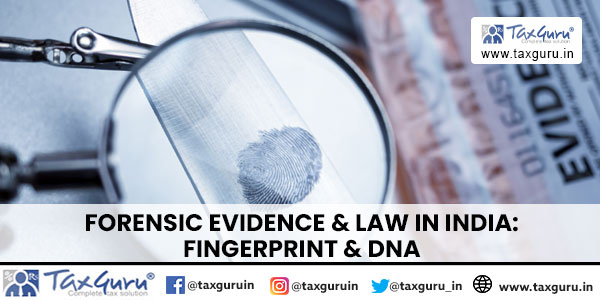
Forensic evidence refers to information obtained through scientific methods, which are used to support or refute claims in criminal cases. Indian law recognizes forensic evidence under the Indian Evidence Act, 1872. Sections 45 to 51 of the Act provide for the opinion of experts, which includes forensic experts in fields such as handwriting, fingerprint analysis, and biology (DNA).
Moreover, the Code of Criminal Procedure, 1973 (CrPC), and the Identification of Prisoners Act, 1920 (recently amended by the Criminal Procedure (Identification) Act, 2022), provide procedural frameworks for collecting biometric and biological data from accused persons.
3. Legal Framework Governing Fingerprint Evidence in India
3.1 Historical Context and Legal Basis
Fingerprint evidence has been recognized in India for over a century. The use of fingerprints was officially introduced during British rule and gradually became an accepted form of identification and evidence. The Indian Evidence Act, 1872, recognizes fingerprint experts under Section 45, which allows the court to admit expert opinions on identity.
3.2 Procedural Laws and Safeguards
The Identification of Prisoners Act, 1920 (now replaced by the Criminal Procedure (Identification) Act, 2022), initially allowed police officers to take fingerprints of convicted and certain non-convicted persons. The 2022 Act has widened the scope significantly, enabling collection of not just fingerprints but also palm prints, footprints, and other biometric data from a larger category of persons.
The new law, however, has raised concerns regarding privacy and proportionality. Critics argue that the expanded powers may infringe upon the right to privacy as laid down in Justice K.S. Puttaswamy v. Union of India (2017). To address this, data protection norms and judicial oversight mechanisms must be developed in tandem.
3.3 Admissibility and Judicial View
Indian courts have consistently accepted fingerprint evidence as reliable when properly collected and analyzed. In State of U.P. v. Ram Babu Misra (1980), the Supreme Court highlighted that fingerprint evidence must be examined by competent experts and corroborated with other evidence for higher evidentiary value.
4. DNA Evidence and Its Legal Standing
4.1 Emergence and Importance
DNA evidence, due to its high accuracy, has become an invaluable tool in criminal investigation and adjudication. It is widely used in cases of rape, murder, paternity disputes, and missing persons.
4.2 Legal Provisions and Challenges
While there is no comprehensive legislation exclusively dealing with DNA evidence in India, the Indian Evidence Act, 1872 allows expert opinions under Section 45 to include DNA analysis. The Criminal Procedure Code (CrPC), under Sections 53, 53A, and 164A, provides for medical examination of accused persons and rape victims, which includes DNA testing.
The proposed DNA Technology (Use and Application) Regulation Bill, 2019 seeks to regulate the use of DNA technology in the identification of individuals for criminal and civil matters. The bill aims to establish a DNA Regulatory Board and set guidelines for the establishment and maintenance of DNA data banks. However, concerns regarding data privacy and the risk of misuse have delayed its enactment.
4.3 Judicial Interpretation
The judiciary has played a significant role in affirming the validity of DNA evidence. In State of Himachal Pradesh v. Rajeev Singh Rana (2016), the Supreme Court upheld DNA evidence as clinching proof in establishing the guilt of the accused. Similarly, in Krishan Kumar Malik v. State of Haryana (2011), the Court held that DNA profiling is a modern and scientific method of proving identity and its probative value is high.
Nevertheless, courts have also emphasized the need for strict compliance with procedural requirements. In Selvi v. State of Karnataka (2010), the Supreme Court ruled that involuntary administration of techniques like narco-analysis, polygraph tests, and brain mapping violates the right against self-incrimination under Article 20(3). While DNA testing was not directly barred, the judgment reinforces the principle of consent and procedural fairness in forensic processes.
5. Balancing Forensic Utility with Fundamental Rights
The increasing reliance on forensic evidence necessitates a careful balancing act between effective law enforcement and the protection of individual rights. The Supreme Court in the Puttaswamy judgment recognized the right to privacy as a fundamental right, which applies to bodily integrity and informational privacy.
As forensic evidence often involves intrusion into bodily autonomy (as in DNA or fingerprint collection), the process must meet the standards of legality, necessity, and proportionality. Adequate safeguards such as informed consent, judicial oversight, and independent review mechanisms are essential to prevent abuse.
6. Recommendations
- Enactment of Comprehensive Legislation: India needs a robust legal framework that comprehensively regulates forensic techniques, especially DNA testing.
- Privacy Safeguards: Any law dealing with forensic data must include strong privacy safeguards, data protection norms, and accountability measures.
- Training and Infrastructure: Capacity-building among police, forensic experts, and judiciary is vital to ensure accurate and ethical use of forensic tools.
- Judicial Oversight: Establishing protocols for court-monitored forensic testing would help balance law enforcement needs with individual rights.
7. Conclusion
Forensic evidence, particularly fingerprint and DNA analysis, is becoming central to the Indian criminal justice system. While Indian law recognizes the utility of such evidence, the legal infrastructure must evolve to meet emerging challenges of privacy, consent, and reliability. A harmonized approach involving legal reform, technological competence, and human rights sensitivity is the way forward in ensuring forensic science serves justice without compromising individual liberties.
Let me know if you’d like a citation format (like Bluebook or APA), case law expansion, or if you’d like help submitting it to a journal or conference.