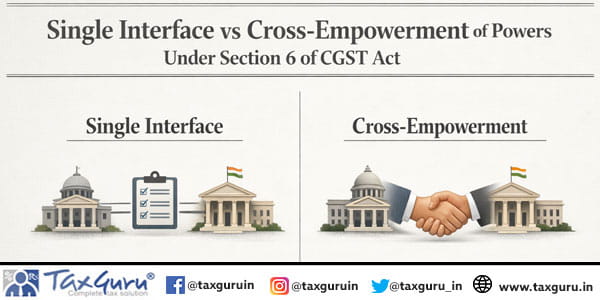
The Goods and Services Tax (GST) system is based on two simple and important ideas: “single interface” and “cross-empowerment.” Single interface means that a taxpayer does not have to deal with multiple tax officers for the same tax work. Earlier, under the VAT system, a taxpayer often faced more than one authority for tax collection and checking of returns. GST has removed this problem by allowing the taxpayer to mainly deal with one tax department, making compliance easier and reducing confusion. Cross-empowerment means that both the Central Government and the State Government tax departments have the power to take action if a taxpayer violates GST laws. This ensures that tax authorities can act effectively and there are no gaps in enforcement.
At first glance, these two concepts may seem to contradict each other. However, when they are properly understood within the GST system, it becomes clear that they actually support each other. Both concepts have been deliberately included in the GST framework and are meant to work together. Their combined purpose is to ensure that GST is implemented smoothly, making tax compliance easier while also ensuring effective enforcement of the law.
When the GST law was being made, it was clearly decided that taxpayers should not be controlled by both Central and State tax authorities at the same time. To avoid this double control and to make tax compliance easier, the idea of a “single interface” was introduced. Under this system, a taxpayer is mainly handled by only one tax department. That single authority looks after all GST-related matters of the taxpayer, including Central GST (CGST), State GST (SGST), and Integrated GST (IGST). This helps reduce confusion, saves time, and makes the GST system simpler for taxpayers.
The main purpose of this system was to make it easier for taxpayers to deal with the tax department. All matters such as notices, audits, assessments, and other proceedings are handled by only one authority. This avoids confusion, repeated work, and unnecessary complications that would occur if two authorities were involved. The idea was that a taxpayer should not be forced to answer the same questions or explain the same transaction to two different tax departments.
Deliberations of the GST Council
In the 5th GST Council Meeting held on 2 December 2016, the Chairman explained that for GST to work properly, cross-empowerment was necessary. This meant that tax authorities should have powers across the entire business activities of a taxpayer. The Finance Minister from Karnataka stated that once a taxpayer had already been audited by the State tax department, there was no valid reason to transfer the same matter to the Central tax department.
The Secretary further suggested that important actions like issuing show cause notices and passing final orders should be done by the same tax authority that had carried out the audit, scrutiny, or enforcement action. This would ensure consistency and avoid confusion. The Finance Minister from Tamil Nadu also expressed that, except in cases based on intelligence inputs (where both authorities may need to act), dual control should be avoided in routine matters such as registration, filing of returns, scrutiny, audit, appeals, tax demands, and refunds.
Later, in the 9th GST Council Meeting held on 16 January 2017, the Chairman of the Central Board of Excise & Customs stated that the States had agreed that both Central and State tax departments would have jurisdiction over all taxpayers. He emphasized that neither authority should be completely excluded from any part of the tax process, as this would help maintain proper checks and balances. At the end of the discussion on cross-empowerment, it was agreed that enforcement actions, especially those based on intelligence inputs, would be common powers of both the Central and State tax authorities. Accordingly, both authorities were empowered to take such enforcement actions across the entire business activities of a taxpayer.
To make sure that taxpayers deal with only one tax authority under GST and to avoid control by both Central and State departments, the GST Council decided in its 9th Meeting to clearly divide taxpayers between the Central and State tax administrations for routine administrative work. At the same time, the Council understood that for effective enforcement, both the Central and State tax departments must have the power to act on cases based on intelligence, even if the taxpayer is administratively assigned to the other authority. This shared power was meant to strengthen enforcement and prevent tax evasion, while still keeping the system simple and clear for taxpayers through the single interface approach.
Statutory Framework under Section 6 of the CGST Act
To allow both Central and State tax officers to exercise powers under GST laws and to ensure cross-empowerment across the CGST, SGST, and IGST Acts, Section 6 was added to the GST Acts. Under Section 6(1), officers appointed under the State GST (SGST) Act or the Union Territory GST (UTGST) Act are allowed to act as “proper officers” for matters under the Central GST (CGST) Act. Similarly, the State GST and Union Territory GST laws contain provisions that allow officers appointed under the CGST Act to act as proper officers under the respective State GST laws. This arrangement ensures that both Central and State tax officers can perform their duties across different GST laws whenever required.
Section 6 of the CGST Act, 2017 reads as under-
“6. Authorization of officers of State tax or Union territory as proper officer in certain circumstances.
(1) Without prejudice to the provisions of this Act, the officer appointed under the State Goods and Services Tax Act or the Union Territory Goods and Services Tax Act are authorised to be the proper officers for the purposes of this Act, subject to such conditions as the Government shall, on the recommendation of the Council, by notification, specify
(2) Subject to the conditions specified in the notification issued under sub-section (1),-
(a) where any proper officer issues an order under this Act, he shall also issue an order under the State Goods and Services Tax Act or Union Territory Goods and Services Tax Act, as authorized by the State Goods and Services Tax Act or Union Territory Goods and Services Tax Act, as the case may be, under intimation to the jurisdictional officer of State tax or Union Territory tax;
(b) where a proper officer under the State Goods and Services Tax Act or Union Territory Goods and Services Tax Act has initiated any proceedings on a subject-matter, no proceedings shall be initiated by the proper officer under this Act on the same subject- matter.”
(3) Any proceedings for rectification, appeal and revision, wherever applicable, of any order passed by an officer appointed under this Act shall not lie before an officer appointed under the State Goods and Services Tax Act or the Union Territory Goods and Services Tax Act.”
Section 6 of the CGST Act, along with similar provisions in the State GST and Union Territory GST laws, is an important and carefully drafted provision. It clearly reflects both the single interface system and the idea of cross-empowerment under GST. This section explains when and how tax officers appointed under one GST law can act as “proper officers” under another GST law. In this way, it balances the goal of allowing taxpayers to deal with only one authority, while also giving both Central and State tax officers the legal power to act when required.
Section 6 of the Central GST and State GST laws is meant to ensure smooth coordination between Central and State tax officers. Under Section 6(1) of the CGST Act, officers appointed under the State GST or Union Territory GST laws are allowed to act as “Proper Officers” for matters under the Central GST law. A reading of Section 6(1) of the CGST Act shows that it starts with a special overriding clause and clearly gives power to officers appointed under the State GST or Union Territory GST laws to act as “Proper Officers” for the purposes of the Central GST Act.
This arrangement allows tax officers from one department to take action under the law of the other department, making enforcement more coordinated and efficient. In the same way, the State GST and Union Territory GST laws also allow officers appointed under the Central GST Act to act as Proper Officers under the respective State or Union Territory GST laws. Overall, this system helps in better tax administration by avoiding gaps in enforcement and ensuring cooperation between Central and State tax authorities.
As part of the system of cross-empowerment, Section 6(2) clearly sets out how tax officers should act. Under clause (a), when a tax officer passes an order under the Central GST Act, the same officer must also pass the corresponding order under the State GST or Union Territory GST Act. While doing so, the officer must inform the concerned State or Union Territory tax officer. Further, clause (b) of Section 6(2) clearly states that if a tax officer under the State GST or Union Territory GST law has already started proceedings on a particular issue, then a Central GST officer cannot start separate proceedings on the same issue. This rule is meant to prevent duplication of action and protect taxpayers from facing multiple proceedings for the same matter.
In particular, Section 6(2)(a) of the CGST Act provides that a ‘Proper Officer’ authorized under either the Central or the State/UT enactments shall be competent to issue orders under both laws. Furthermore, clause (b) of Section 6(2) mandates that where a proceeding has been initiated by an officer under one enactment, the officer under the other enactment shall not initiate a separate proceeding on the same subject matter, thereby preventing duplication and ensuring administrative coordination.
This means that if a State GST officer starts proceedings against a taxpayer under either the State GST law or the Central GST law, the officer can continue with those proceedings, even if the taxpayer has been officially assigned to a Central GST officer. In such a situation, the Central GST officer is not allowed to start a separate case on the same issue, and the same rule applies the other way around. This prevents two different officers from taking action on the same matter. Additionally, whenever a tax officer starts any proceeding under one GST law, they must inform the corresponding officer under the other GST law. This system of coordination and avoidance of duplicate proceedings also applies to Union Territory GST officers.
To make sure that taxpayers do not face multiple proceedings from different tax authorities, Section 6(2)(b) of the Central GST Act clearly provides that once a tax officer under the State GST or Union Territory GST law has started proceedings on a particular issue, a Central GST officer cannot start another proceeding on the same issue. This rule is also present in the State GST and Union Territory GST laws. Therefore, if a Central GST officer has already initiated proceedings on a matter, a State GST or Union Territory GST officer is not allowed to start separate proceedings on the same matter.
The main purpose of Section 6(2)(b) of the Central GST Act is to ensure that allowing both Central and State tax officers to act does not lead to taxpayers facing multiple or parallel proceedings. Importantly, Section 6(2)(b) treats officers empowered under the State GST or Union Territory GST laws as equal to Central GST officers. It does not require that an ongoing investigation or proceeding be transferred from the State tax authority to the Central authority, or vice versa. This ensures that proceedings continue smoothly with the officer who initially started them, without creating duplication or confusion for the taxpayer.
Section 6 of the CGST Act has to be read with Circular No. 01/2017 dated 20.09.2017 and Circular dated 05.10.2018 read with Clarification F. No. CBEC20/10/07/2019-GST dated 22.06.2020 by the Central Board of Indirect Taxes, GST Policy Wing.
The Hon’ble High Court of Himachal Pradesh, in CMPMO No. 273 of 2024, in the matter of M/s. Kundias Loh Udyog vs. State of P and Another, vide judgment dated 17.09.2024 and the Hon’ble High Court of Delhi, in M/s. Amit Gupta v. Union of India & Ors., W.P.(C) No. 8625 of 2022, decided on 04.09.2023, both held that: “The object of Section 6(2)(b) of the Act is to avoid multiple proceedings by the Sales Tax Officer and Central Tax Officer on the same subject matter and the Rules of purposive interpretation requires Section 6(2)(b) of the Act to be read in light of this object.”
The Hon’ble High Court of Orissa in W.P(C) No. 2530 of 2024 and WP(C) No. 24358 of 2022 in the matter of M/s. Satyam Castings Pvt. Ltd. vs. Deputy Director, DGGI and another judgment dated 05.04.2024 has held that “there is no ambiguity in the language of Section 6(2)(b) of the CGST Act, which bars initiation of proceeding by a proper officer under CGST Act where a proper officer under the State Goods and Services Act or the Union territory Goods and Services Tax Act has initiated proceeding on a subject matter.”
In Nutshell – To explain clearly, Section 6(1) of the CGST Act gives the general power that allows both the single-interface system and cross-empowerment to operate. This means that any “Proper Officer” can act as a proper officer under the State GST or Union Territory GST laws, and vice versa. Clause (a) of Section 6(2) strengthens this by stating that when a Proper Officer issues an order under the Central GST Act, the officer must also issue a corresponding order under the SGST or UTGST Act. While doing so, the officer must inform the concerned jurisdictional officer of the other tax department. Clause (b) of Section 6(2) reinforces the idea of cross-empowerment, but specifically for intelligence-based enforcement actions, ensuring that both Central and State tax authorities can act when required while maintaining coordination.
Cross empowerment under IGST Act, 2017
Just like Section 6 of the CGST Act provides for cross-empowerment between Central and State tax authorities, Section 4 of the IGST Act allows the Central Government to authorize officers of the State or Union Territory to act as Proper Officers under the IGST Act. This authorization is subject to any conditions or exceptions that may be prescribed.
As a result, the way courts interpret and apply cross-empowerment under Section 6 of the CGST Act would also apply, in a similar manner, to Section 4 of the IGST Act.
Section 4 of the IGST Act, 2017 reads as under-
“4. Authorisation of officers of State tax or Union territory tax as proper officer in certain circumstances.
Without prejudice to the provisions of this Act, the officers appointed under the State Goods and Services Tax Act or the Union Territory Goods and Services Tax Act are authorised to be the proper officers for the purposes of this Act, subject to such exceptions and conditions as the Government shall, on the recommendations of the Council, by notification, specify.
Circular dated 05.10.2018 (Intelligence-Based Enforcement)
Both the Central and State tax administrations shall have power to take intelligence-based enforcement action in respect of the entire value chain is reflected in the Circular dated 05.10.2018, as reproduced herein. At this point of time, the circular of the CBEC is relevant which is extracted below: –
“D.O.F. No. CBEC/ 20/43/01/2017-GST (Pt.)
Dated 5th October, 2018
Dear Colleague,
It has been brought to the notice of the Board that there is ambiguity regarding initiation of enforcement action by the Central tax officers in case of taxpayer assigned to the State tax authority and vice versa.
2. In this regard, GST Council in its 9th meeting held on 16-1-2017 had discussed and made recommendations regarding administrative division of taxpayers and concomitant issues. The recommendation in relation to cross-empowerment of both tax authorities for enforcement of intelligence based action is recorded at para 28 of Agenda note no. 3 in the minutes of the meeting which reads as follows :-
“viii. Both the Central and State tax administrations shall have the power to take intelligence-based enforcement action in respect of the entire value chain”
3. It is accordingly clarified that the officers of both Central tax and State tax are authorized to initiate intelligence based enforcement action on the entire taxpayer’s base irrespective of the administrative assignment of the taxpayer to any authority. The authority which initiates such action is empowered to complete the entire process of investigation, issuance of SCN, adjudication, recovery, filing of appeal etc. arising out of such action.
4. In other words, if an officer of the Central tax authority initiates intelligence based enforcement action against a taxpayer administratively assigned to State tax authority, the officers of Central tax authority would not transfer the said case to its State tax counterpart and would themselves take the case to its logical conclusions.
5. Similar position would remain in case of intelligence based enforcement action initiated by officers of State tax authorities against a taxpayer administratively assigned to the Central tax authority.
6. It is also informed that GSTN is already making changes in the IT system in this regard.
With best Wishes
Your Sincerely,
(Mahender Singh)
Both Central GST officers and State GST officers can take action against any taxpayer, no matter which department the taxpayer usually deals with. If an officer starts a case based on information or intelligence about tax evasion, that same officer will handle the entire process—from investigation, issuing notices, taking decisions, recovering tax, to hearing any appeals. The case will not be transferred to another department just because the taxpayer is normally under that department. In simple terms, the officer who starts the case will also finish the case.
CBEC-20/10/07/2019-GST dated 22th June, 2020
Further clarity on the issue of cross-empowerment of State GST and Central GST officers is also visible in a recent letter issued by the Central Board of Indirect Taxes and Customs being no. CBEC-20/10/07/2019-GST dated 22th June, 2020 which reads as follows-
“F. No. CBEC-20/10/07/2019-GST
Government of India
Ministry of Finance
Department of Revenue
Central Board of Indirect Taxes Customs
GST Policy Wing
***
Dated: 22nd June, 2020
The Principal Director General,
Directorate General of GST Intelligence,
2nd Floor. Wing- VI, West Block- VIII
R.K. Puram,
New Delhi- 110066
Sir,
Subject: Reference form DGGI on Cross empowerment under GST. reg.
I am directed to refer to DGGI letter F.No.574/CE/66/2020/Inv./15308 dated 26.05.2020 on the issues related to cross empowerment of officers in terms of provisions of section 6 of the Central Goods and Services Tax Act, 2017 (hereinafter referred to as “the CGST Act”).
2. Issue raised in the reference is whether intelligence based enforcement actions initiated by the Central Tax officers against those taxpayers which are assigned to the State Tax administration gets covered under section 6(1) of the CGST Act and the corresponding provisions of the SGST/UTGST Acts or whether a specific notification is required to be issued for cross empowerment on the same lines as notification No. 39/2017-CT dated 13.10.2017 authorizing the State Officers for the purpose or refunds under section 54 and 55 of the COST Act.
3.1 The issue has been examined in the light of relevant legal provisions under the CGST Act, 2017. It is observed that Section 6 of the CGST Act provides for cross empowerment of State Tax officers and Central Tax officers and reads as:-
“6. (1) Without prejudice to the provisions of this Act, the officers appointed under the State Goods and Services Tax Act or the Union Territory Goods and Services Tax Act are authorised to be the proper officers for the purposes- of this Act, Subject to such conditions as the Government shall, on the recommendations of the Council, by Notification specify.”
3.2 Thus in terms of sub-section (1) of section 6 of the CGST Act and subsection (1) of section 6 of the respective State GST Acts respective State Tax officers and the Central Tax officers respectively are authorised to be the proper officers for the purposes of respective Acts and no separate notification is required for exercising the said powers in this case by the Central Tax Officers under the provisions of the State GST Act. It is noteworthy in this context that the registered person in GST are registered under both the CGST Act and the respective SGST/UTGST Act.
3.3 The confusion seems to be arising from the fact that, the said subsection provides for notification by the Government if such cross empowerment is to be subjected to conditions. It means that notification would be required only if any conditions are to be imposed. For example, Notification No. 39/2017-CT dated 13.10.2017 restricts powers of the State Tax officers for the purposes of refund and they have been specified as the proper officers only under section 54 and 55 of the CGST Act and not under rule 96 of the CGST Rules, 2017 (IGST Refund on exports). If no notification is issued to impose any condition, it means that the officers of State and Centre have been appointed as proper officer for all the purpose of the CGST Act and SGST Acts.
4. Further, it may kindly be noted that a notification under section 6(1) of the CGST Act would be part of subordinate legislation which instead of empowering the officer under the Act, can only be used to impose conditions on the powers given to the officers by the section. In the absence or any such conditions, the power of Cross- empowerment under section 6(1) of the CGST Act is absolute and not conditional.”
The question is whether Central GST officers can take intelligence-based action against taxpayers who usually deal with State GST officers, or if a special government notification is needed for this. After looking at the law, it is clear that Section 6 of the CGST Act already allows it. This section gives cross-powers to both Central and State GST officers, meaning officers from one department can act under the GST law of the other department whenever needed.
Because of Section 6, Central GST officers do not need any separate notification to take action against taxpayers who are normally handled by the State GST department. This is also because every GST taxpayer is registered under both the Central GST law and the State GST law. The confusion comes from the fact that Section 6 mentions the Government may issue a notification. This does not mean a notification is always needed. A notification is only required if the Government wants to limit or restrict powers.
For example, in one notification, State officers were allowed to handle only certain types of refunds, and not export refunds. That notification imposed restrictions. If no such notification is issued, it means there are no restrictions, and both Central and State officers have full powers under the law. In simple terms, the cross-empowerment powers under Section 6 are automatic and complete, unless the Government specifically issues a notification to limit them.
Purpose of Cross Empowerment
The GST system keeps the idea of “cross-empowerment” so that tax authorities can enforce the law effectively and prevent tax evasion. Both Central and State tax departments have the power to take intelligence-based enforcement actions. This means they can act when they receive credible information about possible tax evasion from the taxpayer’s business or transaction chain, rather than relying only on audits of accounts or returns.
Collecting such intelligence is meant to be non-intrusive. The tax department uses tools like data analytics, comparison with third-party information, alerts on common methods of evasion, and past records to gather actionable intelligence. Taxpayers should note that information about possible tax evasion cannot be obtained from them simply through summons, vague letters, or ordinary correspondence. The process relies on independent intelligence, not routine notices.
If a case arises from an audit of accounts or a detailed check of tax returns, only the tax department to which the taxpayer is officially assigned can start proceedings. However, if the case is based on intelligence about possible tax evasion, either the Central or the State tax department can initiate proceedings, regardless of which department the taxpayer is normally assigned to.
In simple terms, Section 6 of the CGST Act allows both Central and State tax authorities to have cross powers, meaning they can act under each other’s laws when needed. For ease of administration, the GST Council has divided taxpayers between the Central and State authorities through a circular so that routine matters are handled by only one department. However, when it comes to intelligence-based enforcement actions—cases based on information about possible tax evasion—both Central and State tax authorities are allowed to take action across the entire business activities of the taxpayer.
The Supreme Court has clarified that intelligence-based enforcement actions are actions that do not come from an audit of accounts or a detailed check of tax returns. This does not mean that tax authorities cannot conduct audits or scrutinize returns. Both the Central and State tax departments are fully empowered to do audits or check returns—but such actions must be based on intelligence about possible tax evasion, not just routine compliance checks.
*****
Disclaimer: Nothing contained in this document is to be construed as a legal opinion or view of either of the author whatsoever and the content is to be used strictly for informational and educational purposes. While due care has been taken in preparing this article, certain mistakes and omissions may creep in. the author does not accept any liability for any loss or damage of any kind arising out of any inaccurate or incomplete information in this document nor for any actions taken in reliance thereon.