
In this article, we discuss the statutory and judicial remedies available to taxpayers when an ex parte order is passed by GST adjudicating authorities.
At the outset, it is important to emphasize that taxpayers and their consultants must remain vigilant, particularly with respect to the “Additional Notices” tab on the GST portal. Failure to regularly monitor notices often results in ex parte orders, which not only cause avoidable hardship to taxpayers but also contribute to unnecessary litigation, further burdening an already over-stressed judicial system.
However, where a notice is inadvertently missed and an ex parte order is passed, the law does provide certain remedies, which are discussed below.
Statutory Remedies Available to Taxpayers
1. Rectification Application under Section 161 of the CGST Act 2017
A taxpayer may file a rectification application within three months from the date of the decision or order to correct errors apparent on the face of the record.
Practical challenge:
Based on practical experience, rectification applications in ex parte matters are rarely entertained. Since no reply or documents were submitted during adjudication, adjudicating authorities often take the view that there is no material on record to establish an error apparent from the record. Consequently, the probability of relief under Section 161 in such cases remains minimal.
2. Appeal under Section 107 of the CGST Act, 2017
An appeal may be filed before the Appellate Authority within three months from the date of communication of the order, with a further condonable period of one month.
Practical challenge:
In many cases, non-vigilant taxpayers become aware of the demand only after four months, when recovery proceedings are initiated. Once the statutory time limit (including the condonable period) expires, the Appellate Authority lacks jurisdiction to entertain the appeal—even on medical or other reasonable grounds.
At this stage, taxpayers often believe that no remedy remains. However, with appropriate legal assistance, an effective constitutional remedy may still be available.
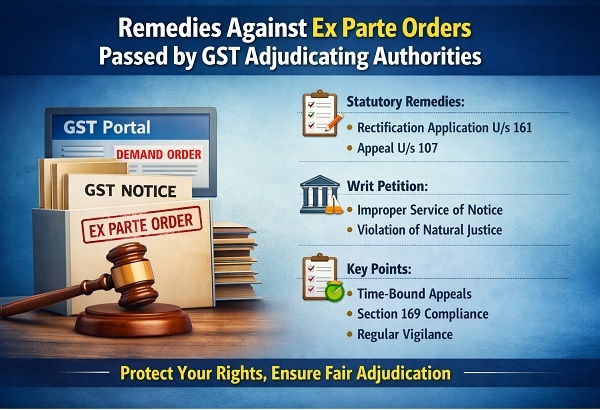
Remedy by Way of Writ Petition – Improper Service of Notice
Section 169 of the CGST Act, 2017 – Modes of Service
Section 169 prescribes multiple modes for valid service of notices, orders, and communications, including:
- Personal delivery or delivery through an authorized representative
- Registered post / speed post with acknowledgment
- Email to the registered email address
- Uploading on the GST common portal
- Publication in newspapers
- Affixture at the last known place of business or residence (as a last resort)
While uploading on the GST portal is a recognized mode, mere portal upload cannot be treated as sufficient service in every case, particularly when there is no response from the taxpayer.
Ground for Writ Petition
Where notices are only uploaded on the GST portal and no effort is made to adopt alternative modes of service, taxpayers may approach the jurisdictional High Court by filing a writ petition, contending that:
- There was no effective service as mandated under Section 169
- Principles of natural justice were violated
- The ex parte order is legally unsustainable
Judicial Precedents in Favour of the Taxpayer
Several High Courts have consistently held that effective service under Section 169 requires the department to explore alternative modes when there is no response from the taxpayer. In such cases, ex parte orders have been set aside and matters remanded for fresh adjudication, often subject to payment of a specified percentage of the demand.
Notable decisions include cases involving Nagappa Textiles, Sri Samy Agencies, M. Muthukumar Store, Sekar Stores, N Star Foods and Beverages, and Priya Safety Wears, among others.
In these matters, the Courts emphasized that procedural compliance under Section 169 is not a mere formality, and failure to ensure proper service vitiates the adjudication proceedings.
Service Through WhatsApp Held Invalid
In one significant appellate decision, the Court categorically held that service of notice through WhatsApp is not a recognized mode under Section 169 of the CGST Act and therefore cannot be treated as valid service.
Decisions Against the Assessee
Courts have also upheld ex parte orders where it was established that:
- Notices were duly sent to the registered email address of the taxpayer
- Such email communication constituted valid service under Section 169
Accordingly, relief was denied where the department successfully demonstrated compliance with statutory service requirements.
Conclusion
An ex parte GST order is not necessarily the end of the road for taxpayers. While statutory remedies are time-bound and limited, constitutional remedies remain available where procedural lapses—particularly improper service of notice—can be demonstrated.
That said, prevention is always better than cure. Regular monitoring of the GST portal, timely responses to notices, and proactive compliance can save taxpayers from avoidable litigation and financial exposure.








Greatly and precisely explained