E-Way Bill Mistakes That Can Stop Your Goods & Hit You With Heavy Penalties — Explained Simply!
The E-Way Bill system under Rule 138 of the CGST Rules is a crucial GST compliance tool, but even minor mistakes can trigger severe consequences, including detention, 200% tax penalties under Section 129, and even confiscation under Section 130. The most common and costly errors include moving goods without an EWB, entering incorrect vehicle or invoice details, allowing the EWB to expire in transit, failing to update Part B or vehicle changes, mismatches between invoices and EWBs, and not cancelling erroneous EWBs within 24 hours. Each mistake converts a valid EWB into “no EWB” under law, leading authorities to treat the movement as unauthorised. Errors often arise from data entry mistakes, transport delays, or weak internal coordination. The key takeaway: businesses must implement strict SOPs, real-time checks, and EWB monitoring controls to avoid avoidable penalties, detention, and disruption of supply chains.
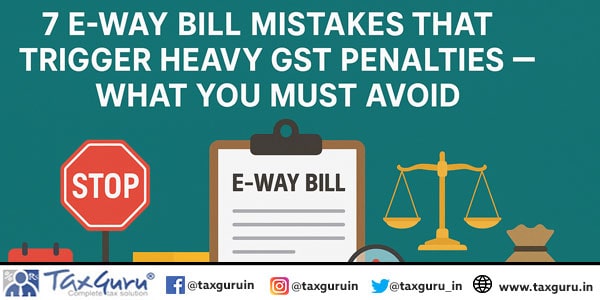
Below are the 7 most common and costly E-Way Bill mistakes, fully explained with legal references and real-time implications.
1. Moving Goods Without an E-Way Bill (Rule 138)
This is the most serious and frequently committed error. As per Rule 138(1), every registered person must generate an e-way bill for the movement of goods valued above ₹50,000.
Many taxpayers violate this unintentionally due to:
- Misjudging the value of the consignment
- Believing distance is too short
- Assuming return goods don’t need a fresh EWB
- Lack of internal communication between accounts and logistics teams
Why is this serious?
The law treats movement without EWB as potential tax evasion.
Penalty under Section 129:
- If owner comes forward → 200% of tax payable
- If owner does not come → 50% of the value of goods
And in repeated cases, Section 130 may apply — leading to confiscation of goods and vehicle.
2. Incorrect Vehicle Number or Wrong Details (Rule 138A)
An EWB is only valid if all details match perfectly during physical verification. A wrong vehicle number, HSN code, GSTIN, document number, or address — even a spelling mistake — can invalidate the EWB.
This mostly happens due to:
- Manual data entry errors
- Transcription mistakes by transporters
- Auto-fill or copy-paste errors
- Similar-looking vehicle numbers
Legal Impact:
Under GST, incorrect details = non-compliance with Rule 138 → treated as if EWB was never generated.
Thus, full Section 129 detention and penalty applies.
This is one of the most common reasons vehicles get stopped on highways.
3. E-Way Bill Expired in Transit (Rule 138(10))
EWB validity is linked to distance:
1 day for every 200 km or part thereof.
Goods may reach late due to:
- Traffic congestion
- Weather issues
- Vehicle breakdown
- Driver delays
- State border checking
Many businesses forget to extend EWB validity, even though Rule 138(10) allows extension 8 hours before or after expiry.
Impact of an expired EWB:
It becomes invalid, and the movement is treated as unauthorised → Section 129 detention + heavy penalties.
4. Invoice and E-Way Bill Mismatch — A Big Red Flag (Section 122 Read With Rule 138)
If the values, quantities, GSTINs, HSN codes, or addresses differ between the invoice and the EWB, officers treat it as a potential attempt to understate tax.
Most mismatches occur due to:
- Last-minute invoice changes not reflected in EWB
- Wrong HSN selection
- Wrong taxable value entered
- E-way bill generated based on draft invoice instead of final invoice
Legal Consequences:
- Penalty under Section 122(1)(i):
₹10,000 OR tax evaded — whichever is higher - If discrepancy appears significant, the officer may also detain goods under Section 129
This is why invoice–EWB reconciliation must be checked before dispatch.
5. Part B Not Updated Before Movement (Rule 138(5))
Part A contains invoice details, but Part B contains the vehicle number, which is mandatory before the goods start moving.
Businesses often generate Part A first and forget to update Part B after assigning the vehicle.
Common causes include:
- Last-minute vehicle changes
- Delay in receiving vehicle details from transporter
- Assuming Part A alone is sufficient (it’s NOT)
Legal Position:
As per Rule 138(5), Part B must be filled before the vehicle starts movement.
If not done, the EWB is treated as invalid, attracting full Section 129 penalties.
6.Not Cancelling Wrong EWB Within 24 Hours (Rule 138(9))
If an EWB is issued with mistakes (incorrect value, wrong consignee, wrong HSN), it should be cancelled within 24 hours.
Once the deadline passes, the incorrect EWB becomes a valid legal document, and discrepancies can be used against the taxpayer in case of verification.
Common reasons taxpayers forget to cancel:
- Assuming EWB will auto-expire
- Correction done in invoice but not in EWB
- Lack of internal SOPs
Legal Impact:
Under Section 122(1)(xiv), transporting goods without accurate documents attracts penalties.
Incorrect EWB = documentary non-compliance → liability under Section 122.
7. Not Updating EWB After Vehicle Change (Rule 138(5) & 138(5A))
During long-distance transportation, goods often shift to another vehicle due to:
- Breakdowns
- Driver change
- Transshipment hubs
- Use of smaller vehicles for local delivery
However, Rule 138(5A) requires that new vehicle details MUST be updated in the EWB portal before movement resumes.
If not updated:
- EWB becomes invalid
- Movement treated as unauthorised
- Goods & vehicle can be detained
- Penalties under Section 129 apply in full
This is especially common during interstate transport and is one of the top 5 reasons for roadside stoppages.