Denial of ITC for Seller’s Default: Legal Position Affirmed by the Supreme Court in Shanti Kiran India Pvt. Ltd.
A recurring issue in various matters has been that, at the time of the transaction, the selling dealer was duly registered with the Department, but the registration was cancelled subsequently. In such situations, two possibilities arise: either the seller may have already deposited the tax collected from the purchasing dealer before the cancellation of registration, or the seller may have defaulted in depositing the tax despite having collected it from the purchaser. This uncertainty often leads to disputes regarding the eligibility of the purchasing dealer to claim Input Tax Credit (ITC) when the seller’s compliance status changes after the transaction.
In the first possibility, where the selling dealer has duly deposited the tax collected from the purchasing dealer with the Department, there is ordinarily no dispute regarding the purchaser’s entitlement to claim ITC. However, it is noteworthy that in several cases, despite the tax having been deposited, the Department has issued show cause notices to the purchasing dealers and even passed adjudication orders denying ITC. Such orders have repeatedly been set aside by various High Courts, holding that once tax has been properly deposited and the transaction is genuine, the purchasing dealer cannot be penalised for circumstances beyond their control.
With respect to the second issue, which arose for consideration before the Delhi High Court, the question was whether the benefit of ITC could be granted to registered purchasing dealers who had paid tax to registered selling dealers in accordance with valid tax invoices, even though those selling dealers had subsequently failed to deposit the tax so collected with the Government. The core issue, therefore, was whether a bona fide purchaser should be denied ITC solely because the seller, despite being registered at the time of the transaction, defaulted in fulfilling its statutory obligation to remit the tax.
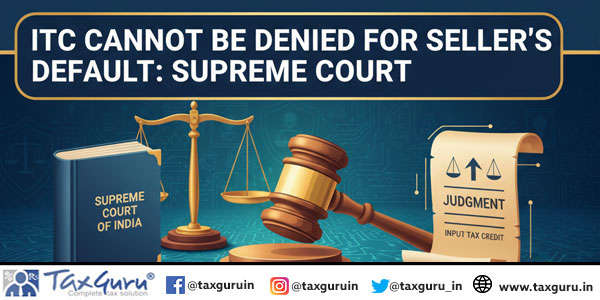
In this matter, the Delhi High Court directed that the benefit of ITC be granted to the purchasing dealers, holding that bona fide purchasers could not be denied ITC merely because the selling dealers failed to deposit the tax collected from them. This decision of the High Court was thereafter challenged before the Hon’ble Supreme Court in Commissioner, Trade and Taxes, Delhi vs. M/s Shanti Kiran India Pvt. Ltd., Civil Appeal No(s). 2042–2047 of 2015. The Apex Court, by its judgment dated 09.10.2025, upheld the view of the High Court and dismissed the appeals, affirming that ITC cannot be denied to genuine purchasing dealers when the seller was registered at the time of the transaction and the invoices were found to be valid.
The Hon’ble Supreme Court observed that there was no dispute regarding the fact that, on the date of the transactions in question, the selling dealers were duly registered with the Department. However, subsequent to the transactions, the registration of those selling dealers was cancelled, and they had defaulted in depositing with the Government the tax that they had collected from the purchasing dealers.
The Hon’ble Supreme Court has also considered the decision of the Hon’ble High Court of Delhi in On Quest Merchandising India Pvt. Ltd. vs. Government of NCT of Delhi and Ors., 2017 SCC On Line Delhi 13037 in the context of the provisions of Section 9(2) (g) of Delhi Value Added Tax Act, 2004. In this matter the Hon’ble High Court held that
“62. In light of the above legal position, the Court hereby holds that the expression ‘dealer or class of dealers’ occurring in Section 9 (2) (g) of the DVAT Act should be interpreted as not including a purchasing dealer who has bona fide entered into purchase transactions with validly registered selling dealers who have issued tax invoices in accordance with Section 50 of the Act where there is no mismatch of the transactions in Annexures 2A and 2B. Unless the expression ‘dealer or class of dealers’ in Section 9 (2) (g) is ‘read down’ in the above manner, the entire provision would have to be held to be violative of Article 14 of the Constitution.
63. The result of such reading down would be that the Department is precluded from invoking Section 9 (2) (g) of the DVAT to deny ITC to a purchasing dealer who has bona fide entered into a purchase transaction with a registered selling dealer who has issued a tax invoice reflecting the TIN number. In the event that the selling dealer has failed to deposit the tax collected by him from the purchasing dealer, the remedy for the Department would be to proceed against the defaulting selling dealer to recover such tax and not deny the purchasing dealer the ITC. Where, however, the Department is able to come across material to show that the purchasing dealer and the selling dealer acted in collusion then the Department can proceed under Section 40A of the DVAT Act.”
It is important to note that the decision of the Delhi High Court in On Quest Merchandising India Pvt. Ltd. was challenged before the Supreme Court in Special Leave to Appeal (Civil) No. 36750 of 2017. The Supreme Court, however, disposed of the SLP without interfering with the judgment of the High Court. As a result, the legal position laid down in On Quest Merchandising—that bona fide purchasing dealers cannot be denied ITC solely because the selling dealer failed to deposit the collected tax—stood affirmed.
Thus, the Hon’ble Supreme Court, in Commissioner, Trade and Taxes, Delhi vs. M/s Shanti Kiran India Pvt. Ltd., held that there was no dispute regarding the fact that the selling dealers were duly registered on the date of the transactions, and neither the genuineness of the transactions nor the validity of the invoices had been questioned on the basis of any inquiry. In these circumstances, the Court found no justification to interfere with the decision of the High Court, which had directed that the benefit of ITC be granted to the purchasing dealers after due verification.
Conclusion: This ruling may be considered an important precedent for GST matters. The Hon’ble Delhi High Court has categorically held that where the selling dealer fails to deposit the tax collected from the purchasing dealer, the proper remedy for the Department is to initiate proceedings against the defaulting selling dealer to recover the tax, rather than denying ITC to a bona fide purchasing dealer. However, the Court also clarified that if the Department is able to gather material indicating that the purchasing dealer and the selling dealer acted in collusion or engaged in fraudulent transactions, then the Department would be justified in proceeding against the purchasing dealer as well.