Income Tax : This guide explains when penalties can be imposed under various provisions of the Income-tax Act, 1961. It also outlines the appli...
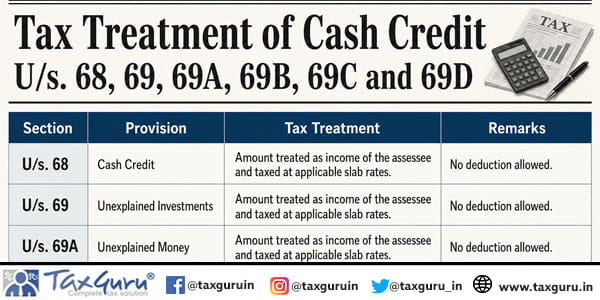
Income Tax : This guide explains how unexplained cash credits under Section 68 and related provisions can attract steep taxation under Section ...
Income Tax : Income without satisfactory explanation is taxed at a special high rate under Section 115BBE. The provisions place strict liabilit...
Income Tax : Courts have clarified that purchases cannot be disallowed without proper evidence. Genuine transactions supported by documents can...
Income Tax : ITAT held that section 69 cannot be invoked where purchases are duly recorded in books and paid through banking channels, making t...
Income Tax : The ITAT Mumbai held that Section 69C cannot be invoked where expenditure is duly recorded in the books and its source is fully ex...
Income Tax : ITAT Guwahati held that additions could not be sustained where the transactions related to a separate partnership firm with a diff...
Income Tax : The ITAT held that an untested third-party statement, without supporting evidence or cross-examination, cannot form the sole basis...
Income Tax : ITAT Ahmedabad held that repayment of the entire loan with TDS-compliant interest payments undermined the allegation that the loan...
Income Tax : ITAT Chennai held that loose sheets and estimates alone cannot justify an addition under Section 69B without independent corrobora...
Income Tax : CBDT has instructed tax officers to uniformly apply Sections 68 to 69D and Section 115BBE after a C&AG audit found inconsistencies...
The Tribunal held that assumption of jurisdiction under Section 153C was invalid due to a defective and consolidated satisfaction note. As the mandatory requirement of year-wise satisfaction was not met, the entire assessment was quashed.
The Tribunal held that failure to indicate the precise charge in a Section 274 notice renders penalty proceedings unsustainable. Following jurisdictional High Court rulings, the penalty was set aside.
The Tribunal condoned a 298-day delay in filing appeal, holding that substantial justice must prevail over technicalities. It deleted additions on exempt gratuity and commuted pension, ruling they cannot be taxed as salary.
The Tribunal ruled that Section 69A applies only when the assessee is found to be the owner of money or assets. Mere suspicion or digital communication cannot replace proof of possession or ownership.
The issue was whether purchases recorded by the assessee were genuine. The Tribunal held that seized Tally data and statements proved bogus purchases, justifying full addition.
Additions under Sections 68 and 69C were set aside after the Tribunal found the mandatory approval to be a mere formality. The ruling reinforces that Section 153D approval is not a procedural ritual.
The tribunal held that a purchase cannot be treated as bogus solely based on third-party allegations. Without independent verification by the Assessing Officer, the disallowance was held unsustainable.
ITAT Mumbai held that protective additions under Sections 68 and 69C cannot survive once substantive additions are confirmed in the hands of beneficiaries. The ruling prevents double taxation of the same income and limits misuse of protective assessments.
Additions based on survey-time valuation of machinery were deleted as the Assessing Officer had not rejected the books of account. Prior binding orders in the same case were followed, reaffirming settled law.
The ruling addressed conflicts between documentary proof of loans and third-party allegations of accommodation entries. The Tribunal held that unsupported allegations cannot override evidence establishing genuine loan transactions.