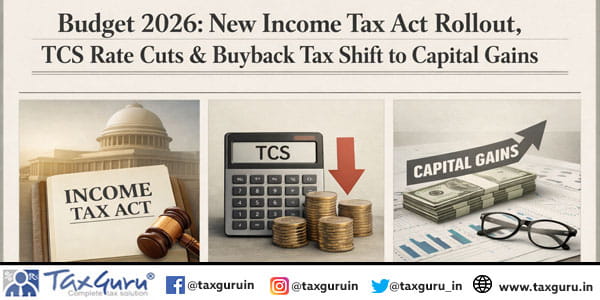
Income Tax : The Income-tax Act, 2025 replaces the dividend-based taxation of buy-backs with capital gains taxation for ordinary shareholders, ...
Income Tax : This guide explains when NRIs should use Form 128 and when payers should use Form 129 to reduce or eliminate excess TDS. It also c...
Income Tax : Sections 356-374 restructure appellate provisions with clearer drafting while retaining the existing appeal hierarchy and taxpayer...
Income Tax : Section 270 of the Income-tax Act, 2025 consolidates return processing and scrutiny assessment into one framework while introducin...
Income Tax : The law permits reassessment only where the Assessing Officer has information indicating escaped income and follows the prescribed...
Finance : The Government has exempted interest and capital gains earned by FPIs on Government securities from income tax with effect from 1 ...
Income Tax : A representation has urged CBDT to merge TDS return codes 1023 and 1024, arguing that both apply to the same contract payments wit...
Income Tax : Association requested CBDT to rationalize CASS 2026 case selection considering the administrative burden caused by implementation ...
Income Tax : The updated TDS challan system reportedly displays incorrect interest-related options under the Company Deductee category. Taxpaye...
Income Tax : The issue was complexity in the existing tax law. It was clarified that the new Act simplifies structure by reducing sections and ...
Income Tax : The Supreme Court set aside the NCLAT order for relying on a non-existent quasi-judicial income tax order. The key takeaway is tha...
Income Tax : Rule 81 prescribes dataset construction, weighted averages, and a 35th–65th percentile arm’s length range when multiple compar...
Income Tax : The latest amendment excludes income arising from transfer of pre-2017 investments from GAAR scrutiny. It reinforces the protectio...
Income Tax : The Finance Act, 2026 prescribes income-tax rates, surcharge, and cess for the assessment year 2026–27. It establishes the legal...
Income Tax : The circular introduces mandatory Form I and Form II for SWFs to claim tax exemptions. The ruling ensures structured application a...
Income Tax : The notification requires payers to generate UINs and file quarterly details of declarations even where no tax is deducted. It enh...
Income Tax : CBDT introduced Income-tax Rules, 2026 to operationalize the Income-tax Act, 2025. The rules standardize procedures on valuation, ...
Rule 111 of the Draft Income-tax Rules, 2026 permits rollback of Advance Pricing Agreements to earlier years subject to strict conditions, but disallows it where appellate orders exist or income is reduced.
Rule 110 of the Draft Income-tax Rules, 2026 clarifies that Advance Pricing Agreements are binding only if critical assumptions and conditions remain unchanged, and may be revised or cancelled upon material change.
Draft Rule 109 of the Income-tax Rules, 2026 lays down a detailed, time-bound procedure for processing Advance Pricing Agreement applications, including consultation, enquiry, agreement finalisation, and conditions for closure without refund.
Draft Rule 108 of the Income-tax Rules, 2026 establishes a structured deficiency review process for Advance Pricing Agreement applications, allowing correction of defects and providing for refund of fees if the application is rejected.
Draft Rules 103 to 107 of the Income-tax Rules, 2026 define key expressions, eligibility, consultation, application, and withdrawal procedures for Advance Pricing Agreements to provide structured and transparent APA implementation.
Draft Rules 101 and 102 of the Income-tax Rules, 2026 prescribe the procedure for opting safe harbour in income attribution cases and clarify that taxpayers cannot invoke Mutual Agreement Procedure once the option is validly exercised.
Rule 100 mandates minimum profit margins of 4% and 2% for specified businesses to qualify for safe harbour, while restricting deductions and loss set-offs to ensure certainty and simplified taxation.
Rule 99 defines eligible assessees, businesses, goods, and gross receipts for safe harbour in income attribution cases, covering foreign diamond miners and electronics manufacturing through custom bonded warehouses.
Rule 98 introduces a structured filing, verification, and appeal mechanism with strict timelines, ensuring deemed acceptance of safe harbour for specified domestic transactions if authorities fail to act within prescribed periods.
Rule 97 allows automatic acceptance of transfer prices for specified domestic transactions where electricity tariffs are regulator-approved and milk pricing is quality-based and transparent, eliminating comparability adjustments.