

Reverse Charge Mechanism on GTA and Renting Transactions under GST – A Practical Guide for Taxpayers, GTAs, Landlords and Professionals
1. Concept and Legal Framework of RCM
Under the normal GST mechanism, the supplier charges GST on the invoice and discharges the tax, while the recipient takes input tax credit (ITC) subject to section 16 conditions. Under Reverse Charge Mechanism (RCM), this liability to pay GST is shifted from supplier to recipient for specified categories of services or specified situations notified under section 9(3) and section 9(4) of the CGST Act and section 5(3) of the IGST Act.
RCM applies only where the underlying supply is taxable; if the supply is exempt, nil‑rated or non‑taxable, RCM does not arise. Once a recipient is liable to pay tax under RCM, all provisions relating to registration, time of supply, payment, interest, late fee and penalty apply to that recipient as if he were the supplier.
Key legal instruments include:
- Section 9(3), CGST Act – empowers Government to notify services on which tax is payable by the recipient.
- Section 9(4), CGST Act – RCM on specified supplies received from unregistered persons, now restricted through notifications.
- Notification No. 13/2017‑Central Tax (Rate), dated 28‑06‑2017, as amended up to 2025 – the main list of services under RCM (GTA, legal services, Government renting, motor vehicle renting, security services, etc.).
In practice, for purposes of this article, the most relevant RCM entries are GTA, renting of immovable property, and renting of motor vehicles.
2. RCM on Goods Transport Agency (GTA) Services
2.1 Who is a GTA?
“Goods Transport Agency” is defined in GST rate notifications as a person who provides service in relation to transport of goods by road and issues a consignment note. Only the person issuing the consignment note is treated as GTA; mere truck owners who do not issue consignment notes are not GTAs, and their services are generally outside the GTA‑RCM entry.
Notification 13/2017 specifies that where services are supplied by a GTA in respect of transport of goods by road, tax is payable under RCM by the recipient if the recipient falls under certain classes and the GTA is not paying tax under forward charge.
2.2 Notified recipients for GTA RCM
RCM is attracted when all of the following conditions are satisfied:
- Supplier: GTA (consignment note issued).
- Supply: Transport of goods by road in a goods carriage.
- Recipient, located in taxable territory, is one of:
- A factory under the Factories Act.
- A society registered under the Societies Registration Act.
- A co‑operative society.
- Any person registered under GST.
- A body corporate.
- A partnership firm (registered or not).
- A casual taxable person.
If the recipient does not fall in the above list (for example, an individual unregistered consumer), RCM is not attracted; the GTA is liable under forward charge if otherwise taxable and registered.
2.3 GTA choosing forward charge vs RCM route
Rate notifications allow GTA to opt to pay GST under forward charge at specified rates (e.g., 12% with full ITC, or 5% with conditions) by exercising an annual option. Where the GTA has validly exercised the option to pay tax under forward charge, the corresponding RCM entry in Notification 13/2017 does not apply, and the recipient has no RCM liability.
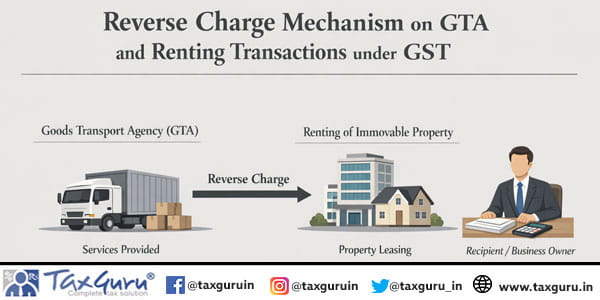
This makes the GTA’s choice of tax scheme crucial for recipients: if GTA is on forward charge, recipient only takes ITC; if GTA is under RCM route, recipient must self‑pay tax under RCM and then take ITC.
2.4 Practical examples – GTA RCM
Example 1 – Registered trader in Karnataka
- A registered trader in Mysuru hires a GTA to transport goods from Bengaluru to Mysuru.
- Freight: ₹50,000.
- GTA has not opted for forward charge and does not charge GST on invoice, but issues a consignment note.
- Recipient is a registered person (notified category).
RCM liability:
- Taxable value: ₹50,000.
- GST rate: 5% (2.5% CGST + 2.5% SGST).
- Tax payable in cash under RCM: ₹2,500 CGST + ₹2,500 SGST.
The trader can claim ITC of ₹5,000 in the same or subsequent period, subject to section 16 conditions (receipt of service, tax actually paid, etc.).
Example 2 – Individual unregistered shifting household goods
- An unregistered individual hires a GTA to shift household goods.
- GTA issues consignment note.
- Recipient is not one of the notified categories and is unregistered.
Result:
- RCM does not apply to the individual.
- If the GTA is registered and liable, GTA pays GST under forward charge; if GTA is below threshold, the supply may remain outside GST.
2.5 Case law pointer – “Two GTAs” controversy
In Liberty Translines, in re (AAAR Maharashtra), it was argued whether there could be two GTAs for the same transportation, with both issuing consignment notes. The authorities concluded that the appellant’s activity did not qualify as GTA service under the relevant SAC and effectively rejected the concept of “two GTAs” for a single transportation, reinforcing that only the person actually providing transportation and issuing the consignment note is to be treated as GTA for RCM.
3. RCM on Renting of Immovable Property and Motor Vehicles
RCM on “renting” creates maximum confusion because multiple entries exist: Government renting of immovable property, renting of motor vehicles to body corporates, and more recent changes on renting of commercial property by unregistered persons.
3.1 Government renting of immovable property to registered person
Notification 13/2017, as amended by Notification 3/2018, inserted entry “5A” for services supplied by Central/State Government, Union territory or local authority by way of renting of immovable property to a registered person. In such cases:
- Supplier: Government, local authority or similar public body.
- Recipient: Any person registered under GST (subject to specific exclusions).
- Liability: GST payable by recipient under RCM.
Example 3 – State corporation renting industrial shed
- A State Industrial Development Corporation (Government entity) rents an industrial shed to a registered manufacturing unit.
- Monthly rent: ₹1,00,000.
RCM liability:
- Tax rate: 18% (9% CGST + 9% SGST).
- Tax payable in cash by recipient: ₹18,000.
The manufacturing unit may claim ITC of ₹18,000 if the shed is used for taxable business activities and all ITC conditions are met.
3.2 Renting of commercial and residential property – recent changes
Subsequent council decisions and notifications have widened RCM in renting cases:
- Commercial property:
- Historically, renting of commercial property by a registered landlord to any person attracted GST under forward charge.
- Following recommendations in the 54th GST Council meeting (September 2024), if an unregistered person rents commercial property to a registered person, RCM applies from 01‑10‑2024 and the registered tenant is liable to pay GST.
- Residential property:
- Renting for residential use was generally exempt initially.
- With later changes, where a registered business entity takes a residential property on rent for business/commercial purposes, GST is applicable under RCM and the tenant (registered person) pays the tax.
- If a property is rented to an unregistered person for residential purposes, or used as own residence, GST is typically not levied.
These developments mean that both commercial and certain residential rentals can fall under RCM depending on landlord’s registration status and nature of use.
3.3 Ordinary private landlord–tenant cases (forward charge)
Where a private registered landlord rents commercial property to any person (registered or not) and no specific RCM notification applies, tax is payable under forward charge by the landlord. RCM primarily targets Government/local authority renting to registered persons and, with effect from the notified date, unregistered landlords letting commercial property to registered tenants.
3.4 Renting of motor vehicles to body corporates
Notification 13/2017, as amended by Notification 22/2019, provides RCM for renting of motor vehicles used to carry passengers, including fuel cost, supplied to body corporates in specified situations. RCM applies when:
- Supply: Renting of motor vehicle designed to carry passengers.
- Supplier: Any person other than a body corporate.
- Recipient: Body corporate located in taxable territory.
- Supplier has not charged GST at 12% (6% CGST + 6% SGST) under forward charge.
In such cases, recipient pays GST under RCM, typically at 5% (2.5% CGST + 2.5% SGST).
Example 4 – Motor cab to company (RCM)
- An individual cab operator rents a car with driver to XYZ Ltd., a body corporate, for staff movement.
- Rent: ₹60,000 per month, no GST charged.
- Vehicle is used to carry passengers; supplier is not a body corporate; no 12% charged.
Result:
- XYZ Ltd. liable under RCM at 5% = ₹3,000.
ITC will usually be restricted under section 17 if used for employee transportation and not covered by allowed exceptions.
Example 5 – Corporate lessor – no RCM
- A leasing company (body corporate) rents vehicles to ABC Ltd. (body corporate).
- Since supplier is a body corporate, the RCM entry (which requires supplier other than body corporate) is not triggered.
- GST is payable by the leasing company under forward charge, and ABC Ltd. may take ITC subject to eligibility.
4. Registered vs Unregistered Recipient – Who Bears RCM and Registration Impact
RCM entries under section 9(3) apply regardless of whether the recipient is otherwise liable to registration; if a person receives notified supplies covered by RCM and is liable to pay tax, he is mandatorily required to obtain registration under section 24 of the CGST Act.
Broadly:
- Registered recipient in notified category: Must pay RCM using cash ledger, then can usually avail ITC (subject to section 16 and 17).
- Unregistered recipient in notified category (e.g., partnership firm or body corporate otherwise below threshold): Compulsory registration is triggered by liability under RCM; thereafter, RCM must be discharged.
- Unregistered recipient outside notified category (e.g., individual hiring GTA for household shifting): Not liable to pay RCM; economic burden, if any, lies with GTA under forward charge or remains outside GST.
Economically, parties may contractually agree who ultimately bears the cost (for example, tenant reimbursing landlord for RCM), but legal liability under GST remains with the person specified in the notification.
5. Reporting of RCM in GSTR‑3B and GSTR‑1, with Practical Editing
5.1 RCM in GSTR‑3B
RCM tax must be paid in cash; ITC balance cannot be used to pay RCM itself, though ITC can be taken afterwards. In GSTR‑3B:
- Table 3.1(d) – “Inward supplies (liable to reverse charge)”
- Report taxable value and tax for all inward supplies on which recipient is liable under RCM (GTA, Government renting, motor vehicle renting, etc.).
- Payment – Tax is offset from electronic cash ledger at the time of filing.
ITC of RCM tax paid:
- Table 4(A) – Eligible ITC
- Normally shown under “All other ITC” or the relevant sub‑head for services.
Practical example – Monthly working for ABC Pvt. Ltd.
Assume for April:
- GTA freight (RCM): ₹4,00,000.
- Government rent of industrial shed: ₹1,00,000.
- Motor cab rentals (RCM case): ₹60,000.
Working:
- GTA @ 5% = ₹20,000 (CGST ₹10,000 + SGST ₹10,000).
- Government rent @ 18% = ₹18,000 (CGST ₹9,000 + SGST ₹9,000).
- Motor cab @ 5% = ₹3,000 (CGST ₹1,500 + SGST ₹1,500).
GSTR‑3B (3.1(d)):
- CGST: ₹10,000 + ₹9,000 + ₹1,500 = ₹20,500.
- SGST: ₹10,000 + ₹9,000 + ₹1,500 = ₹20,500.
Total RCM tax payable in cash: ₹41,000.
ITC:
- GTA and Government rent – ITC generally allowed if used for business.
- Motor cab – ITC may be blocked if for employee transportation.
Thus, ABC Pvt. Ltd. may claim ITC of ₹38,000 and treat ₹3,000 as cost if ITC on cab rentals is ineligible.
5.2 Whether RCM appears in GSTR‑1
GSTR‑1 is a statement of outward supplies; inward supplies under RCM are not reported by recipient in GSTR‑1. However:
- Suppliers of RCM‑notified services (e.g., GTA under RCM route, Government renting) report the outward supplies in their own GSTR‑1.
- While reporting, they typically tick “reverse charge – yes” or the relevant field to indicate that tax is payable by recipient.
Self‑invoices under section 31(3)(f) for notified supplies from unregistered persons (where 9(4) applies) are for documentation and ITC and are not outward supplies for GSTR‑1.
5.3 Editing RCM errors in GSTR‑3B
Common situations:
1. RCM short‑paid or omitted in past period
-
- Taxpayer should pay the missing RCM tax with interest.
- This can be done either by:
- Adding the taxable value and tax in a subsequent GSTR‑3B under 3.1(d), or
- Using Form DRC‑03 for voluntary payment.
- ITC can generally be taken when tax is paid, subject to section 16(4)-time limits and other conditions.
2. RCM excess reported by mistake
-
- Excess can be adjusted in a subsequent GSTR‑3B by reducing reported reverse charge value/tax in 3.1(d), or reconciled through annual return with proper workings.
- Where ITC was also taken, reverse ITC if underlying liability did not exist.
3. Tax paid under RCM but ITC not claimed
-
- ITC can be claimed in a later return as long as within the statutory time limit (currently the due date of 30 November of the following year or such date as notified) and subject to all conditions.
For audit trail, maintain a separate RCM working paper showing month‑wise transactions, liability computation, payments and ITC claims.
6. Interest, Penalties and Consequences for Non‑payment of RCM
Non‑payment or short‑payment of RCM is treated like any other tax default.
6.1 Interest under section 50
Interest at 18% per annum is payable for delay in payment of tax, including RCM, from the due date (usually 20th of the following month) until the date of payment. A simple working formula is:
Example 6 – Interest on delayed GTA RCM
- RCM liability on GTA for April: ₹10,000.
- Due date: 20 May.
- Actual payment: 19 June (30 days delay).
Interest ≈ ₹10,000 × 18% × 30/365 ≈ ₹148.
6.2 Penalty under sections 73 and 74
If RCM non‑payment is identified during scrutiny, audit or investigation:
- Section 73 (non‑fraud cases):
- Tax plus interest, plus penalty up to 10% of tax or ₹10,000, whichever is higher, if tax remains unpaid beyond specified timelines.
- Section 74 (fraud/suppression cases):
- Tax plus interest, plus penalty up to 100% of tax in cases involving fraud, willful misstatement or suppression.
Additionally, late fees for GSTR‑3B or GSTR‑1 apply if returns themselves were filed late, though late fee is for late filing, not for non‑payment of RCM per se.
6.3 ITC on belated RCM payments
Late payment of RCM does not automatically entitle ITC; ITC is admissible only if all statutory conditions are satisfied, including possession of documents, receipt of services, payment of tax, and compliance with the outer time limit. In litigation, departments may contest very late ITC on old RCM liabilities, so documentation and timing are important.
7. Practical Compliance Checklists
7.1 For businesses receiving GTA services
- Confirm whether the transporter is actually a GTA (consignment note issued).
- Check if you fall in the notified recipient categories.
- Obtain a declaration or copy of rate notification option from GTA to know whether GTA is under forward charge or RCM route.
- Maintain a monthly RCM register for freight bills, with separate columns for taxable value, GST rate, tax, payment date, and ITC claim.
- Ensure entries are correctly made in GSTR‑3B (3.1(d) and ITC column) and that ITC is not taken on blocked credits under section 17.
7.2 For landlords and tenants (including Government entities)
- Where landlord is Government/local authority and tenant is registered, treat rent as RCM and ensure tenant pays tax.
- From 01‑10‑2024, when an unregistered person rents commercial property to a registered person, examine RCM applicability; tenant may have to pay GST.
- For private registered landlords, in normal commercial renting, tax is under forward charge; landlord collects GST and pays, and tenant takes ITC if eligible.
- Lease agreements should clearly spell out whether GST is extra, who will pay RCM where applicable, and how tax will be reimbursed, though statutory liability remains as per notification.
7.3 For body corporates availing motor vehicle rentals
- Map all car hire/employee transportation contracts and identify suppliers who are not body corporates.
- Check invoices: if suppliers do not charge 12% (6% CGST + 6% SGST) and conditions of Notification 22/2019 are satisfied, compute RCM at 5%.
- Evaluate ITC eligibility carefully; many employee transportation services are hit by section 17 ITC blocks and RCM tax may have to be expensed.
8. Summary Comparison – Who Pays GST in Key RCM Situations
| Scenario | Supplier | Recipient | Who pays GST | Basis |
| GTA service to registered trader with GTA under RCM route | GTA (issues CN) | Registered person, notified category | Recipient under RCM @ 5% | Notif. 13/2017, GTA |
| GTA service to individual shifting house | GTA | Unregistered individual, non‑notified | GTA (if registered) or no GST | Notif. 13/2017 scope |
| Government renting industrial shed to registered unit | Govt./local authority | Registered person | Recipient under RCM @ 18% | Entry 5A, Notif. 13/2017 as amended |
| Private registered landlord renting shop to registered tenant | Registered landlord | Registered tenant | Landlord under forward charge | Renting of commercial property rules |
| Unregistered landlord renting commercial property to registered tenant (from 01‑10‑2024) | Unregistered person | Registered person | Tenant under RCM | Council 54th meeting, later notification. |
| Individual cab operator renting car to company (no 12% charged) | Non‑corporate | Body corporate | Company under RCM @ 5% | Notif. 22/2019, motor vehicle entry. |
| Corporate car leasing company renting cars to company | Body corporate | Body corporate | Supplier under forward charge | Supplier‑type condition. |
9. Conclusion
Reverse Charge Mechanism has moved from being a niche technical provision to a routine compliance area that touches almost every registered business availing GTA services, Government or commercial premises on rent, and motor vehicle rentals. The legal liability for tax, interest and penalty always follows the person identified in Notification 13/2017 and its amendments, irrespective of how parties apportion cost contractually.
For GTA, the key determinant is whether the recipient falls within the notified categories and whether the GTA has opted for forward charge or RCM route; a simple mis‑classification can result in large unpaid RCM exposures over multiple years. For renting transactions, practitioners must carefully distinguish Government renting, commercial property renting by unregistered persons to registered tenants, and ordinary private renting, and also factor in recent council‑driven changes for commercial and residential properties.
Professionals should institutionalise monthly RCM working notes, maintain documentation like consignment notes, lease agreements, and declarations, and periodically review earlier periods to detect missed RCM liability and regularise them through DRC‑03 before departmental action. Proper understanding and communication of RCM rules among taxpayers, GTAs and landlords will significantly reduce disputes and interest/penalty costs and will help clients remain compliant in a legally robust manner.

Author Bio



Sir, GTA issuing CN/LR and billing under RCM or some cases giving vehicles on hire to GTA.
Turnover crossed above 5Cr. E-invoicing is not applicable as per Notification No. 13/2020-Central Tax, read with Rule 54(3) of CGST Rules, 2017. is this correct GTA exempted unnder e-invoicing.
Sir, in the summarised comparison chart, the headings were missed. Kindly provide each columns headings to understand further better manner. Thqs.
Kindly check now
***
Thank you for your observation regarding the summarised comparison chart headings.
In the article, the comparison chart already contains column headings, which are as follows:
| Scenario | Supplier | Recipient | Who pays GST | Basis |
– **Scenario** – Describes the fact pattern (e.g., GTA to registered person, Govt renting to registered tenant, etc.).
– **Supplier** – Indicates who is providing the service (GTA, Government, private landlord, cab operator, leasing company, etc.).
– **Recipient** – Indicates who is receiving the service (registered person, body corporate, unregistered individual, etc.).
– **Who pays GST** – Clarifies whether tax is payable under reverse charge by the recipient or under forward charge by the supplier.
– **Basis** – Mentions the relevant notification / legal entry relied on.
However, I appreciate that in some printed or PDF layouts the headings may not stand out at first glance. In future versions, I will ensure stronger visual emphasis (for example, bold formatting or a brief caption above the table) so that readers can immediately recognise these as column headings.
***