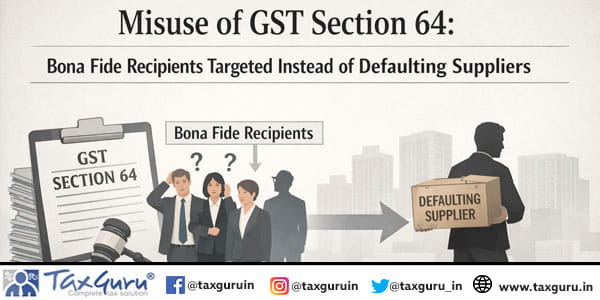
Section 64 is being misused in some cases to target bona fide recipients instead of focusing on defaulting suppliers
Section 64 is being misused in some cases to target bona fide recipients instead of focusing on defaulting suppliers, despite strong judicial trends protecting genuine purchasers and ITC. Courts have repeatedly held that honest buyers cannot be punished for supplier‑side non‑compliance when they meet section 16 conditions.
Section 64: legal framework and purpose
- Section 64 allows summary assessment in certain special cases where there is clear evidence of tax liability and delay is likely to adversely affect revenue, with prior written approval of AC/JC.
- Rule 100(3) mandates that such order is passed in ASMT‑16, meant as an emergency, protective measure, not a substitute for regular sections 73/74 adjudication.
How department is misusing it against recipients:
- In some matters, officers invoke section 64 against recipients merely because the supplier has not paid tax or registration is later cancelled, even though:
- Recipient holds proper tax invoice, has received goods/services, paid consideration plus tax, and has complied with section 16 documentation.
- This treats bona fide recipients on par with fraudulent players and uses 64 as a “shortcut” to fast‑track demand and recovery, ignoring other tools like: suspension/cancellation of supplier registration, blocking credit of suspect parties, and regular 73/74 proceedings against the supplier.
Key case‑law protecting bona fide recipients (ITC):
These cases are mostly on section 16 ITC, but the ratio is directly usable to attack arbitrary 64 action against recipients:
- Tripura High Court – bona fide purchaser not liable for supplier’s default (2026): Held that ITC cannot be denied to a bona fide purchaser merely because the supplier failed to deposit GST; section 16(2)(c) must be read down to apply only to collusive/fraudulent transactions, not genuine ones.
- Gauhati High Court – McLeod Russel India Ltd (2025): Read down section 16(2) (aa), holding that bona fide purchasers must be given fair opportunity to prove genuineness and ITC cannot be denied solely due to supplier’s failure to file GSTR‑1 or mismatches; penalising buyers for supplier lapses is arbitrary and causes impermissible double taxation.
- Recent HC decisions compiled in Centax/Taxmann: Multiple judgments hold that ITC cannot be denied to genuine buyers merely because the supplier did not upload invoices or deposit GST, especially when buyer has valid invoices, proof of payment and receipt of goods.
These principles, though framed in ITC context, strongly support the argument that drastic measures like summary assessment under section 64 against a bona fide recipient are disproportionate and unconstitutional where there is no fraud or collusion.
Why using section 64 on bona fide purchasers is legally vulnerable:
- Section 64 is designed for immediate revenue risk situations (fly‑by‑night operators, smuggled/unaccounted goods, perishable stock etc.), not for routine ITC disputes based on supplier’s non‑payment or retrospective cancellation.
- When a recipient satisfies section 16 conditions (invoice, receipt of goods, tax charged, due diligence), courts say burden cannot be indefinitely shifted onto the buyer to ensure supplier’s deposit of tax; using section 64 to crystallise demand in such cases amounts to punishing the buyer for conduct outside their control and leads to double taxation.
Strategy and drafting suggestions to counter section 64 action:
If ASMT‑16 has been issued against a bona fide recipient, a layered approach can be used:
1. Immediate statutory remedy
- File ASMT‑17 within 30 days seeking withdrawal of the summary assessment, highlighting:
- No “immediate adverse effect on revenue” justifying section 64; dispute is only on ITC linked to supplier default.
- Recipient’s full compliance with section 16 (invoices, e‑way bills, GRN, payment proofs, ledger, stock movement etc.).
- Availability of other effective measures against the supplier (73/74, recovery, registration cancellation) showing 64 is misused as shortcut.
2. Grounds for appeal / writ (draft themes):
In an appeal (APL‑01) or writ (where maintainable), typical grounds can include:
- Jurisdictional misuse of section 64:
- No contemporaneous material establishing immediate revenue risk; at best, it is a standard ITC dispute which must follow 73/74 with SCN and hearing.
- Non‑application of mind to pre‑conditions of 64; AC/JC approval mechanical or not recorded.
- Violation of protection to bona fide purchasers:
- Rely on Tripura HC and Gauhati HC decisions reading down section 16(2) / 16(2) (aa): bona fide purchasers with valid documentation and payment of tax cannot be denied ITC merely due to supplier default; applying 64 to them is arbitrary and offends Articles 14 and 19(1)(g).
- Emphasise that the department is effectively recovering tax twice on the same transaction (from supplier via DRC plus from recipient through 64), which courts have criticised as double taxation and contrary to GST design.
- Disproportionate and arbitrary use of drastic power:
- Section 64 is an exceptional, drastic power and cannot be invoked as routine or to avoid regular adjudication; professional literature and HC observations describe it as a “protective” measure for special cases only.
- For a registered, traceable, compliant recipient, there is no risk of revenue loss warranting summary assessment; department has enough time and tools to issue SCN under section 73/74 instead of invoking 64.
- Natural justice and evidentiary defects:
- Challenge non‑speaking ASMT‑16 orders, absence of clear computation, and failure to consider documents proving bona fide conduct.
- Argue that denying ITC or raising liability without considering buyer’s bona fides contradicts HC direction to give buyers opportunity to prove genuineness before adverse action.
3. Practical compliance and documentation:
To strengthen your “bona fide recipient” position in all such disputes:
- Maintain full chain of documents: tax invoices, e‑way bills, transport proofs, GRN, stock records, payment proofs, GST registration status of supplier at the time of supply.
- Show due diligence: basic checks on supplier GSTIN, GST returns status at the time, and any correspondence chasing the supplier to comply (emails, notices) to demonstrate absence of collusion.
If you share the specific ASMT‑16, period involved, nature of supplier default and your document set, a more precise set of grounds and a draft paragraph‑wise reply/appeal can be structured around these principles and case‑laws.