The Hon’ble Allahabad High Court, in Shubhangi Gupta vs. State of U.P. and Others, Writ Tax No. 4222 of 2025, decided on September 4, 2025, addressed the issue of GST proceedings initiated against a deceased individual.
Relying on the principles laid down in Amit Kumar Sethia (Deceased) vs. State of U.P. and Another, Writ Tax No. 917 of 2025 (decided on April 2, 2025 [Neutral Citation No. 2025:AHC:45317-DB]), the Hon’ble Court held that the entire show cause notice and the impugned order passed under Section 74 of the Act cannot be sustained. The relevant paragraphs of the said judgments are provided below:-
“6. Undisputed facts are that the show cause notice, reminders and determination of tax have been made after the death of the proprietor of the firm. Provisions of Section 93 of the Act, insofar as relevant, reads as under:
“93. Special provisions regarding liability to pay tax, interest or penalty in certain cases:
(1) Save as otherwise provided in the Insolvency and Bankruptcy Code, 2016 (31 of 2016), where a person, liable to pay tax, interest or penalty under this Act, dies, then –
(a) if a business carried on by the person is continued after his death by his legal representative or any other person, such legal representative or other person, shall be liable to pay tax, interest or penalty due from such person under this Act; and
(b) if the business carried on by the person is discontinued, whether before or after his death, his legal representative shall be liable to pay, out of the estate of the deceased, to the extent to which the estate is capable of meeting the charge, the tax, interest or penalty due from such person under this Act, whether such tax, interest or penalty has been determined before his death but has remained unpaid or is determined after his death.”
7. A perusal of the above provision would reveal that the same only deals with the liability to pay tax, interest or penalty in a case where the business is continued after the death, by the legal representative or where the business is discontinued, however, the provision does not deal with the fact as to whether the determination at all can take place against a deceased person and the said provision cannot and does not authorise the determination to be made against a dead person and recovery thereof from the legal representative.
8. Once the provision deals with the liability of a legal representative on account of death of the proprietor of the firm, it is sine qua non that the legal representative is issued a show cause notice and after seeking response from the legal representative, the determination should take place.
9. In view thereof, the determination made in the present case wherein the show cause notice was issued and the determination was made against the dead person without issuing notice to the legal representative, cannot be sustained.
10. Consequently, the writ petition is allowed. The order dated 17.11.2023 (Annexure-1 to the writ petition) is quashed and set aside. The respondents would be free to take appropriate proceedings in accordance with law.”
The petitioner, Shubhangi Gupta, is the wife of the late Ankur Gupta, who was the proprietor of M/s Modern Steel Traders. Ankur Gupta passed away on February 21, 2019. Following his death, Shubhangi Gupta applied for the cancellation of the GST registration, which was granted on July 8, 2019. Despite this, the authorities issued multiple show cause notices and assessment orders under Section 74 of the Uttar Pradesh Goods and Services Tax Act, 2017, for periods ranging from October 2017 to March 2018, directed at the deceased proprietor.
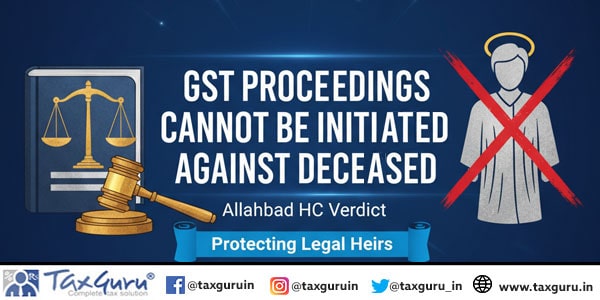
The Court emphasized that proceedings cannot be initiated against a person who is deceased, and consequently, they cannot be initiated against the legal heirs or the estate of the deceased. However, the authorities may proceed in a proper manner against the legal representatives or heirs of the deceased proprietor. Having failed to do so, all proceedings initiated from the stage of the show cause notice are invalid and bad in law.
This means that if the GST authorities want to recover tax or take action, they cannot directly target the deceased person. Instead, they must follow proper legal procedures to deal with the legal heirs or representatives of the deceased. For example, they might issue notices to the person legally handling the deceased’s estate, rather than issuing notices in the deceased person’s name. Since the authorities issued notices and started proceedings against the deceased person directly, without following the correct procedure, everything they did from that point is legally invalid. In other words, the GST actions like the show cause notice and subsequent assessment have no legal effect and cannot be enforced.
Conclusion
The judgment serves as a crucial reminder that tax authorities cannot bypass legal formalities. Any attempt to proceed against a deceased person without involving their legal heirs correctly will render the proceedings null and void. Tax authorities must carefully follow legal channels to ensure that proceedings are valid and enforceable.
*****
Disclaimer: Nothing contained in this document is to be construed as a legal opinion or view of either of the author whatsoever and the content is to be used strictly for informational and educational purposes. While due care has been taken in preparing this article, certain mistakes and omissions may creep in. the author does not accept any liability for any loss or damage of any kind arising out of any inaccurate or incomplete information in this document nor for any actions taken in reliance thereon.