
What to Do When an Adverse GST Order is Passed (A Practical Step-by-Step Guide for Filing and Preparing an Appeal under GST Law)
Introduction
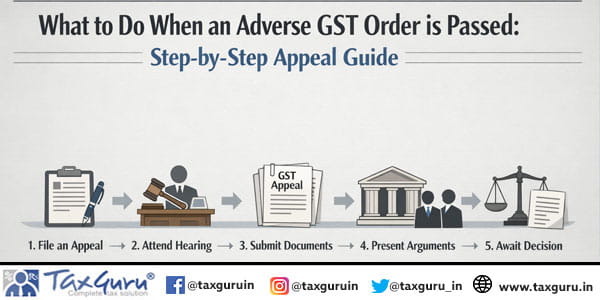
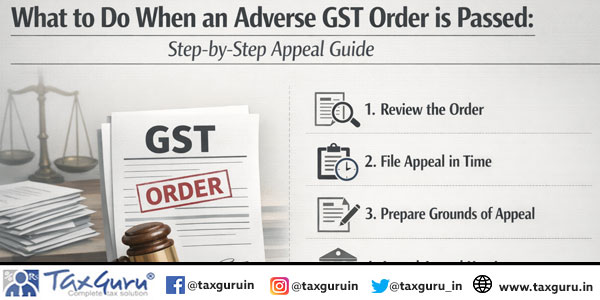
When an adverse GST order is received, the first and most important thing is to remain calm and not panic. Such orders are not final, and the law provides a clear right to challenge them through rectification or appeal. In many cases, adverse orders are passed due to non-consideration of replies, misunderstanding of facts, or lack of proper verification of records. These issues can be corrected by carefully reviewing the order and taking appropriate legal steps within the prescribed time. With proper preparation, supporting documents, and a well-drafted appeal, the assessee has a fair opportunity to get relief from the appellate authority.
An adverse order under the Goods and Services Tax law can have serious financial and legal consequences for a taxpayer. However, the GST statute provides structured remedies, including rectification and appeal, to ensure that errors, jurisdictional defects, or legal misinterpretations are corrected. The key to a successful appeal lies in systematic analysis of the order, identification of procedural and substantive defects, and careful preparation of appeal documents supported by law and evidence.
This guide provides a practical, professional, and legally sound roadmap for handling an adverse GST order and preparing for appeal before the Appellate Authority under Section 107 of the CGST Act, 2017.
1. Preliminary Examination of the GST Order
1.1 Immediately upon receipt of the adverse order, the assessee must carefully examine the order from a jurisdictional, procedural, and factual standpoint.
1.2 Verification of Assessee Particulars
The first step is to verify whether the order is correctly issued to the assessee concerned. The following particulars must be checked:
- Legal name of the assessee
- GSTIN
- Trade name
- Registered address
- Assessment period mentioned in the order
If any of these particulars are incorrect, it may indicate a procedural defect affecting the validity of the order.
1.3 Jurisdictional Analysis of the Proper Officer
1.3.1 The order must be passed by the Proper Officer having jurisdiction over the assessee as per Section 2(91) of the CGST Act read with jurisdictional notifications.
1.3.2 In case the order is passed by an officer of another jurisdiction, verify:
- Whether cross-empowerment notification exists
- Whether administrative or territorial jurisdiction was properly transferred
- Whether authorization exists in law
An order passed without jurisdiction is liable to be set aside.
1.3.3 Limitation Period of the Order
Verify whether the order has been passed within the statutory limitation period prescribed under relevant provisions such as:
- Section 73(10) – within 3 years from due date of annual return
- Section 74(10) – within 5 years from due date of annual return
An order passed beyond limitation is void in law.
1.3.4 Verification of Financial Year / Tax Period
Confirm whether the order correctly identifies the relevant tax period, financial year, and return period involved. Errors in period identification can materially affect tax liability and legal validity.
2. Examination of Legal Basis and Scope of the Order
2.1 Identify the Section under which Order is Passed
Carefully verify the statutory provision under which the order is passed, such as:
- Section 73 – Non-fraud cases
- Section 74 – Fraud, suppression, or wilful misstatement
- Section 122 – Penalty provisions
- Section 61, 62, 63, 64 – Scrutiny and Best Judgment Assessment
The legal consequences differ significantly depending on the section invoked.
2.2 Issue-Wise Analysis of Liability
Identify each issue raised in the order and determine:
- Tax demanded
- Interest demanded
- Penalty imposed
- Legal provision invoked
Prepare a structured issue-wise liability summary.
2.3 Compare Order with Show Cause Notice (SCN)
This is a critical step.
2.3.1 The Proper Officer cannot travel beyond the Show Cause Notice. Verify whether:
- All issues in the order were originally raised in the SCN
- Any new issue has been introduced in the order
2.3.2 If new issues appear in the order without being mentioned in the SCN, it constitutes violation of principles of natural justice, and such portion of the order is legally unsustainable.
3. Verification of Replies and Evidence Submitted
3.1 Whether Replies Have Been Properly Considered
Carefully compare the reply submitted earlier with the findings of the Proper Officer.
Check whether:
- Each reply has been examined issue-wise
- The officer has applied independent reasoning
- The officer has merely rejected submissions without proper analysis
Non-consideration of replies is a strong ground for appeal.
3.2 Whether Evidence Submitted Has Been Properly Considered
3.2.1 Verify whether documentary evidence submitted earlier has been discussed and evaluated.
Examples include:
- Tax invoices
- E-way bills
- Ledger extracts
- Agreements
- Bank statements
- Financials
- Reconciliation statements
3.2.2 If evidence has not been considered, it indicates procedural impropriety.
4. Verification of Tax Payment and Accepted Positions
4.1 Whether Accepted Issues Have Been Properly Recorded
If certain issues were accepted by the assessee in reply, verify whether the officer has correctly recorded the same without imposing additional liability.
4.2 Whether Tax Already Paid Has Been Properly Adjusted
If tax, interest, or penalty was already paid:
Before issuance of SCN, or
After SCN but before order
4.3 verify whether the same has been properly adjusted in the order.
Failure to consider tax already paid leads to excess demand.
5. Consolidation of Deficiencies and Preparation for Appeal
5.1 Once all defects are identified, consolidate them issue-wise.
Prepare Issue-Wise Deficiency Chart
This chart should contain:
- Issue raised
- Reply submitted
- Evidence submitted
- Finding in order
- Defect or omission in order
5.2 Prepare Legal Rebuttal
Prepare rebuttal by citing:
- Relevant sections of CGST Act
- Relevant GST Rules
- Notifications
- CBIC Circulars
- Judicial precedents
5.3 Resubmit Evidence Where Necessary
If evidence was ignored earlier, resubmit it with proper indexing and affirmation that the same was submitted previously but not considered.
6. Filing Rectification Application under Section 161
6.1 Before filing appeal, examine whether rectification can be sought.
Section 161 allows rectification of:
- Errors apparent on record
- Mathematical mistakes
- Clerical errors
- Typographical mistakes
6.2 Rectification cannot be used to challenge legal findings or interpretation.
6.3 Rectification application should be filed:
- Online through GST portal
- Physical copy submitted with covering letter
- Supporting documents enclosed
- Rectification must be filed promptly.
7. Filing Appeal before Appellate Authority under Section 107
When rectification is not sufficient, appeal becomes the appropriate remedy.
7.1 Limitation Period for Appeal
7.1.1 Under Section 107 of CGST Act:
Appeal must be filed within 3 months (90 days) from date of communication of order
Delay up to 1 additional month (30 days) may be condoned if sufficient cause is shown
Thus, total maximum permissible period is 120 days.
It is advisable to exclude both:
- Date of order
- Last date
to avoid limitation errors.
7.2 Pre-Deposit Requirement
7.2.1 Mandatory pre-deposit:
10% of disputed tax amount
Maximum limit ₹25 crore
This must be paid before filing appeal.
7.3 Documents to be Filed with Appeal
The appeal must include:
- Form GST APL-01
- Statement of facts
- Grounds of appeal
- Certified copy of order
- Pre-deposit proof
- Authorization letter / Power of Attorney
- Supporting documents
- Index and annexures
All documents must be properly indexed and paginated.
7.4 Brief Facts of Appeal
A brief synopsis should be prepared explaining:
- Background of case
- Nature of dispute
- Key errors in order
- Reason for appeal
This helps appellate authority quickly understand the dispute.
7.5 Statement of Facts
7.5.1 Statement of facts must be chronological, clear, and comprehensive.
It should include:
- Date of GST registration
- Nature of business
- Relevant tax period
- Filing of GST returns
- Events leading to issuance of SCN
- Reply filed by assessee
- Issuance of adverse order
- Legal and factual errors in order
- Grounds for filing appeal
The statement must be factual, not argumentative.
7.6 Grounds of Appeal
Grounds of appeal form the backbone of the appeal.
7.6.1 Issue-Wise Legal Grounds
Each issue must be denied separately.
Examples include:
- ITC wrongly denied
- Classification error
- Wrong rate applied
- Jurisdictional defect
- Violation of natural justice
7.6.2 Supporting Legal Provisions
Extract and rely upon:
- Relevant Sections
- GST Rules
- Notifications
- Circulars
7.6.3 Judicial Precedents
Mention:
- Relevant Case name
- Court
- Year
- Citation
Attach copies of judgments relied upon.
7.6.4 Supporting Documents
Attach:
- Invoices
- Returns
- E-way bills
- Agreements
- Reconciliation statements
- Any Other Relevant Documents
7.7 Prayer Clause
Prayer must clearly state relief sought.
Example:
- Setting aside the order
- Dropping demand
- Allowing ITC
- Granting consequential relief
7.8 Condonation of Delay (If Applicable)
7.8.1. If appeal is filed beyond 90 days but within 120 days, then a condonation petition must be filed.
7.8.2 It must include:
- Number of days delayed
- Specific reason for delay
- Supporting evidence
Medical reasons, unavoidable circumstances, Professional Hardships, or genuine hardship may be accepted if properly documented.
Appeals filed beyond 120 days are generally rejected as time barred.
8. Practical and Strategic Considerations
8.1 Never Delay Appeal Filing
Filing the appeal within the statutory limitation period is one of the most critical aspects of GST litigation. The appeal must be filed within ninety days from the date of communication of the order, with a further condonable period of thirty days available at the discretion of the Appellate Authority upon sufficient cause being shown. Any delay beyond this condonable period generally results in outright rejection of the appeal without examination of merits.
Therefore, it is always advisable to initiate appeal preparation immediately upon receipt of the adverse order and ensure that the appeal is filed well in advance of the limitation period. Early filing also provides sufficient time to correct defects, if any, pointed out by the department.
8.2 Proper Documentation is Critical
Proper documentation forms the foundation of a successful GST appeal. All documents relied upon, including the Show Cause Notice, submissions of reply made earlier, tax invoices, reconciliation statements, ledger extracts, returns filed, and supporting agreements, must be compiled in an organized and systematic manner. Properly arranged documentation enhances the credibility of the assessee’ s case and assists the Appellate Authority in verifying the facts efficiently. Disorganized or incomplete documentation may weaken the case and create an adverse impression regarding the genuineness of the claim.
8.3 Legal Grounds Must Be Precise
The grounds of appeal must be drafted with precision, clarity, and proper legal reasoning. Each ground must clearly explain the specific error committed by the Proper Officer, whether it relates to incorrect interpretation of law, failure to consider evidence, jurisdictional defect, or violation of principles of natural justice. Vague, general, or ambiguous grounds weaken the appeal and reduce the chances of success. Precise and well-structured legal grounds supported by statutory provisions, notifications, circulars, and judicial precedents significantly strengthen the appeal.
8.4 Evidence Must Be Properly Indexed
All supporting documents submitted along with the appeal must be properly indexed, paginated, and referenced in the statement of facts and grounds of appeal. Proper indexing enables the Appellate Authority to easily locate and verify the relevant documents while examining the appeal. This ensures efficient adjudication and prevents unnecessary delays. Proper presentation of evidence reflects professionalism, preparedness, and seriousness in pursuing the appeal.
9. Conclusion
9.1 An adverse GST order is not the end of the road. The GST law provides robust appellate mechanisms to correct jurisdictional errors, procedural violations, factual mistakes, and legal misinterpretations.
9.2 A successful GST appeal depends upon:
- Careful examination of order
- Identification of procedural and legal defects
- Proper consolidation of evidence
- Strong legal drafting
- Timely filing of appeal
A structured, legally supported, and professionally presented appeal significantly enhances the chances of obtaining relief from the appellate authority.







Highly usefull
Thank you so much.
Export related refund issued 2023/2024 amount 3825000/-
kindly send what exactly you require? i will try to clarify