In re Santhosh Distributors Kottayam (GST AAAR Kerala)
1. Whether the discount provided by the M/s Castrol to their dealers through the appellant attracts any tax under GST ?
Yes, the additional discount reimbursed by M/s Castrol, is liable to be added to the consideration payable by the customers or dealers to the appellant. The appellant is liable to pay GST at the applicable rate.
2. Whether the amount shown in the commercial credit note issued to the appellant by M/s Castrol attracts proportionate reversal of Input tax credit?.
M/s Castrol is issuing commercial credit notes, hence are not eligible to reduce their original tax liability. Thereby the appellant will not be liable to reverse the ITC attributable to the commercial credit notes Issued to them by Mb Castro/.
3. Is there any tax liability under GST laws on the appellant for the amount received as reimbursement of discount or rebate provided by M/s Castro! as per written agreement between the principal and distributors ?
The appellant is liable to pay GST at the applicable rate on the amount received as reimbursement of discount or rebate from M/s Castrol.
FULL TEXT OF ORDER OF APPELLATE AUTHORITY OF ADVANCE RULING, KERALA
1. This appeal stands filled under section 100(1) of the GST Act, 2017 by M/s. Santhosh Distributors {hereinafter referred to as the appellant}, an authorized distributor of M/S. Castrol India Ltd (Castrol) for the supply of Castrol brand Industrial and automotive lubricants bearing HSN node 2710.
Brief facts of the case
2. The appellant preferred an application before the. Advance Ruling Authority and sought ruling on the following questions of law:
The appellant is paying tax due as per the value of the invoice issued and availing the Input tax credit of GST shown in the inward invoice received by them from tm Principal Company Castrol or their stockiest. The advance ruling Sought clarification on the following issues:
a. On the tax liability of the appellant for the transactions mentioned herein and explained as above The appellant is paying the tax due as per invoice value Issued by them and availing the input credit of GST Shown In the inward invoices reached by them from the Principe Company Castrol their stockiest.
b. Whether the .discount provided by the Principal Company to their dealers through the Appellant as shown in Annexure D attracts any tax Linder the GST laws.
c. Whether the amount shown In the Commercial Credit note issued to the appellant b the Principal Company attracts proportionate reversal of input tax credit.
d. Is there any tax liability under GST laws on the appellant for the amount received as reimbursement of discount or rebate provided by the Principal Company as per written agreement between the Principal Company and their dealers and also an agreement between the principal and distributors.
3. The Authority for Advance Ruling Kerala vide order No. KER 60/2019 dated 16/09/2019 issued ruling as follows;-
a. The applicant/distributor is eligible to avail ITC shown In the inward invoice received by him from the supplier of goods / principal company.
b. It is established from the Statement of the applicant that the prices of the products supplied by the applicant is determined by the supplier /principal company and the applicant has no control on the price of-the products, Therefore it is evident that the additional discount given by the supplier through the applicant which is reimbursed to the applicant is to offer a special reduced price by the distributor/ applicant to the customers and hence the amount represent consideration paid by the supplier of goods / principal company to the distributors applicant for supply of goods by the distributor / applicant to the customer. Therefore, this additional discount reimbursed by the supplier of goods / principal company the distributor / applicant is liable to be added to the consideration payable by the customer to the distributor/ applicant arrive at the value of supply under Section 15 of the CGST / SGST Act at the hands of the distributors/applicant.
c. The supplier of goods / principal company issuing the commercial credit notes not eligible to reduce his original tax liability and hence and recipient / applicant will not be liable to reverse the ITC attributable to the commercial credit notes received by him from the supplier
d. The applicant is liable to pay GST at the applicable rate on the amount received as reimbursement of discount/ rebate from the principal company.
4. Aggrieved of the above decision, the appellant has filed the instant appeal before this Appellate authority. The appellant submitted following facts For the consideration of this authority.
5. GROUNDS OF APPEAL
5.1 The Appellant has submitted the details obtained from Castrol about the transactions, the nature of discounts, and the issuance of credit notes, They have contended. that the Appellant and Castrol have executed an agreement dtd. 25th Sept, 2013 with respect to the distribution of the above products on a principal to principal basis, Some of the key terms agreed between Castrol and the Appellant (Distributor) under the Distribution Agreement dated 25th Sept. 2013 are as under:
– The Distributor shall maintain a minimum quantity of the product as mutually agreed.
– Whenever the Distributor effects a Sale of the Products, as per Castrol’s Automated Order Generation Distributor Replenishment model, a computerized Purchase Order will be automatically generated to ensure that the Distributor maintain stock as mutually agreed.
– The Distributor shall purchase the products at the rates which will be fixed by Castrol from time to time.
– The Distributor undertakes that in respect of supplies to be made by it to the Distributor’s customer / dealer, it shall not charge prices exceeding the prices recommended by Castrol.
– The Distributor undertakes to submit information to Castrol at such intervals as may be agreed regarding the total benefits which the dealers will be entitled to under the schemes of Castrol.
– In consideration of the obligations undertaken by the Distributor pursuant to the Agreement, the Distributor will be entitled to the Distributor’s rebate @4.3% of the basic price of the Products. For the said purpose, the basic price of which the product is invoiced to the- Distributor by Castrol but does not include any type of discounts, taxes, and the said commission rebates.
5.2 To the best understanding of the Appellant, Castrol has two types of dealers: (a) normal dealers, and (b) workshops sales to whom are made by Distributors like the Appellant In relation to workshops, Castrol announces (through its Distributors) different types of discounts, namely: (i) SKU discounts, (ii) quantity-based discounts etc., which are serviced by the Distributors Castrol also announces various schemes to its normal dealers through It Distributors. The Appellant Is entitled to discounts announced by Castrol to appellant’s dealers in addition to discount rebate of 4.3%. The Appellant is. obliged to give the discounts as announced by fasted to appellant’s dealers and in turn is entitled to receive these additional discount from Castrol. The scheme in question in these proceedings is SKU discount offered by Castrol in relation to a Sale by Its. distributor, the Appellant, with a workshop dealer. For the purpose of better appreciation of the relevant issues, there are two sets of transactions which are of relevance to this proceeding, namely:
1.The transaction of sale between Castrol and its distributors (hereinafter “Transaction 1”);
2. The transaction of sale between the Distributor and its customers, viz. dealers workshops (hereinafter ‘Transaction 2”).
5.3, Based on economic trends and other commercial factors, In certain Instances for specified products and periods, Castrol devises suitable 5chernes of discounts to augment the sales volumes. such schemes of discounts are introduced and effectuated on a needs basis, The discounts as offered may broadly categorised as under;
(I) Discounts known at or prior to the point of time of supply, terms and conditions of which are known and agreed prior to the point of sale. Such a discount may be offered either in relation to Transaction 1 from Castrol to the Appellant or in relation to Transaction 2 between the Appellant and the Dealers. Such a discount when offered would normally be reflected in the relevant sale invoice and the GST paid would be on the transaction value post deducting such discounts.
(II) Discounts which are offered post the point of time of supply These discounts are discount’s Offered post the sale made to the Distributor. These discounts may be known at the point of time of supply but may not be quantified, Further, some discounts may not be even known at the time of supply- If some additional discount Is agreed with Castrol and to be offered to dealers after the point of time of supply, the Appellant is obliged to give the additional discount to Appellant’s customers/dealers and Is hi turn entitled to this post sale additional discount. Both type of post-sale discounts, whether known at the time of supply or not are discounts evidenced by credit notes. In cases where the post
sale discounts were known at the time of supply but not relatable to invoices and even In cases where it was not known at the time of supply Castrol issues a financial credit note. In reiatioh.to such credit notes, there is no reduction of the transaction value or of the tax paid sought under Section 15(3)(b) of the CGST Act
The sample copies of the commercial credit note and corresponding supply invoice were submitted by them.
5.4 Further from fads as aforesaid, it is ciear that:
(a) The Appellant is entitled to received both prior or post sale discounts, from Castrol against the discounts given by Appellant to appellant’s customer/dealers in terms of agreement entered between Carrel and Appellant customers/dealers. Castrol grants post sale discounts to its Distributors in such circumstances where it considers it commercially expedient to do so increase the volume of Its sales. In the ordinary course of trade, Castrol would seek to sell products at-predetermined prices. All credit notes Which emanate from Castrol in relation to a post supply discount extended to a distributor are not tax credit notes In relation to which Castrol seeks any reduction of its transaction value” or reduction of the GST already discharged on the relevant sale- transaction under Section 15(3)(14 of the GGST Act, The amounts transacted under the credit notes (post-sale discounts) are en embedded and intrinsic cost of the transaction value 0f Castrol on which transaction value, GST has already been discharged at the point in time when Transaction 1 occurs as described preceding paragraph.
(b) Furthermore, in relation to any amounts du is a evidenced by a credit note issued by Castrol to the Distributor, the amount in question is meant to enable the distributor to give a discount or lower sale value to the customer (dealer or the workshop) In terms of the distributor agreement with Castrol. The entirely of the amount as evidenced by a credit note practically works to secure a lower sale price for the customer, The distributor is obligated to ensure that the impact of any credit note issued its passed on to the customer. On account of the prescribed conditionality’s of section 15(3)(b) 0f the CGST Act, the post sale discounts in the present case do not qualify as the eligible fiat being deducted from the transaction value. These post-sate discounts are therefore part of the transaction value on which GST is paid. On an analysis of actual price realization (post-discounts), both. in Transaction 1 and Transaction 2, it Is seen that the actual price realization In no.th these transactions (when post-sale. discounts are .given)are lower than the relevant transaction value on which GST is paid relevant to Transaction 1 and Transaction 2.
5.5 The impugned Order at pages 3 and 4 relies verbatim on paragraph 4 of Circular no. 105 dated 28th June 2019 which Circular has been since withdrawn ab initio by a later Circular no. 112 dated 3rd October 2019. Further, the Impugned Order is passed on wrong appreciation of facts. The impugned Order is a nonspeaking order. The impugned Order is passed contrary to the statutory scheme of valuation prescribed under Section 15 o the CGST Act where under the levy is restricted to the transaction value viz. the price paid or payable for the relevant transaction of supply/sale. The impugned order creates a basis of taxation which would result in double taxation the price which has already been taxed in respect of Transaction 1 is also sought t0 be taxed once again as part of the transaction value of Transaction 2.
The impugned Order has failed to appreciate the legal significance and impact of the issuance of credit notes In terms of Section 15 and Section 34 of the CGST Act read with the Circular no. 12 dated 7th March 2019. Discount/ credit note cannot be construed as consideration as defined under Section 2(31) of CGST Act. Taxability cannot be determined by reading language or concepts alien to the statute into the statute Discount/ schemes/ rebate is in nature of pure financial credit notes only.
5.6. The detailed submissions of the Appellant on above grounds are as follows, which are without prejudice to each other:
a. It Is submitted that in the present case, the discount is routed through the distribution chain. It is not a Case where the additional benefit is .given by the manufacturer to dealers directly by passing the wholesalers/distributors and thus, the additional discount would not merit to be treated as additional consideration in the hands of the distributor. The Impugned AAR Ruling has been passed by the Respondent Ne.1 based on a misapplication Pf law. The Impugned AAR Ruling, which was passed oh 16th September 2019, particularly has placed reliance (although not specifically referred to) on the Circular No. 105/24/2019-GST dated 28th June 2019 (“June Circular issued by the Central Board of Indirect Taxes and Customs (”Board”) on ‘Clarification on various doubts related to treatment of .secondary or post-sales discounts under, GST reg, which is evident from the below table:
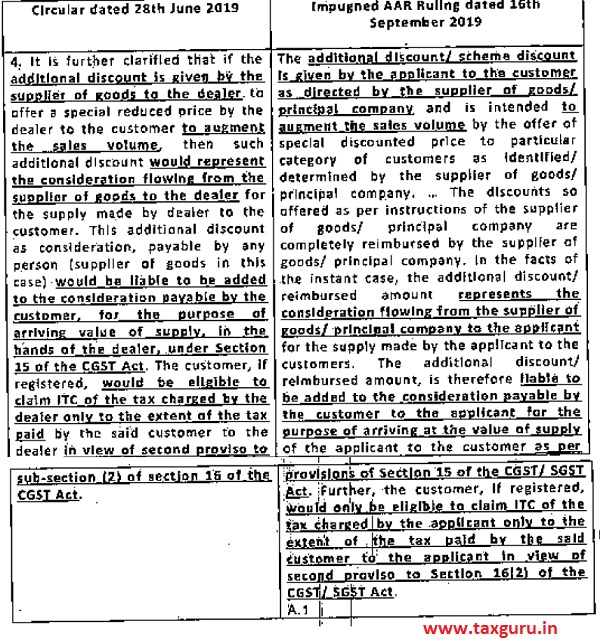
b. The said June Circular has since be n withdrawn ob inito by a Circular 112/31/2D11 -GST dated 3rd October 2019 passed by the Board (“Withdrawal Circular”) The A copy of the June Circular and withdrawal Circular are hereto annexed and marked as .Exhibit D. The withdrawal circular was Issued In exercise of its powers conferred by Section 168(1) of the CGST Act with a view to ensure uniformity in the Implementation of the provisions of the law across field formations. As a corollary to the settled law .that a Circular is binding upon the Revenue, It also follows that a Circular withdrawn is also equally Wilding on the Revenue. The Impugned Order which relies paragraph 4 of the June Circular as the basis of its approach and findings is therefore clearly unsustainable and bad in law. The additions to the assessable value made under the Impugned Order are therefore without jurisdiction and without the authority of law. The Impugned Order is passed in breach of the principle so f natural justice, as It is not a speaking Order, inter alla, for the reasons that:
The issue raised before the. authority was as to the appropriate basis of valuation of the transaction between the Appellant and its customers. Section 15 of the CGST Act prescribes various circumstances and statutory variations based on which the value of the levy of GST is to be determined, Value is therefore, determinable under various sub-sections and clauses of Section 15 of the CGST Act, each covering a different circumstance or nuance in law
c. The Impugned Order, without any reasoning whatsoever, merely states that:
Page 4: The additional discount / reimbursement amount is therefore liable to be added to the consideration payable by the customer to the applicant for the purpose of arriving at the value of supply of the applicant to the customer as per provision of section 15 of the CGST / SGST Act.
Page 2: in the case of the Appellant, the supplier of Goods/Castrol is issuing Commercial credit Notes for reimbursement of the scheme discount provided by the Appellant to the customer as per instruction of the supplier. Since the commercial credit notes issued by the supplier/Castrol do not satisfy the condition prescribed in sub-section(3) of section 15 of the CGST / SGST Act, the supplier is not eligible to reduce the original tax liability.
d. The Learned Respondent In the impugned order has just stated that ‘since the commercial credit notes Issued by the supplier / Castrol do not satisfy the conditions prescribed in subsection 15 of the CGST Act, thus, the supplier is not eligible to reduce the original tax liability. It is nowhere elaborated/ commented as to why the said discount does riot fulfil the criteria provided under Section 15 (3) of the CGST Act. In this regard, it is imperative to reference Section 15 (3) of the CGST Act and the fulfilment therefore in the in present case.
e. The Appellant places reliance on the decision of the Apex Court In the case of Siemens Engineering Vs. UOI [1976 (63) AIR 1785 (SC)] wherein the Supreme Court has held as follows:
”………….. it is essential that administrative authorities and tribunals should accord fair and proper hearing to the persons sought ta be affected by their orders and give sufficiently clear and explicit reasons in support of the orders made by them. Then alone administrative authorities and tribunals exercising quasi-judicial function be able to Justify their existence carry credibility with the people by inspiring confidence In the adjudicatory process. The rule requiring reasons tube given in support of an Order is, like the principle of audi ateram partem, a basic principle of natural’ justice which must inform every quasi-Judicial process and this Me must be observed in Its proper spirit and mere pretence of compliance with It would not satisfy the requirement of law,’
f. The Appellant also invites attention to the Apex Court’s decision in the case of Assistant Commercial Tax Officer Vs M/s Rijhumal Jeevandas [2010-TIOL-30-SC-CT], wherein it has held as follows:
“The administrative authority and tribunals are obliged to .give tensors, absence whereof could render The Order liable to judicial chastise. Thus, It will not be for from absolute principle of law that tie Courts should record reasons for its conclusions to enable the appellate or higher Courts to exercise their jurisdiction appropriately and in accordance with law. It is the reasoning alone, that can enable higher or an appellate court to appreciate the controversy in issue in its correct perspective and to hold weather the reasoning recorded by the court whose order is impugned, is sustainable in law and weather it has adopted the correct legal approach.
g. The Appellant also refers to the decision of the Gujarat High Court In the case of The commissioner of Central Excise and Customs Vs Chandubhau shiroya (2009-TIOL-105-HC-AHM-CX). In this case, the Honourable High Court held as follows:
“13. it can also be. said that the reasons ore like the bricks with which the edifice of Justice is built. If the bricks .are not in pace of are missing, the entire edifice cames crashing down. The conclusion arrived at by a judicial or quasi-judicial authority should rest upon the foundation or reasons. and Cannot be sustained if they are In .the air. An Order passed by a quasi judicial forum has to be supported by convincing and cogent reasons, howsoever brief they may be.”
Therefore, in view of the aforesaid judicial precedents, the Appellant submits that the impugned non-speaking Order is not in accordance with the law anti against the principles of natural justice and hence, should be set aside.
h. In terms of Section 15 (1) of the CGST Act, the levy of GST Is on the ”transaction value” of the supply, which is the price actually paid of payable qua the supply provided the parties are unrelated and price is the sole consideration. The levy is therefore on the actual consideration, and, does not extend to any notional consideration, Moreover, in terms or Section 15(3) of the CGST Act, discounts (both pre-sale and post-sale) are deductible from the value of the supply. provided certain conditions are met. For post-sale discounts, the provisions envisage the issuance of a credit note within the prescribed time limit by which output tax liability of GST payable on the supply of goods can be reduced subject to conditions specified therein. It is a settled law that the existence of a machinery provision to measure or compute the levy is indispensable in a fiscal statute. The valuation mechanism under GST is entrenched in Section 15 of the CGST Act. As per Sub-section (1) of the said Section 15 of the CGST Act, the levy of GST Is on the ‘transaction value” of the supply which is the price actually paid of payable qua the supply provided the parties are unrelated and price is the sole consideration. The levy is therefore on the actual consideration, and, does not extend to any national consideration. Moreover, in terms of section 15(3) of the CGST Act, discounts (both pre-sale and post-sale) are deductible from the value of the supply, provided certain conditions are met. For post-sale discounts, the provision envisage the issuance of a credit note within the prescribed time limit by which output tax liability of GST payable on the supply of goods can be reduced.
i. On a reading of these provisions, there is a statutory prescription of what should be included in the value, and what Is not t be included in the value. On a reading of Section 15(1) and 15(3) (b) of the CGST Act, from the price actually Paid or payable, the amount of any discount is required to be excluded from the value of the said supply If the conditions set out in. Section 15(3)(a) and 15(3) (b) of the CGST Act, are satisfied. Therefore, discount is a concept which by statute is Intrinsically co-related to the value of the ‘supply. In the present case, therefore, any discount given by the manufacture to the distributor is intrinsically co-related to the value of the said supply, yiz. Transaction 1. In the facts of the present case, the conditions for exclusion of discount from the value under Section (15) (3) of the CGST Act are not satisfied. As a result, this discount cannot be excluded from the value, Tax is Therefore, paid on the full value absent any adjustment for discount. Factually this position is undisputed between the parties.
j. In the facts of the present case, it is undisputed and indisputable that transaction value of Transaction 1 has not been reduced by the post-sale discounts evidenced by the credit notes under consideration. The transaction value of Transaction 1 therefore treats the amounts covered by the credit notes as being part of the price actually paid or payable or Transaction 1. The impugned Order which holds that the amounts evidenced by the credit notes should he added In to the transaction value of Transaction 2 is wholly unsustainable for the reason that It seeks to tax an amount which already been taxed as part of the transaction value of the Transaction 1, by also treating such mount as constituting a part of the price actually paid or payable for Transaction 2. This position is Unsustainable in normal ‘trade and commerce and also Is unsustainable in terms of provisions of Section 15 of the CGST Act.
k. The definition of the term ‘consideration under Section. 2(01) of the CGST Act needs to be read consistently and harmoniously With the definition and concept of ”transaction value” viz. the price actually paid or payable for the said supply”. When the transaction value for Transaction 1 a formulated and GST is levied, it is an accepted position that this transaction value is the price actually paid or payable for the said supply and that the price is the sole consideration for the supply’, Relevant to Transaction 1, this transaction value” which is the “sole consideration for sale, also includes the amounts of discount as evidenced by the credit notes In question. Under the scheme of section 15 of the CGST Act, It is impermissible In law to consider an element which is an intrinsic part of the “transaction value” and is the sole Consideration for Transaction 1, to also be considered as being part of the Consideration under Transaction 2.
l It follows from the scheme of Section 15 of the CGST Act that if the term “consideration” as defined under Section 2(31) of the CGST Act is to be harmoniously read with the term “‘transaction value’ and with the provisions of Section 15(1) and 15(3) of the CGST Act. then the term “consideration’ can only refer to ‘Payments’, which have not already been subjected to GST in an antecedent transaction (in respect of the same goods) as being part of the transaction value and sole consideration of such antecedent transaction, In the present case, the definition of the term ‘consideration” under Section 2(31)(a] as applied to Transaction 2, cannot be applied so interpreted as to treat any amount (being the post-supply discounts evidenced by credit notes) which have already been taxed as part of the transaction value in Transaction 1.
m. The Impugned Order has been.. passed in a manner wholly contrary to the principles laid down in the binding decisions of the Hon’ble Supreme Court in Deputy Commissioner of Sates Tow (Law), Board of Revenue (Taxes), Ernakulam Vs. M/s. Motor Industries Co., Ernakulam, [(1983) 2 SCC,108], and of the Hon’ble Kerala High Court In kalpana Lamps and Components Ltd. v. State of Kerala (2006) 143 STC 666. These decisions specifically recognize that a discount given to promote further trade, irrespective of the nature for which it is given, when it is In terms of agreement or established practice between parties, is still in the nature of a ‘trade discount’, The re-characterization of a discount given by a supplier in relation to a transaction of ‘supply of goods’ (”Transaction 1′ In the present fact) as part price being paid for a subsequent transaction of sale of goods (“Transaction 2′ In the present facts’), is wholly contrary to the principles laid down in such binding decisions. Insofar as the impugned Order, has been passed wholly ignoring the binding decisions of the Hon’ble Supreme Court and this Hon’ble High Court on what constitutes a ‘trade discount’.
n. The Impugned Order is legally unsustainable as it results in double taxation, which. Is impermissible in law as well Settled by the Hon’ble Supreme C0urt in the cases of Union of India Vs Tate Iran and Steel Co. Ltd. [1977 (1) ELT 162 (SC)]’; Govt. of India vs. Polfsettly Samasundaram Pvt. Ltd. [1999 (113) ELT 378 (SC)
o. It is submitted that not only Is the impugned Order contrary to the basic legal and commercial principle that the same amount cannot be a ‘discount’ in relation to one transaction, and, at the same time be a ‘consideration’ in relation to a subsequent sale transaction, but also Incorrectly seeks to bring the same amount to tax twice over, In terms of the Impugned Order:
The additional discount provided by Castrol to the Appellant Is not an eligible discount under section 15(3) of the CGST Act, 2017 and hence is not deducted from the price of supply of goods by Castrol to the Appellant, Therefore, Castro’ has already paid lax on a value which includes the value of such trade discount, which fact.is not disputed;
p. The Appellant submits that the impugned order itself clarifies that Castrol is issuing invoices at a price to its Appellant and the Appellant supplying the goods to the dealers based on the various rate scheme pre-fixed by Castro).
The said Para itself implies that the schemes/ discounts were first launched by Castro) and. communicated to the Appellant. Thus, the consideration for the procurement of goods.by the Appellant is reduced In the hands of the Appellant.
It is not the facts that the Appellant at its own first offers discounts to its customer and effect sale of goods to its customer at a reduce price but it is based on pre-existing scheme of Castrol.
It shall be noted that, had the fact of the case would have been as understood by the Authority for advance Ruling goods are sold at a lesser price by the Appellant is not under commercial compulsion to pass on this credit note to its distributor.
The vey fast that Castrol launches schemes and provides discounts from time to time to its distributors as per the contract executed between Castrol and distributor makes the Appellant legally eligible for the benefits and has the right to procure the goods at the respective prices from Castrol.
Thus, due to the above discounts / schemes / rebate etc., the cost of procurement of goods is reduced in the hands of the Appellant is able to supply goods at a lesser / discounted price to its customers.
In the present case, it is not the facts that the above discounts / schemes / rebate are qua specific buyer / class of buyer of the Appellant and there is no such condition in the schemes / discount etc. but these are uniform practice in selling products through distributors with full consent and concurrence of the distributors.
It shall be noted that no one will effect the sale of goods in a systematic manner as pronounced by the Honourable supreme court in the case of FIAT decision. Thus, it evidences that the nature of the transaction is discount passed on by Castrol to its distributor and not the consideration an account of sale of goods by distributor to its retailor as held in the impugned decision.
Thus, the Appellant submits that in the present case, the entire advance ruling passed by the tax authority is bad in law as the same is in contravention of the principle of natural justice as specified by the supreme court.
q. In this regard, the Appellant relies on the decision of the Hon’ble supreme Court in the case of Glan Mahtanj V. State of Maharashtra AJR 1971 SC 1898 in which it was held that the findings of revenue authorities based on pure assumption and conjecture and not an evidence should be quashed.’
Similarly, the Hon’ble Tribunal in the case of M Square Chemicals Vs. CCE [2002 (146) ELT 323 (Tri.)] held that demands based on mere conjuncture without any evidence and those involving unwanted assumption were not sustainable. In this regard, the Appellant wishes to rely on the following decision: