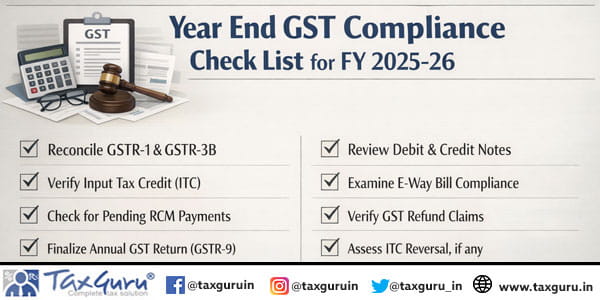
As the financial year transitions from 2025-26 to 2026-27, businesses must ensure compliance with various GST regulations. Key actions include filing the Letter of Undertaking (LUT) by March 31, 2026, for zero-rated supplies, opting for the GST Composition Scheme, and deciding on the Quarterly Return Monthly Payment (QRMP) scheme by April 30, 2026. Invoice numbering must be reset, and year-end reconciliations for outward and inward supplies, ITC balances, and stock should be conducted to avoid discrepancies. Businesses must also calculate the reversal of Input Tax Credit (ITC) under Rules 42 and 37 for exempt supplies and unpaid vendor invoices. Compliance with e-invoicing regulations is crucial for businesses with an aggregate turnover exceeding ₹5 crores, requiring registration and implementation from April 1, 2026.
Exporters must ensure inward remittances comply with FEMA regulations to avoid refund reversals. Businesses should also verify supplier e-invoice status and validate 1% cash payment conditions under Rule 86B. Other significant updates include GST liabilities under the Reverse Charge Mechanism (RCM) for commercial rent paid to unregistered suppliers and adjustments under Form GST DRC-03A for demand order payments. Ensuring compliance with these regulations will facilitate a smooth transition into the new financial year.
Background: As the financial year 2025-26 draws to a close and we gear up for FY 2026-27, it’s crucial for businesses and professionals to stay updated on the Goods and Services Tax (GST) implications that could affect annual closure of books and future planning. The transition between financial years is a critical period for addressing GST compliances, making strategic decisions like opting for the GST Composition Scheme, and ensuring readiness for new regulations such as e-invoicing requirements. This guide highlights key aspects to consider for smooth GST compliance and effective financial planning for the upcoming year. Considering the various GST implication some of the key aspects are summarized as below.
I Compliances for Annual Closure of Books of Accounts.
1. File LUT for zero-rated supplies for F.Y .2026-27
Taxpayers are required to be submit Letter of Undertaking for undertaking zero-rated supplies i.e.,
1. EXPORT of goods or services outside India or
2. Supply to SEZ Unit/Developers
without payment of IGST for every Financial Year. The application for LUT has to be made on or before making supply. Therefore, For F.Y. 2026-27, LUT is due to be filed latest by 31st March 2026 if company intended for zero-rated supplies on or after 01.04.2026.
2. Opt-in for GST Composition Scheme for F.Y. 2026-27
If Taxpayer wish to opt for Composition Scheme subject to the fulfilment of criteria and conditions for F.Y. 2026-27, last date to file CMP-02 is 31st March 2026.
Note: In case of switch from Normal to Composition Scheme, ITC claimed on inputs lying in form of Inputs, WIP, finished goods stock as on 31.03.2026 and capital goods (on reduced percentage basis) is required to be reversed by filing ITC-03 by 30th May 2026.
3. Opt-in or out of QRMP for F.Y. 2026-27
Quarterly Return Monthly Payment or QRMP scheme under GST is a scheme introduced by the Government in its initiative to simplify compliance for taxpayers. In this scheme, registered persons having aggregate turnover up to Rs 5 Cr. are allowed to furnish their GST returns on a quarterly basis along with monthly payment of tax under QRMP Scheme. Last date to opt in or opt-out from the QRMP Scheme is 30th April 2026 for the financial year 2026-27.
4. Declarations to be taken from Goods Transport Agency (GTA) for opting to pay GST under Forward Charge.
As per the amendments, in case of GTA service, Supplier has an option to opt for payment of GST under forward charge (GST is charged on invoice) or under reveres Charge (recipient will pay the GST directly).
For the FY 2026-27, declarations to be taken from Goods Transport Agency (GTA) for opting to pay GST under Forward Charge should be obtained and kept in record to justify the reason for non-payment of GST under RCM.
5. Reset Invoice Number Series
As per the GST advisory released in 2019, with the start of the new financial year, GST taxpayers should start a new invoice series, unique for the financial year.
A similar provision is there in Rule 49 of the CGST Rules 2017, in respect of the issue of Bill of Supply by registered taxpayers availing Composition Scheme or supplying exempted goods or services or both. If the provisions of Rule 46 or Rule 49 are not adhered to, apart from being a compliance issue, taxpayers may face problems while generating E-Way Bill on the E-way bill system or furnishing their Form GSTR 1 or applying for a refund, etc.
6. Re-calculation of Aggregate Turnover of F.Y. 2025-26 for various compliances related to F.Y. 2026-27
For Various decision making and compliances in GST are dependent upon threshold as per Aggregate Turnover like GST registration, Composition Scheme, QRMP Scheme, E- Invoicing, Rule 86B (1% Cash Payment) etc. For F.Y. 2026-27, please make sure that recalculation is done for each of relevant compliances as per aggregate turnover in F.Y. 2025-26 wherever applicable.
7. Year-end reconciliation of Outward Supplies, Following reconciliation at the year-end are must:
1. Turnover as per books of accounts vs turnover as per GST returns.
2. Physical stock vs stock as per books of accounts – to identify shortages/ excess stock, if any.
3. Reconciliation related to the Opening Goods – in –transit vs closing Goods-in- transit.
4. Reconciliation related Opening vs closing unbilled revenue.
5. Reconciliation related open advance at the beginning of the year against which invoices are issued in the current Financials year and corresponding “Advance Adjusted” in GST return filed.
6. Reverify the closing unadjusted advances at the end of Financial year vs reported in the current as well are previous financials years.
7. Any income recognized due to 26AS reconciliation or claimed / reimbursements and its GST implication.
8. Year-end reconciliation of Inward Supplies, Following reconciliation at the year-end are must:
1. Closing balance of ITC as per books of accounts vs closing balance as per GST portal.
2. Reconciliation of unclaimed ITC due to GSTR 2B mismatch / not reported by Supplier.
3. ITC temporarily parked under reversal and reclaim ledger from April 2025 till Jan 2026.
4. Any write back of creditors proposed by management, where ITC was claimed previously.
5. And Shortage/damages identified at the time of stock taking. And reversal of ITC.
6. Pending ITC not matched with GSTR-2B to be reconciled and then to be transferred in a separate ledger. In case of any hits and misses, such adjustments in output liability or ITC should be reported in GST return of March 2026.
Note: In case of RCM liability, it is suggested to also look for entries appearing in GSTR-2B ticked as ‘RCM’ by Suppliers and ensure that RCM liability has been paid. Further, please report exempted supplies like interest income in GST returns as well.
9. Reversal of ITC for unpaid vendors as per Rule 37.
As per the provision of GST Act, In case of ITC availed on Goods / services, Payment for the said invoice shall be made within period of 180 days, in case failure of making payment ITC availed previously is need to reversed on expiry of 180 days along with Interest from date of availment of ITC.
On the basis of Vendors outstanding as on 31 March 2026, aging is need to be done for unpaid vendors invoices more than 180 days and ITC of the same was not reversed previously. And take action accordingly for reversal. ITC can be claimed back in future, once the payment is made to the vendor.
Same time, any ITC was reversed previously under this rule, but the payment of same is made during F Y 2025-26, ITC can be claimed back
II Other Compliance Points
1. Availment of correct Input Tax Credit for the FY 2025-26
1. Reconciliation of E- Credit Ledger with books of accounts for FY 2025-26.
2. Check the tax has been correctly calculated and paid under RCM in case of Import of services, Sitting fees paid to Directors, GTA, Security Services, Rent a cab, Advocate fees etc.
3. In compiled data of GSTR 2B, check status of date of filing of GSTR-1 and GSTR-3B of the suppliers to know whether your suppliers have filed GSTR-3B to avoid any query from Department.
4. Revisit the natures of expenses incurred and ITC claimed thereupon. In case any blocked credit claimed, reverse the same immediately, rather to wait for annual return.
2. Reporting of correct outward supplies for the FY 2025-26
1. Reconciliation of turnover/tax as reported in GSTR 1/ GSTR 3B with books of accounts for FY 2025-26
2. Review the correct HSN/ SAC code and GST rate has been opted.
3. Reconciliation of E-way bills generated during the FY 2025-26 with tax invoices reported in GSTR 1.
4. Reconciliation of e-Invoices with IRN viz. e-way bills generated viz. reported in GSTR 1.
5. Check whether the GST paid on advances received in FY 2025-26 towards the supply of services made or agreed to be made has been properly adjusted in GSTR 1 and GSTR 3B.
Check whether the goods sent on approval basis has been either returned within 6 months or sold on issuance of tax invoices.
3. Job Work related compliances
1. In case of material sent for job work, check whether the same has been returned within the time limit prescribed (Inputs – 1 year and Capital goods – 3 years) and the same has been duly reported in ITC 04.
2. The due date for filing ITC-04 shall be as below:
i. Those with an annual aggregate turnover of more than Rs.5 crore – (April 2025-Sep2025) 25th Oct 2025 and (Oct 2025-March 2026) 25th April 2026.
ii. Those with an annual aggregate turnover of up to Rs.5 crore – For FY 2025-26 due on 25th April 2026.
3. Records related goods send and returned back have been properly updated and reconciled with the stock with job worker.
4. Real Estate Sector
To assess the value of all Input and Input services received from both the registered and unregistered suppliers and if the value of procurements received from registered suppliers is not exceeding 80% of total inward supplies, then the Developer of the project is required to pay GST @18% under RCM for such shortfall (28% in case of cement to be paid on monthly basis). Expenses on which GST is payable under RCM would be considered as procurements made from the registered persons. Last date to submit such details for FY 2025-26 is 30th June 2026.
5. E-invoice Registration-
1. For all those taxpayers whose Aggregate PAN based Turnover exceeds Rs 5 Crores during FY 2025-26 for the first time from the introduction of GST has to generate and issue E- invoice from 01st April 2026.
2. Those who are covered as described above are required to take E-invoice registration on Invoice Registration portal and start generating E-invoice-
https://einvoice1.gst.gov.in/Home/Login
6. SEZ Endorsement copies for supply made without GST –
IGST act amendment
As per the amendment, supply of Goods / Service made to the SEZ units / developers will be considered as ZERO rated supply (No GST), only if, same are received for the authorized operation of unit or SEZ Developer.
Thus to ensure that Goods / Service are used for authorized operation, it is important to take the endorsement by The Commissioner / Appropriate authority from SEZ unit / developers.
Reconcile the Supply made to SEZ Unit/ developer and copies of endorsement received for the same.
7. Export of Goods / Services with payment of Tax and inward remittance thereof.-
The exporter has the options
- Pay IGST on exports and then claim refund of the same once Export is executed. Or
- Export of Goods / services, under LUT (Without payment of tax), here refund of ITC involved in the goods / services can be claimed.
However, in this connection provision has been amended and as per amended provision, in case refund for export is claimed and export proceed (both for goods / services) is not received as per time limit under Foreign Exchange Management Act (FEMA) regulation(within 9 months from the date of issue of invoice for export).
1. The person shall deposit the amount so refunded , to the extent of non – realization of sale proceeds, along with applicable interest within 30days of expiry of the said period of FEMA. And
2. Where the sale proceeds are realized by the applicant, in full or part, after the amount of refund has been recovered from him under sub-rule (1) and the applicant produces evidence about such realization within a period of three months from the date of realization of sale proceeds, the amount so recovered shall be refunded by the proper officer, to the applicant to the extent of realization of sale proceed.
So, need to check for the exports executed in FY 2025-26 or initial period of 2026-27, for which time limit of FEMA is expired. In such case if refund was received but the export proceed are not received, then deposit the refund to the extent of unrealized export proceed. To avoid additional interest burden.
Note:- incase tax is paid due to non realization on export proceed and Export refund was claimed earlier, in such cases, re-refund can be claimed, once export proceeds realized at later stage.
8. Filing of GSTR 3B for inward supplier to avoid ITC reversal under rule 37A-
Rule 37A of GST provides that the GST-registered buyers of goods and services must reverse Input Tax Credit claimed before when their corresponding supplier fails to deposit such taxes in their GSTR-3B within a defined time. The due dates for supplier as per Rule 37A are: 30th Sep 2026 for F Y 2025-26.
In case supplier have not filed returns by the above due date, the amount of input tax credit shall be reversed by the said registered person , while furnishing a return in FORM GSTR 3B on or before the 30th Nov 26 (for F Y 2025-26) following the end of financial year.
However, ITC of the same can be re-claimed once the corresponding tax is paid by supplier, in GSTR 3B.
9. E-invoice status validation for all supplier-
In case supplier is required to issue E-invoice, but does not do so, it will result in claim of ITC on the basis of invalid documents and reversal of ITC shall be demanded by the Department from recipient of Goods / Services.
Therefore, A taxpayer (recipient) shall ensure the applicability of E-invoicing to its vendors. Taxpayer shall follow the below steps:
Step 1: Visit the e-invoice portal.
Step 2: Go to the search tab and select “e-invoice status of taxpayer”. Step 3: Enter the GSTIN of supplier and the captcha code. Click Go.
This status is based on the turnover reported by a GSTIN in its GSTR-3B. However, it should be noted that the enablement status on the e-invoice portal doesn’t mean e-invoicing is applicable to a particular taxpayer. If a particular category of the taxpayer is exempt from e-invoicing, then the e-invoicing enablement status can be ignored.
10. 1% Cash payment conditions validation.-
As per the Rule 86B of CGST-2017, Taxable persons can use Electronic credit ledger for making payment of Outward Tax liability up to 99% of the outward tax. and 1% is compulsorily to be paid from Cash ledger. However, this provision shall not be applicable in case where,
- Value of Domestic Supply (excluding Exempt Supply) for a GSTN is below 50 Lakh, for current Month.
- If the specified persons as mentioned in rule have paid more than 1 lakh as Income Tax under Income Tax Act, 1961.
- If the registered person has received a refund of amount greater than Rs.1 lakh in the preceding financial year on account of export under LUT or due to inverted tax structure.
- If the registered person has discharged his output tax liability by electronic cash ledger for an amount in excess of 1% cumulatively up to the said month in the current financial year.
- If the registered person is Government dept, PSU, Local authority, Statutory Authority
11. System automation for HSN and SAC codes in GSTR
Taxpayers will no longer be able to manually enter HSN codes in GSTR-1 and GSTR-1A. Instead, they must choose the appropriate HSN code from a predefined dropdown list. Additionally, Table 12 of GSTR-1 has been restructured into separate sections for B2B and B2C supplies to enhance clarity in reporting. While new validation checks have been implemented, they will initially function in warning mode and will not prevent return filings.
12. Adjustment of liability for order dues paid DRC 03 in DRC 03A
After the assessment proceedings, where demand of tax is confirmed, Many taxpayers had mistakenly used DRC-03 for discharge the tax liability. Whereas portal has provided the facility for “Payment Towards Demand”. As the facility is not used by the taxpayer, it appears in the system for tax is neither paid by the taxpayer nor the matter is contested in the appeal.
This inconsistency leading to recovery proceeding by the department despite of the fact that, tax was already paid. Therefore, to overcome this, new Form GST DRC-03A has been introduced to allow businesses to adjust payments made under DRC-03 against demand orders. The new form enables proper adjustments and linking of payments to outstanding demands.
13. Input service distribution (ISD mechanism)
The Finance Act, 2024, has amended Section 2(61) of the CGST Act, making it mandatory for any office receiving tax invoices for input services, including those under RCM, on behalf of distinct persons (as per Section 25) to register as an Input Service Distributor (ISD).
Previously, businesses used the cross-charge mechanism as an alternative for distributing Input Tax Credit (ITC) on common services or goods procured. However, with the recent amendment, ISDs are now explicitly permitted to distribute ITC related to common supply of service for multiple states.
This provision has taken effect from April 1, 2025. and entities having the multiple GSTN as on 31.03.2025 are required to comply with ISD provision w e f 01.04.2025, however, in case single GSTN entity taken fresh additional registration, need to apply for the ISD registration and validat the compliances freshly.
14. Updating Bank Details on GST Portal
At the close of the financial year, it is important to review and update the bank account details registered on the GST Portal to ensure accuracy and avoid any delays in refund processing or compliance issues. The registered person should verify all bank accounts currently linked with the GSTIN and confirm that the account numbers, IFSC codes, bank names, and account status are correct and active. Any bank accounts that are closed, inoperative, or no longer in use should be identified and removed, and at least one active and operational bank account must be maintained on the GST portal for statutory purposes.
In case of any addition, deletion, or modification of bank account details, the amendment should be filed through Form GST REG-14 under the non-core amendment section on the GST portal, and the ARN generated upon filing should be preserved for future reference and audit purposes. It should also be ensured that the correct bank account is selected for receiving GST refunds, including refunds related to exports, inverted duty structure, or excess balance in the electronic cash ledger.
15. Aadhar Authentication
The registered person should review the profile section on the GST portal and confirm whether Aadhaar authentication has been successfully completed for the primary authorized signatory.
It should be ensured that the name, PAN, and Aadhaar details of the authorized signatory are correctly matched and authenticated on the GST portal. The mobile number linked with Aadhaar must be active and accessible, as Aadhaar authentication is completed through OTP verification. In case Aadhaar authentication is pending, failed, or not completed, immediate steps should be taken to complete the authentication process through the Aadhaar authentication option available on the GST portal.
Additionally, it should be verified that the authorized signatory whose Aadhaar authentication is completed continues to be associated with the entity and is actively handling GST compliance. If there is any change in authorized signatory, Aadhaar authentication of the newly appointed signatory should be completed promptly to avoid any compliance disruptions.
16 Authorized Signatory
The registered person should verify that the existing authorized signatory continues to be employed or associated with the organization and is duly authorized to act on behalf of the entity for GST matters. The name, designation, PAN, mobile number, and email ID of the authorized signatory should be reviewed to ensure that all details are accurate and up to date on the GST portal.
Any change in authorized signatory should be updated on the GST portal by filing an amendment application through Form GST REG-14. The amendment should be verified using DSC or EVC, and the ARN generated upon submission should be preserved for record and audit purposes. It should also be ensured that at least one primary authorized signatory is always active on the GST portal to avoid disruption in GST return filing, response to notices, refund applications, and other compliance activities.
17. GST Litigation & Contingent Liability Review
1. Review of Open notices:- Track all pending /ASMT-10, SCNs u/s 73 or 74 or 74A .Ensure replies filed and hearings attended.
2. Mapping of exposure:- issue-wise (ITC, valuation, RCM, classification).Reconcile SCN register with GST portal notices.
- Action on Confirmed Demands & Recovery:- Risk Identify adjudication orders passed during Financial Year. Verify appeal filed within 3 months. Check recovery risk under Section 79.Validate adjustment of DRC-03 payments via DRC-03A.
3. Appeal & Pre-Deposit:- Compliance Confirm 10% mandatory pre-deposit paid. Ensure correct accounting as recoverable asset. Evaluate interest exposure on disputed demand. Maintain stay order documentation.
4. Provision vs Contingent Liability:- Alignment Assess probability of liability crystallization. Create provision where required; disclose contingent exposure otherwise. Compute interest up to 31.03.2026.Align disclosures with financial statements (Ind AS 37 / AS 29).
******
Disclaimer: The information in this document is for educational purposes only and nothing conveyed or provided should be considered as legal, accounting or tax advice. User is advised to apply his/her analytical skills before implementing any or all the suggestions above. The suggestions are given, keeping in mind the present legal position.