
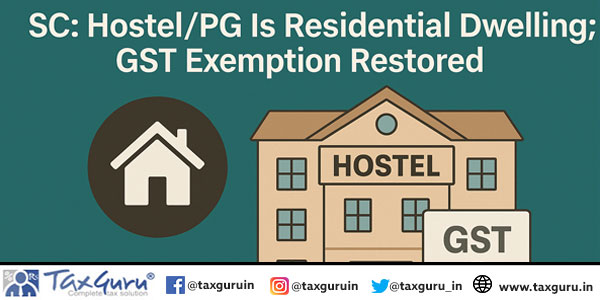
State of Karnataka & Anr. Vs Taghar Vasudeva Ambrish & Anr. (Supreme Court of India)
SC Declares Hostel/PG as Residential Dwelling – Lessee Need Not Reside: Sub-Lease Still Qualifies for Residential Exemption- Revenue’s Narrow View Rejected: Residential Use Is the Real Test- GST Exemption Restored for 2019–2022
Summary: The Supreme Court upheld GST exemption on renting of a residential building used as a hostel/PG for 2019–2022, holding that a hostel constitutes a “residential dwelling” and that the lessee need not personally reside there for the exemption to apply. The Court rejected the revenue’s argument that the exemption fails because the intermediary company did not itself “use” the premises as a residence, clarifying that residential use by the ultimate occupants—students and working women—meets the requirement. It found that the property’s municipal classification, long-term stay patterns, and the nature of living activities carried out on the premises confirm its residential character. The Court applied a purposive interpretation, stating that the exemption aims to prevent GST on residential accommodation and is activity-specific, not person-specific. Commercial intent of the lessee does not alter the residential use. It further held that the 2022 amendment withdrawing exemption for registered persons operates prospectively and cannot be used to deny benefits for earlier years. Restoring the exemption, the Court affirmed the High Court’s decision and set aside contrary AAR and AAAR rulings.
Background Facts
- Respondent was co-owner of a 42-room residential building in Bengaluru, classified as residential in municipal records.
- Property was leased in 2019 to DTwelve Spaces Pvt Ltd, an aggregator running long-stay PG/hostel accommodation.
- DTwelve sub-leased units to students & working women for 3–11 months; average stay ~8 months.
- Respondent claimed exemption under Entry 13 of Notification 9/2017: services by way of renting of residential dwelling for use as residence.
- AAR & AAAR denied exemption; High Court allowed it; revenue appealed to SC.
Revenue’s Arguments (Against Exemption)
1. Three Conditions Must Be Cumulatively Satisfied in Same Transaction
- Entry 13 requires:– renting,– of a residential dwelling,– used as residence.• Revenue argued the use as residence must be by the lessee itself (DTwelve), not its customers.
2. DTwelve Did Not “Use” the Premises as Residence
- DTwelve is a company; companies cannot “reside”.
- DTwelve used property commercially for hostel operations.
- Therefore the primary supply (lessor → DTwelve) fails the “use as residence” requirement.
3. Exemption Is Supply-Specific, Not End-User Specific
- GST exemption attaches to the first supply only.
- Facts of second transaction (DTwelve → students/workers) cannot be imported.
- Allowing end-user test rewrites the notification, shifting focus from supply to downstream consequences.
4. Property Not a “Residential Dwelling”
- 42 attached rooms look like hostel/lodge; Education Guide under service tax excluded places of temporary stay.
- Hostel resembles commercial accommodation, not dwelling.
5. Commercial Intent Defeats Exemption
- DTwelve operates for profit; lease deed recognises business operations, sub-leasing rights & management of premises.
- Exemption not intended for commercial enterprises.
6. Mother Superior Case Not Applicable
- That judgment dealt with “principally used” test (charitable/religious institutions).
- Entry 13 has no such wording; hence “dominant purpose” cannot be imported.
Assessee’s Arguments (For Exemption)
1. Property Is Indisputably a Residential Dwelling
- BBMP khata, sanctioned plan & layout show residential classification.
- Long-term stay (3–11 months) is typical residential use, not temporary lodging.
- Hostels used for sleeping, eating & living have been held to be residential in multiple judgments.
2. Entry 13 Does Not Require Lessee to Personally Reside
- Revenue’s interpretation rewrites entry as “for use as residence by the lessee”.
- Notification requires only that the property is used as a residence — not by whom.
- DTwelve’s sub-tenants are ultimate users & their residential use fulfils entry conditions.
3. Beneficial Exemption Should Be Construed Purposively
- Once property is a residential dwelling used as residence, exemption should be liberally applied.
- Wood Papers & Parle Exports: strict at threshold, liberal once conditions met.
- Purpose of exemption: prevent GST burden on residential use.
4. Commercial Intermediary Does Not Change Residential Use
- Exemption is activity-specific, not person-specific.
- Many exemptions under GST are based on nature of service, not status of supplier/recipient.
- Residential utilisation by students/workers remains the decisive factor.
5. 2022 Amendment Proves Revenue Is Wrong
- From 18.07.2022, exemption withdrawn where dwelling is rented to registered person.
- This implies:– before 18.07.2022, even renting to registered persons was covered by exemption.
- Revenue is trying to apply 2022 amendments retrospectively.
Supreme Court’s Key Findings
1. Hostel = Residential Dwelling
- “Residential dwelling” = any residential accommodation meant for long-term stay.
- Hostel where students/working women eat, sleep & live is a residential dwelling.
- Precedents (Bandu Ravji Nikam, Kishore Chandra Singh Deo, Uratemp Ventures) confirm broad meaning of residence.
- Municipal classification supports residential character.
2. Lessee Need Not Personally Use the Premises
- Entry 13 contains no condition requiring lessee’s personal occupation.
- Imposing such requirement amounts to judicial redrafting.
- Sub-lease to ultimate residents satisfies “use as residence”.
3. Purposive Interpretation Applies
- Exemption is beneficial — aimed at reducing residential living costs.
- A narrow interpretation would frustrate legislative intent by passing GST burden to students & workers.
- Ultimate purpose: residential use must not attract 18% GST.
4. Exemption Is Activity-Specific
- Nature of activity (renting residential dwelling for residence) triggers exemption.
- Status or commercial motive of lessee is irrelevant.
5. 2022 Amendment Not Retrospective
- From 18.07.2022 onwards, exemption not available when rented to registered persons — a prospective change.
- Revenue cannot retrospectively deny exemption for 2019–2022.
Final Holding
- For period 2019–2022, leasing of this residential building to DTwelve for hostel/PG accommodation is exempt under Entry 13.
- AAAR & AAR rulings set aside; High Court judgment affirmed.
- Appeals dismissed.





What’s your take on RCM on rent of such places?