Income Tax : Gifts exceeding Rs.50,000 are taxable for the receiver under Income Tax, except those from relatives or received on marriage. TDS ...
Finance : Summary of mandatory financial record-keeping periods under the Income Tax Act, GST Law (72 months), and Companies Act (8 ye...
Income Tax : Summary: Taxpayers, particularly Individuals and HUFs not required to audit their accounts, must file their Income Tax Returns (IT...
Goods and Services Tax : The 56th GST Council meeting is set for September 2025. The agenda includes rationalizing tax slabs, simplifying compliance, and a...
Income Tax : Learn how new ITR business codes impact tax filing. Key additions include codes for influencers and traders. AI to boost complianc...
Corporate Law : Right now, MSME’s are in a bind, there are lot of suppliers who are not paying MSME’s their dues on time and it's causing MSME...
Recently the Finance Minister declared the Interim Budget for 2019-20. No such changes were proposed under GST. Earlier the recommendations were made to amend certain provisions. Some of the provisions are now made applicable from 1st Feb, 2019. Most of the taxpayers being unware of the same, let’s discuss them.
Recently the government is focusing on ease and simplicity of returns, because of which the government has initiated certain steps to provide for rectification of tax invoices entered in GSTR 1 of the previous financial year.
From 1st January, 2019, Government has made certain changes in Tax Rates. As per the changes made, Security Service Provider has been exempted from GST liability for non corporate suppliers . The changes made the Security Service taxable under RCM which means Security Service Receiver who will be a registered taxpayer have to bear the GST liability.
f we compare GST and kite flying, then the person who is flying kite is the Taxpayer , kite is GST, Chakri means books of accounts, jumbling in threads means Returns, Air means Tax collection, Cutting of Kites means Matching mis-matching, and String means Law.
New Year celebration and resolutions for year 2019 are thought over by all. Many new notifications, circulars, orders, etc. in GST are issued on 31-12-2018. What are new changes in GST?
Year 2018 saw many changes such as improvement in GST law, changes in old provisions, implementation of new provisions, changes in GST rates, changes in schemes etc. Let us now discuss all the changes in brief.
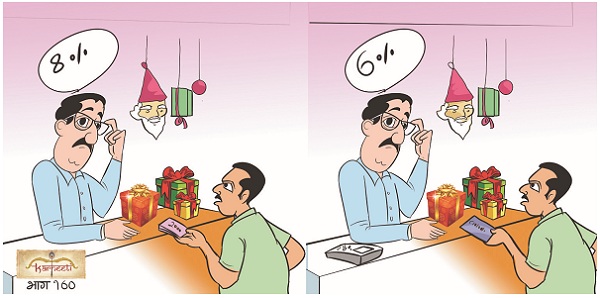
31st GST Council Meeting held on Saturday, took decisions on ITC, Tax Slab Rates, Composition Scheme, Return Filing process etc. Leading to a wonderful gift to all taxpayers before Christmas from Santa Clause (through Government).
Arjuna, In the financial year 2017-18, 3 months were of Vat while the remaining 9 months were of GST. Therefore, taxpayers would be required to get their books audited as per their Turnover under both the laws. Hence while finalizing financials taxpayers might face problems. So let us discuss on the same.
Employer whose tax liability exceeds Rs. 50000/- in the previous year are required to file monthly returns. Remaining tax payers have to file yearly return. Newly registered tax payers in any year are also required to file monthly returns in that year. For subsequent year, their periodicity depends on the tax payment of the previous year.
GSTR 9C is an annual audit form for the taxpayers registered under GST. It is reconciliation statement between the Annual Return 9 filed and the figures as per Audited Annual Financial statements. In short it can be said that it is similar to the audit report furnished under the Income tax act. It is certified by the CA.