

Introduction
Filing periodical returns under GST laws is a mandatory compliance for any registered person. It is observed that even after nine years since GST had been introduced, taxpayers make different type of mistakes while filing GST returns. Such mistakes may attract interest, notices and penalties at later stage. Being GST is a IT driven tax system so needs 100% perfection while uploading data or documents.
Nowadays the GST Departments are using Artificial Intelligence (AI) based infrastructure to analyze data, identify errors and mismatches in returns and documents filed by the taxpayers. Commonly known errors are mismatch between GSTR-1 and GSTR-3B, excess or ineligible ITC claimed, short payment or non-payment of output taxes, incorrect HSN codes and e-way bill discrepancies, etc.
Based on information received from Artificial Intelligence analytical tools now-a-days, GST Departments conduct frequent surveys and raids. In one instance, we observed that within fifteen days of obtaining GST registration, a dealer was flagged by the GST Department’s head office to review the dealer’s activities based on AI-driven intelligence.
Therefore, taxpayers must remain cautious from the time of obtaining GST registration and ensure accurate and timely filings of returns. Additionally, taxpayers must stay updated and connected with the GST portal and amendments under GST.
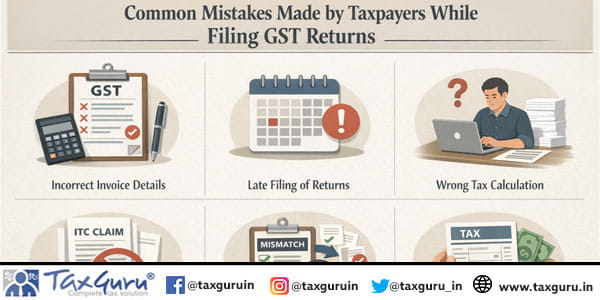
Based on our experience with GST laws and GST portal, we have identified some issues as narrated below, which need proper attention of tax payers. By avoiding these mistakes, taxpayers can protect themselves from receiving notices and can avoid taxes, interest, penalties and litigation to a extent
1). MISMATCH BETWEEN GSTR-1 AND GSTR-3B :
One of the most frequent mistake is mismatch between outward supply as reported in GSTR-1 return and the tax liability declared in GSTR- 3Breturn .
REASONS OF MIS-MATCH:
- Incorrect reporting of sales and taxes in either return.
- Omission of invoices in GST-1.
- Amendments made in one return but not updated the other.
- Misallocation of taxable value, incorrect tax heads or clerical error in GSTR-3B.
- Debit notes and Credit notes reported in GSTR-1 but missed or incorrectly adjusted in GSTR-3B.
CORRECTIVE MEASURES:
- Sale should be correctly reported in both GSTR- 1 and GSTR 3B.
- Reconcile GSTR-1 and GSTR-3B on monthly basis.
- Adjust tax liability in upcoming GSTR-3B, wherever required.
- Recheck all details thoroughly before filing GSTR-1 and GSTR-3B as the case may be with books of accounts or sales register maintained.
2.) INCORRECT ITC CLAIMED:
Sometimes, taxpayers claim incorrect Input Tax Credit (ITC) due to a lack of awareness regarding Section 16 and Section 17 of the CGST Act, 2017 as amended from time to time. Section 16 deals with the eligibility criteria and conditions for claiming ITC, while Section 17 relates to the apportionment of ITC and blocked credits.
REASONS OF MISMATCH :
- Claiming ITC without a valid tax invoice.
- Failure to properly reconcile ITC with GSTR-2B/2B.
- Lack of awareness of updated GST law and rules made there under.
- Claiming ineligible or blocked Input Tax Credit by having own interpretation of law.
CORRECTIVE MEASURES:
- Reverse excess ITC if availed in next GSTR-3B.
- Reconcile ITC with GSTR-2B/2A on monthly basis.
- Claim only eligible ITC as per GST Act and rules.
- Pay and File DRC-03 for short payment/non-payment of tax and applicable interest.
3). MIS-CLASSIFICATION OF SUPPLIES:
- Sometimes, taxpayers get confused between intra-state and inter-state supplies, which leads to incorrect tax payments.
- Intra-state supply refers to a supply made within the same state.
- Inter-state supply refers to a supply made between two different states.
- Sometimes, the “bill to” and “ship to” addresses are different, which may create confusion in classification.
- There is also confusion between composite supply and mixed supply.
CORRECTIVE MEASURES:
- Reconcile returns thoroughly with respect to place of supplies.
- Use the correct HSN/SAC codes.
- Develop a clear understanding of intra-state and inter-state supplies.
- Understand the difference between composite and mixed supply.
4). NON-FILING OF NIL RETURNS:
- Non-filing of NIL returns can block the filing of subsequent returns.
- Non-filing attracts late fees, interest, and tax notices.
- If returns are not filed continuously for six months, it may lead to cancellation of GST registration.
CORRECTIVE MEASURES:
- Even if there are no business transactions during the month or quarter, it is mandatory to file nil returns for said tax periods
- Always file returns before due dates.
5). MISTAKES IN INVOICE DETAILS AND HSN/SAC CODES
- Incorrect GSTIN can affect the recipient’s Input Tax Credit (ITC).
- Incorrect invoice details increase the burden of amendments.
- Errors in HSN/SAC codes can lead to incorrect tax rates, classification and payment of taxes.
CORRECTIVE MEASURES:
- Recheck the GSTIN from buyer documents or registration certificates before filing.
- Do timely amendments/changes in returns, wherever required.
- Verify HSN/SAC codes carefully before filing returns.
6.) ERROR IN E-WAY BILL COMPLIANCE:
Many times, due to following errors in e-way bills:
- Incorrect GSTIN.
- Incorrect vehicle number.
- Incorrect party address.
- Incorrect HSN code.
- Expired e-way bill.
Taxpayers get notices from department which can be avoided with extra care.
CORRECTIVE MEASURES:
- Cancel the e-way bill within 24 hours if not needed and generate a new one if needed.
- Re-verify invoice and e-way bill details before movement of goods.
7.) NOT PAYING THE TAX UNDER RCM:
- RCM (Reverse Charge Mechanism) is governed by Section 9(3) & (4) of the CGST Act. Under RCM, the recipient is liable to pay tax to the Government instead of the supplier.
- Many taxpayers fail to pay GST under the reverse charge mechanism due to a lack of understanding of its applicability and provisions.
CORRECTIVE MEASURES:
- Taxpayers should determine whether RCM is applicable to the goods or services received.
- Taxpayers should be aware of the applicable tax rates on goods/services under RCM.
- Taxpayers must know the point of taxation for transactions and payment of taxes covered under RCM
8.) NOT UNDERSTADING DIFFERENCE BETWEEN ZERO -RATED AND NIL- RATED SUPPLIES :
- Most taxpayers assume that zero-rated and nil-rated supplies are the same, but this is incorrect.
- Zero-rated supplies include exports and supplies made to Special Economic Zones (SEZ), which are taxed at zero-rate and tax is not charged, but refund of input tax credit can be claimed.
- On the other hand, nil-rated or exempted supplies are goods or services that attract a nil rate, and input tax credit is not available.
CORRECTIVE MEASURES:
- Ensure that figures are reported in the correct tax column in GSTR-1 and GSTR-3B.
- Recheck values and their corresponding tax treatment before filing.
- Clearly understand the difference between zero-rated and nil-rated supplies.
9) MIS-REPORTING B2B SUPPLIES AS B2C SUPPLIES
- Sometimes, taxpayers incorrectly report B2B supplies as B2C supplies.
- Due to this mistake, Input Tax Credit (ITC) does not get reflected in GSTR-2B of recipient and the recipient is unable to claim ITC.
CORRECTIVE MEASURES:
- Clearly understand the difference between B2B and B2C supplies:
- Transactions between two registered persons are treated as B2B supplies.
- Transactions where the recipient is unregistered are treated as B2C supplies.
- Recheck all details before filing the return.
- Verify the GSTIN and ensure its accuracy on the GST portal.
10) LATE FILING OF RETURNS
- Some taxpayers do not file their returns in time, which results in late fees and interest.
- The late fee for NIL returns is ₹20 per day (₹10 CGST + ₹10 SGST), subject to a maximum of ₹500 per head.
- For other returns, the late fee is ₹50 per day (₹25 CGST + ₹25 SGST), subject to a maximum of ₹1,000 per head.
- Once a taxpayer obtains GST registration, it becomes their primary responsibility to file returns on or before the due dates.
CONCLUSION
Avoiding these common mistakes can help taxpayers save on late fees, interest, penalties, notices, and compliance hassles. Proper record maintenance, timely reconciliation, adherence to compliance requirements, and awareness of GST provisions are essential for accurate return filing.

Author Bio



Well explained
Well-Crafted, It’s very helpful.
subscription fees for monthly e magazine
Nicely explained