Commissioner of Customs (Port) Vs KEC International Limited (CESTAT Kolkata)
Introduction: The Customs, Excise, and Service Tax Appellate Tribunal (CESTAT) Kolkata recently addressed a crucial aspect in the case of Commissioner of Customs (Port) vs. KEC International Limited. The appeal questioned the order-in-appeal that allowed refund claims filed by the respondent, focusing on the burden of customs duty and the concept of unjust enrichment.
Detailed Analysis: KEC International Limited, an importer of fiber optic cable (DWSM & OPGW), faced a dispute with the Customs Department over the classification of their products. Provisional assessment was carried out, classifying the goods under CTH 90011000 with a 10% customs duty rate. The importer, under protest, paid the duty but later got the goods tested, leading to a conclusion by the Department that the goods were classifiable under CTH-85447090, attracting nil customs duty.
The importer filed refund claims for the 26 Bills of Entry, backed by a Chartered Accountant’s Certificate and a Statutory Auditor’s Certificate, both indicating the amount as due refund of customs duty and not passed on to buyers. The Adjudicating Authority rejected the claim, citing a failure to satisfy the test of unjust enrichment.
The Commissioner (Appeals) upheld the importer’s contention, emphasizing that the amount had been shown as receivables in the Books of Accounts, substantiated by certificates from financial experts. The order also referred to a Supreme Court case highlighting the need for empirical justification and evidence to establish the non-passing of the customs duty burden to buyers.
The CESTAT Kolkata, in alignment with legal precedents, rejected the Revenue’s appeal. It emphasized that the mere accounting treatment is not conclusive proof that the burden of duty has been passed on. The Tribunal highlighted the importance of empirical justification and the need for the Department to present irrefutable evidence to counter the importer’s substantiation.
Quoting the Bombay High Court, the Tribunal reiterated that the treatment of the amount in the Books of Account is irrelevant in determining the passing of the duty burden. The decision underlined that there was no infirmity in the order-in-appeal, dismissing the Department’s appeal and upholding the Commissioner (Appeals)’s decision.
Conclusion: The CESTAT Kolkata’s ruling in the Commissioner of Customs vs. KEC International Limited case reinforces the requirement for empirical justification to establish the non-passing of the customs duty burden. Mere accounting treatment is deemed insufficient, and the burden of proof rests on the Department to provide irrefutable evidence. Importers facing similar disputes should take note of this decision, emphasizing the importance of presenting clear evidence to support refund claims and avoid unjust enrichment allegations.
FULL TEXT OF THE CESTAT KOLKATA ORDER
The present appeal has been filed by the Revenue assailing the order-in-appeal passed by the ld.Commissioner of Customs (Appeals), Customs House, Kolkata. Vide the impugned order, the Commissioner (Appeals) allowed the refund claims filed by the respondent.
2. The facts of the case are that the respondents are importer of fibre optic cable (DWSM & OPGW) and filed 26 Bills of Entry for clearance of the same.
2.1 At the time of assessment, the dispute regarding classification of the impugned products did arise between the importer and the Department. As a result, provisional assessment of the impugned Bills of Entry were resorted to.
2.2 The Department, therefore, classified the impugned goods under CTH 90011000 attracting Customs duty at the rate of 10% adv. The importer paid the duty under protest and also followed it up by formal letter of protest to the Department. The goods were subsequently got tested from Electronic Regional Test Laboratory (ERTL) whereupon the Department concluded that the subject goods were classifiable under CTH-85447090 attracting nil rate of Basic Customs Duty.
2.3 The respondent herein, thereafter, filed two refund claims with reference to the said 26 Bills of Entry. They also enclosed therewith Chartered Accountant’s Certificate indicating that the amount was due as refund of Customs duty and was shown in the Books of Account and not passed on to the buyers. The respondent also submitted Statutory Auditor’s Certificate Reference No.SN/2016-17/004 dated 18.04.2016 issued by Deloitte Haskins and Sells, which clearly indicated therein as “Amount due as refund of Customs duty”.
2.4 The ld. Adjudicating Authority, however, rejected the said refund claim of the respondent herein on the ground the claimant has failed to satisfy the test of unjust enrichment. The ld. Adjudicating Authority has also observed that the importer had not challenged the assessment order in respect of 24 Bills of Entry.
2.5 Two separate appeals were, therefore, filed by the respondent before the ld.Commissioner (Appeals), Kolkata, who upheld the contention of the importer and allowed the refund claim.
2.6 The Revenue is aggrieved by the said order and has filed the present appeals.
3. Heard both sides, perused the records and considered the submissions.
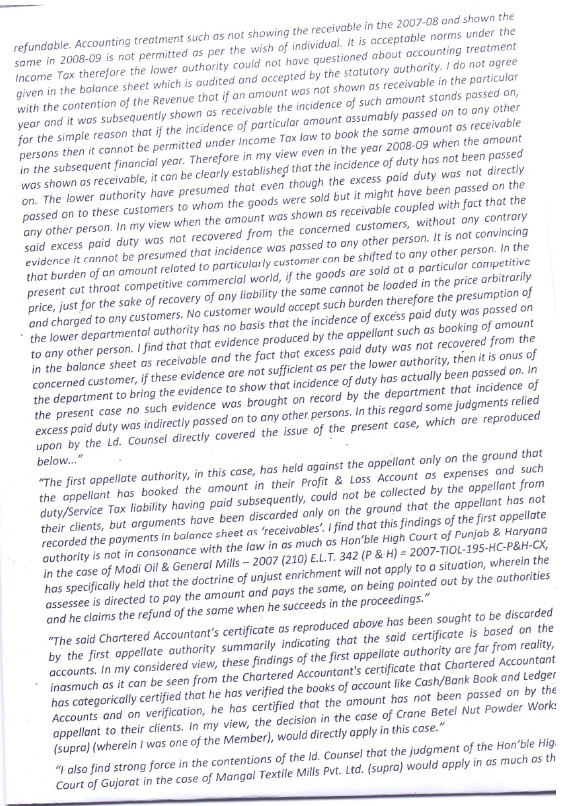
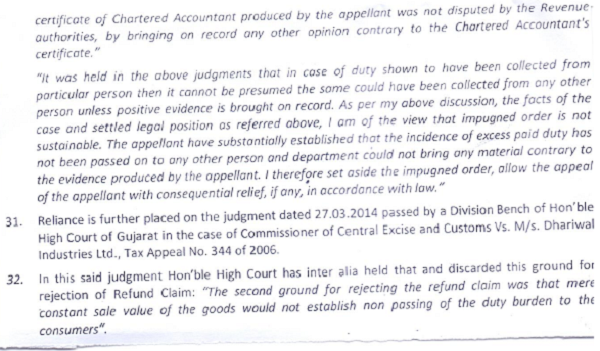
4. We note that the ld.Commissioner (Appeals), inter alia, has stated as under :
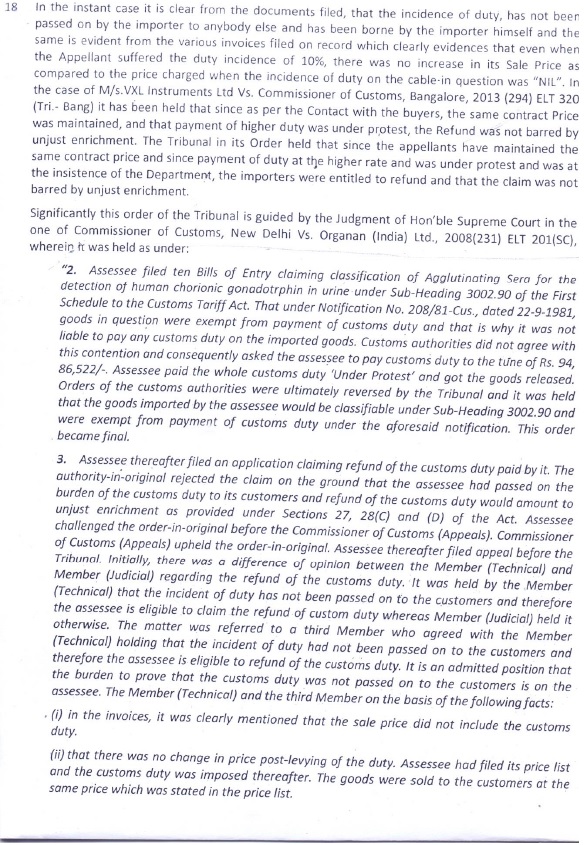
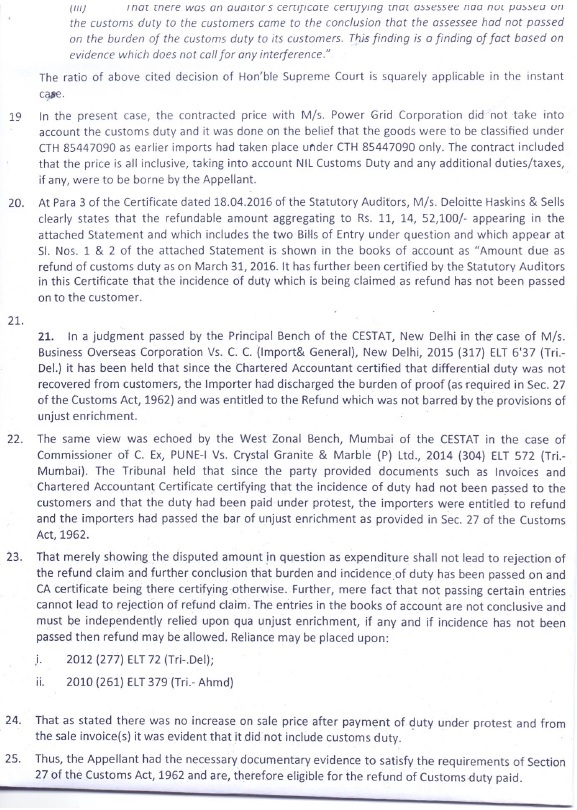
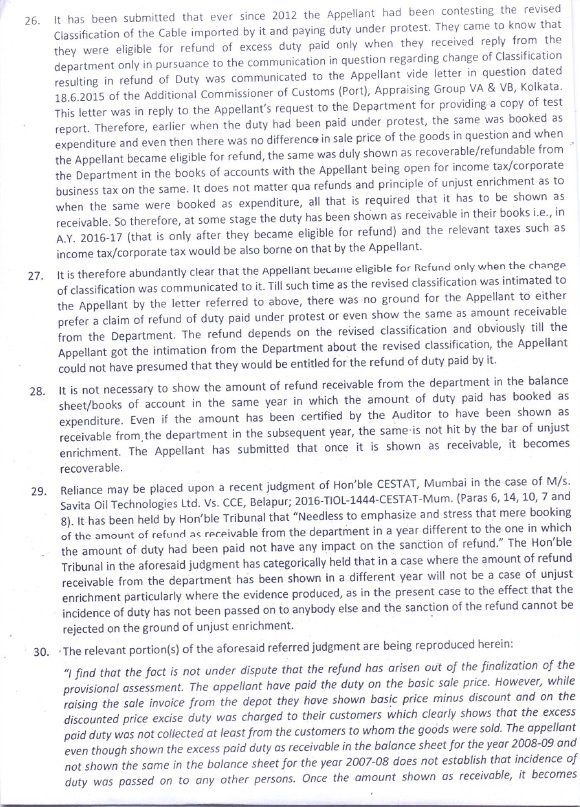
5. The ld.Commissioner (Appeals) has also relied upon the decision of the Hon’ble Apex Court in the case of Commissioner of Customs, New Delhi Vs. Organan (India) Limited reported in 2008 (231) ELT 201 (S.C.), wherein the Hon’ble Apex Court has observed as under :
“2. Assessee filed ten Bills of Entry claiming classification of Agglutinating Sera for the detection of human chorionic gonadotrphin in urine under Sub-Heading 3002.90 of the First Schedule to the Customs Tariff Act. That under Notification No. 208/81-Cus., dated 22-9-1 981, goods in question were exempt from payment of customs duty and that is why it was not liable to pay any customs duty on the imported goods. Customs authorities did not agree with this contention and consequently asked the assessee to pay customs duty to the tune of Rs. 94,86,522/-. Assessee paid the whole customs duty ‘Under Protest’ and got the goods released. Orders of the customs authorities were ultimately reversed by the Tribunal and it was held that the goods imported by the assessee would be classifiable under Sub-Heading 3002.90 and were exempt from payment of customs duty under the aforesaid notification. This order became final.
3. Assessee thereafter filed an application claiming refund of the customs duty paid by it. The authority-in-original rejected the claim on the ground that the assessee had passed on the burden of the customs duty to its customers and refund of the customs duty would amount to unjust enrichment as provided under Sections 27, 28(C) and (D) of the Act. Assessee challenged the order-in-original before the Commissioner of Customs (Appeals). Commissioner of Customs (Appeals) upheld the order-in-original. Assessee thereafter filed appeal before the Tribunal. Initially, there was a difference of opinion between the Member (Technical) and Member (Judicial) regarding the refund of the customs duty. It was held by the Member (Technical) that the incident of duty has not been passed on to the customers and therefore the assessee is eligible to claim the refund of custom duty whereas Member (Judicial) held it otherwise. The matter was referred to a third Member who agreed with the Member (Technical) holding that the incident of duty had not been passed on to the customers and therefore the assessee is eligible to refund of the customs duty. It is an admitted position that the burden to prove that the customs duty was not passed on to the customers is on the assessee. The Member (Technical) and the third Member on the basis of the following facts :
(i) in the invoices, it was clearly mentioned that the sale price did not include the customs duty.
(ii) that there was no change in price post-levying of the duty. Assessee had filed its price list and the customs duty was imposed thereafter. The goods were sold to the customers at the same price which was stated in the price list.
(iii) That there was an auditor’s certificate certifying that assessee had not passed on the customs duty to the customers. came to the conclusion that the assessee had not passed on the burden of the customs duty to its customers. This finding is a finding of fact based on evidence which does not call for any interference.”
6. It is a fact on record that the refund amount has been shown as receivables in the Books of Accounts of the respondent in the year 2015-2016 and is clearly indicated as “claims receivables from the Customs”. The plea of the Department that the said claim was shown as “expenditure” in the financial year wherein transactions had taken place, does not carry any force in view of the categorical assertion of the Statutory Auditor’s Report and the Certificate issued by the Chartered Accountant as referred in Para 2.3 above and the fact that the Department has cited no evidence in support of their assertion. A bald statement to state that the impugned amount has been shown as expenditure carries no evidentiary value unless substantiated by express irrefutable evidence. Also the Department has not been able to counter the substantiation of the respondent in support of their case.
7. It is a fact on record that the assessee could only indicate the amount shown as receivables, as informed to them by the Department, the respondent has also indicated the same in the accounts as receivables, once they were informed of the test results and for which reasons they had paid the duty at the first instance only under protest. Once certain about the leviability of the imported goods at nil rate of duty, as informed to them by the Department, the respondent has also indicated the same in their books of account. Since the refund amount was contingent upon the outcome of the test report, it is very obvious that the said amount could not be reflected as receivables then and there.
8. We also take note of the fact that in case of Savita Oil Technologies Limited Vs. Commissioner of Central Excise, Belapur reported in 2016 TIOL 1444-CESTAT-Mum. wherein the co‑Customs Appeal Nos.76240 & 75630 of 2017 ordinate bench of this Tribunal had held that when the amount actually paid does not lead to obvious conclusion that the burden of duty has been passed on, the date of recording of the said amount in the Books of Accounts is irrelevant. Even otherwise, mere accounting is not conclusive proof that the burden of duty has been passed on and has to be empirically justified.
9. We find that on the very issue, the Hon’ble Bombay High Court in the case of Commissioner of Central Excise, Pune I Vs. Sandvik Asia Limited reported in 2015 (323) ELT 431 (Bom.), has held as under :
“4. On perusal of the impugned order and considering the arguments of both learned counsel, we are unable to agree with Mr. Kantharia. The Tribunal was not concerned with the treatment given to the amount and as deposited in the Assessee’s profit and loss account. It is immaterial and irrelevant for the Tribunal and equally for us as to what the Assessee terms this amount in his Books of Account. Even if it is shown on the ‘expense side’ that does not mean that the presumption that the burden has been passed to the consumer can be raised.”
10. In view of the aforesaid reasons and the law as pronounced by the higher judicial forums including the Hon’ble Apex Court, we are of the view that there is no infirmity in the order-in-appeal passed by the ld. Commissioner (Appeals). Accordingly, the appeal filed by the Department is without merit. The same is, therefore, dismissed and the order of the ld. Commissioner (Appeals) is upheld.
(Operative part of the order was pronounced in the open court)