
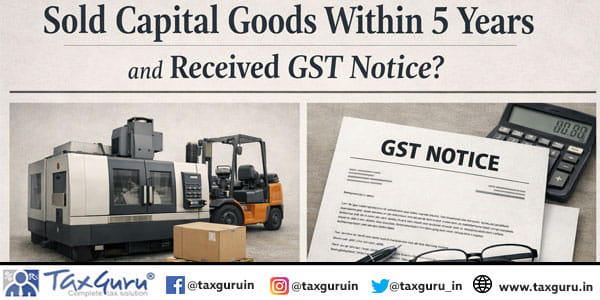
The article explains the GST implications on the sale of capital goods where input tax credit (ITC) has been availed. Under Section 18(6) of the CGST Act read with Rule 44(6), taxpayers must pay either the reduced ITC (based on remaining useful life of 5 years) or GST on transaction value, whichever is higher. Many taxpayers mistakenly assume that paying GST on the sale value alone ensures compliance, leading to short payment and departmental notices when reduced ITC exceeds such tax. The computation requires proportionate reduction of ITC at 5% per quarter. Non-compliance typically arises from interpretational or computational errors rather than intent to evade tax, and interest is payable on differential tax. Voluntary correction via DRC-03 is advised. Judicial precedents support leniency in genuine cases, emphasizing substantive compliance over procedural lapses, with most cases falling under Section 73 (no fraud), thereby generally avoiding penalties.
Author’s Note: A friend once asked me, “Aman, you have 2-3 GST registrations, and I want to purchase a new phone can you provide me one using your GST?”, He asked so as to get some money from me in exchange of giving me GST credit, but being aware of the legal provisions, especially Section 17(5) relating to blocked credit, I declined, GST law is very complicated when it comes to the capital goods, let’s discuss a practical case that came to me during my professional practice.
Introduction
Practically in the case of GST, certain provisions appear to be simple and straightforward but just on the surface in real it carries significant technical depth when applied and even lead to litigations, fines and penalties. One such provision is the treatment of sale of capital goods on which input tax credit has been taken.
I am not talking about whether you should favour your friend or someone by allowing them to use your GST, of course it may lead to big trouble for you as a taxpayer, but I am going to talk about a common misconception among taxpayers that if they pay GST on “transaction value” at the time of sale of capital goods is a sufficient compliance.
The GST law have a mechanism and a dedicated procedure regarding sale of capital goods and ignoring that will surely lead to notice from GST department, hence in this article, I have analysed Section 18(6) along with Rule 44(6) of CGST Rules.
Legal point of view
Section 18(6) of the CGST Act, 2017
“In case of supply of capital goods or plant and machinery, on which input tax credit has been taken, the registered person shall pay an amount equal to the input tax credit taken on the said capital goods or plant and machinery reduced by such percentage points as may be prescribed or the tax on the transaction value of such capital goods or plant and machinery determined under section 15, whichever is higher”
That means, this provision governs the treatment of ITC when capital goods or plant & machinery are supplied, which mandates that the registered person shall pay an amount equal to ITC taken on such capital goods reduced by prescribed percentage, OR tax on transaction value, whichever is higher
Rule 44(6) of CGST Rules
“The amount of input tax credit for the purposes of sub-section (6) of section 18 relating to capital goods shall be computed in accordance with the provisions of sub-rule (1) and the amount shall be determined separately for input tax credit of central tax, State tax, Union territory tax and integrated tax.
Provided that where the capital goods have been used for a period of time, the input tax credit involved in the remaining useful life in months shall be computed on pro rata basis, taking the useful life as five years.”
That means, this rule prescribes the manner of computing reduced ITC i.e. the useful life of capital goods is 5 years (60 months) and the ITC is reduced @ 5% per quarter or part thereof
Thus, remaining ITC attributable to useful life must be computed proportionately.
Illustration
Let’s discuss this with an example, STS Ventures had purchased a machinery on 1st April 2020, on which the ITC of 1.2 lakhs was availed. Now, it was sold on 1st April 2023 for Rs. 3,00,000, GST Rate was 18%
Now to determine liability forts of all I need to compute useful life consumed, here, as per GST law total useful life is 5 years (60 months), Used period is 3 years i.e. 36 months and the remaining life is 24 months.
Now we need to compute ITC attributable to remaining life i.e. ITC=1,20,000×24/60=Rs. 48,000
The GST of sale will be 3,00,000×18%=Rs. 54,000
Application of Section 18(6):
| Particulars | Amount |
|---|---|
| ITC (remaining life as per Section 18(6)) | Rs. 48,000 |
| GST on sale value | Rs. 54,000 |
Hence here Final Liability i.e. the tax payable shall be Rs. 54,000, Since GST on transaction value is higher, no additional ITC reversal required
Now, how I calculated the above? Let me explain using steps
As we did in the illustration, first of all, compute reduced ITC by calculating the original ITC availed less reduction based on usage period.
Then we are required to compute GST on sale value i.e. Transaction value × applicable GST rate, after that compare both the values by paying higher of the two
Practical case that I observed in notices received by one of the client
In many cases (including the present scenario) taxpayer pays GST on sale value, assumes compliance is complete, but he fails to compute reduced ITC, hence the ITC attributable to remaining life exceeds GST paid leading to short payment of tax. Resulting in demand raised for differential amount along with interest.
Illustrative for this:
| Particulars | Amount |
|---|---|
| Suppose if in above example ITC attributable comes to be | Rs. 40,000 |
| GST on Sale Value comes to be | Rs. 25,000 |
Then the liability would be Rs. 40,000 (higher value) and if taxpayer paid Rs. 25,000 and think that he is complied with GST law, then he is wrong as there is a shortfall of Rs. 15,000, which will attract notice.
Nature of default
As we discussed above, a question might be raised here, that what is the nature of default that is also the main issue in the case of litigation. Whether it is a bona fide error that means is the tax actually paid on transaction value, there is no concealment of sale, the books are properly made with rightly record of transactions and there is any misinterpretation of Section 18(6) OR whether it is seen on the other hand by the tribunal, i.e. ignorance of this section is a suppression of facts that means intentionally not disclosing the transaction or there is an intent to evade tax.
As per my experience, in most such cases, the issue is computational and interpretational, and not the deliberate evasion.
Next issue is the interest liability i.e. 18% to 24% depending upon situation
As per Section 50 of CGST Act, 2017, the interest is payable on differential tax liability (Rs. 15000 in above illustration which we discussed). It is calculated from date of supply till the date of payment, even if tax is voluntarily paid later, interest is mandatory.
Voluntary compliance
Where discrepancy is identified by the client, then he must first recompute the liability as per Rule 44(6) then to pay the differential tax through DRC-03 along with applicable Interest.
A detailed submission should be prepared in this case by including computation working, legal position, explanation of error and the proof of payment.
Note: Form GST DRC-03 is a voluntary payment form under GST used when a taxpayer wants to pay tax, interest, penalty, or any other amount on their own (or before/after notice).
How to respond to the notice once received
As per my approach, I believe in strong submission that should establish the full Disclosure of transaction recorded in books and reflected in returns with no malafide intent i.e. the tax already paid (though lower) and no revenue loss intent
Then you must disclose the nature of the issue that should purely be computational with the complex provision requiring interpretation
Regarding the voluntary compliance as we discussed earlier, the differential tax along with interest to be paid also there should be a proper cooperation with the department.
Judicial view
The tax liability must be determined based on the real nature of transaction, not merely procedural lapses, That means voluntary payment via DRC-03 reflects substantive compliance and the minor reporting errors (e.g., GSTR-3B mismatch) should not lead to harsh consequences.
Like in case of Commissioner of Central Excise vs. M/s. Hari Chand Shri Gopal, it was held that substantive compliance prevails over procedural lapses if conditions are essentially fulfilled, In the case of Mangalore Chemicals & Fertilizers Ltd. vs. Deputy Commissioner it distinguished between substantive vs procedural conditions, procedural non-compliance should not deny benefit if intent is genuine and in the case of Amit Cotton Industries vs. Principal Commissioner of Customs the GST regime recognised that technical lapses should not defeat substantive benefits (refund case).
Also, penalty requires intent to evade tax (mens rea), especially under fraud provisions (Section 74), as stated in Hindustan Steel Ltd. vs. State of Orissa which is the landmark ruling that stated penalty will not ordinarily be imposed unless the party acted deliberately in defiance of law, hence the genuine mistakes, especially in a new law like GST, should be treated leniently.
Penalty provision
I am trying to summarise above analysis with a small table
Section 73 vs Section 74
| Scenario | Applicable Section |
|---|---|
| No fraud / suppression | Section 73 |
| Fraud / wilful misstatement | Section 74 |
In most of the cases as above, the argument strongly lies under Section 73, Hence generally no penalty is imposed.
Conclusion
The sale of capital goods under GST is not merely a transaction, rather it is a compliance event requiring careful recalibration of ITC. Hence just payment of GST alone is not sufficient, the law mandates payment of the correct amount, determined through a comparative mechanism. Failure to apply this test often leads to avoidable notices, interest burden, and litigation exposure.
Frequently Asked Questions (FAQs)
Q1. What does Section 18(6) of the CGST Act require when capital goods are sold?
Ans. Section 18(6) requires a registered person who has availed Input Tax Credit (ITC) on capital goods to pay the higher of: (i) the ITC reduced based on the remaining useful life of the capital goods, or (ii) the GST calculated on the transaction value of the sale.
Q2. How is the reduced ITC calculated on the sale of capital goods?
Ans. Under Rule 44(6) of the CGST Rules, the useful life of capital goods is taken as five years (60 months). The remaining ITC is computed on a proportionate basis by reducing the original ITC at 5% per quarter or part thereof, and this amount is compared with the GST payable on the sale value.
Q3. Why do taxpayers receive GST notices after selling capital goods?
Ans. Many taxpayers pay GST only on the transaction value and assume they have complied with the law. However, if the reduced ITC attributable to the remaining useful life is higher than the GST paid on the sale value, the differential amount becomes payable, leading to GST notices along with applicable interest.
Q4. What should a taxpayer do if a short payment is identified?
Ans. If a discrepancy is identified, the taxpayer should recompute the liability under Rule 44(6), pay the differential tax along with applicable interest through Form GST DRC-03, and maintain detailed computations, legal explanations, and proof of payment for submission to the department.
Q5. Is penalty always applicable if there is a short payment on the sale of capital goods?
Ans. Not necessarily. According to the article, most such cases arise from computational or interpretational errors rather than fraud or suppression. Consequently, they generally fall under Section 73 of the CGST Act, where penalties may not be imposed, although interest on the differential tax remains payable.
***
The author can be contacted at [email protected]







The notice is for reversal under Section 18(6) of CGST Act read with Rule 40(2).
When you sell a capital good on which ITC was originally claimed, you must reverse the HIGHER of:
1. ITC proportional to remaining useful life: Original ITC claimed multiplied by (60 minus months of use) divided by 60
2. GST on the transaction value at the applicable rate on the date of sale
Example: Machine purchased for Rs 10 lakh, ITC claimed Rs 1.8 lakh (18%), used for 30 months, sold for Rs 5 lakh at 18%.
– Formula reversal = Rs 1.8 lakh multiplied by 30 divided by 60 = Rs 90,000
– GST on sale value = Rs 5 lakh multiplied by 18% = Rs 90,000
– Both are equal here, so reverse Rs 90,000
Reporting: The GST on sale appears in GSTR-1 (outward supply, taxable at 18%). The ITC reversal is shown in GSTR-3B Table 4(B)(2) (reversal of ITC as per rules 38, 42 and 43 of CGST Rules and Section 17(5)).
In your notice reply: attach the computation showing both amounts, indicate which is higher, show the GSTR-3B period where you reported the reversal, and attach the challan if you paid additional liability. If you paid GST on the sale and that exceeded the formula amount, the excess GST payment is your evidence., a practising CA