The GST portal has introduced a stricter enforcement of bank account validation for all registered taxpayers in March 2026. If you have not added or validated your bank account details on the GST portal, your GSTIN could be automatically suspended. This article explains what this update means, who it affects, what gets blocked if you do not comply, and exactly how to fix it in just a few minutes.
Key Facts at a Glance
| Requirement | Detail |
|---|---|
| Deadline to Add Bank Account | 30 days from GST registration |
| Alternate Trigger | Before filing GSTR-1 or IFF, whichever comes first |
| Risk if Not Complied | GSTIN suspension by the portal |
| Services Blocked on Non-Compliance | E-Invoice, E-Way Bill, Refunds, Return Filing |
| How to Restore GSTIN | Update valid bank details; portal auto-restores |
| Applicable From | March 2026 (Enforced) |
What Is the GST Bank Account Validation Requirement?
The GST Network (GSTN) has made it mandatory for every GST-registered business to link a valid bank account to their GSTIN on the portal. This rule is not entirely new, but enforcement has become significantly stricter from March 2026 onwards.
Earlier, taxpayers could often ignore this step without immediate consequences. That has now changed. The portal actively checks whether a valid bank account is linked. If it finds none, or if the account details have not been validated, it can automatically flag the GSTIN for suspension.
This is part of a broader government initiative to reduce fraudulent GST registrations and ensure that refunds, credits, and compliance activities are tied to verifiable business bank accounts.
Who Does This Affect?
This requirement applies to all GST-registered taxpayers, including:
1. Regular taxpayers filing GSTR-1 and GSTR-3B
2. Composition scheme dealers
If you registered for GST and skipped the bank account addition step, or if your registered bank account has been closed or changed, you are at risk of GSTIN suspension.
What Is the Deadline?
The GST rules specify that bank account details must be added within 30 days of GST registration. However, if you file GSTR-1 or use the Invoice Furnishing Facility (IFF) before that 30-day window closes, the bank account must be validated before that filing.
In simple terms, the deadline is whichever comes first:
1. 30 days from the date of GST registration, or
2. Before you file your first GSTR-1 or IFF
What Gets Blocked If You Do Not Comply?
Non-compliance with this requirement can result in the portal blocking several critical GST services tied to your GSTIN. Here is what may stop working:
1. E-Invoice generation: You will not be able to generate IRNs (Invoice Reference Numbers) for B2B invoices.
2. E-Way Bill generation: Businesses moving goods above the threshold value will be unable to generate e-way bills.
3. GST refund processing: Any pending refund claims will be stuck until the bank account is validated.
4. Return filing restrictions: In some cases, the portal may restrict GSTR-1 filings as well.
Any of these blocks can seriously disrupt day-to-day business operations, especially for businesses that depend on e-invoicing or transport goods regularly.
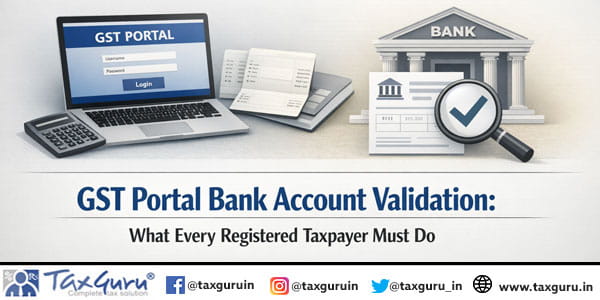
How to Add or Validate Your Bank Account on the GST Portal
The process is simple and takes only a few minutes. Follow the steps below:
Step 1 – Log in to the GST Portal at www.gst.gov.in using your credentials.
Step 2 – Navigate to Services and then click on Registration.
Step 3 – Select Amendment of Registration (Non-Core Fields).
Step 4 – Go to the Bank Accounts tab and add or verify your bank account details.
Step 5 – Submit the amendment. The portal will validate the account and lift any suspension automatically.
Once valid bank details are submitted, the GST portal will validate the account in the background. If your GSTIN had been suspended, the system will automatically restore it after successful validation. You do not need to raise a manual request for reinstatement.
Conclusion
The GST portal’s bank account validation requirement is a compliance step that every registered taxpayer must take seriously in 2026. Failing to add or validate a bank account within the stipulated time can lead to automatic GSTIN suspension, which blocks e-invoicing, e-way bills, refunds, and return filing. The good news is that the fix is quick: log in to the GST portal, go to the Amendment of Registration section under Non-Core Fields, and update your bank account. Once done, the portal reinstates your GSTIN automatically. Do not delay this step; check your GST registration today and make sure your bank details are validated and up to date.
Frequently Asked Questions (FAQ)
Can my GSTIN get suspended just because I did not add a bank account?
Yes. As per the March 2026 enforcement, the GST portal can automatically suspend your GSTIN if a valid bank account is not linked within the required time frame. This is a system-level action and does not require a manual order from a tax officer.
Will my past GST filings be affected?
No. Your past returns remain valid. The suspension only affects future compliance activities like filing returns, generating e-invoices, and e-way bills. Once the bank account is validated, all services are restored automatically.
What type of bank account should I add?
You should add a current account in the name of the GST-registered entity. For sole proprietors, a savings or current account in the proprietor’s name is acceptable. The account must be active and held in an Indian bank.
How do I know if my GSTIN is suspended?
Log in to the GST portal and check your registration status under Services > Registration. If your status shows as Suspended, you need to update your bank account details immediately to get it reinstated.
Is there a penalty for not validating the bank account?
While a direct monetary penalty is not mentioned for this specific lapse, the practical consequences, such as blocked e-invoice and e-way bill services, can lead to business disruptions and indirect penalties for non-issuance of proper documents.