In recent times, many traders across the country have been facing increasing difficulties during the transportation of goods due to strict enforcement actions relating to e-way bills under the Goods and Services Tax (GST) regime. While the objective of the GST law is to prevent tax evasion and ensure transparency in the movement of goods, the manner in which certain enforcement provisions are being applied in practice is creating hardship, particularly for small and medium traders.
One of the most frequently invoked provisions during inspections of goods in transit is Section 129 of the CGST Act, 2017, which empowers officers to detain goods and vehicles when they are transported in contravention of the GST law. The provision was intended to address cases where there is a clear attempt to evade tax, such as transporting goods without proper documentation or without generating an e-way bill.
The Government itself clarified this in CBIC Circular No. 64/38/2018-GST.
It lists minor errors where only ₹500 penalty under Section 125 should apply, not detention.
Examples:
- Minor spelling mistake in name
- Wrong pin code but correct address
- Minor HSN error
- Slight vehicle number mismatch
Several High Courts have held that minor mistakes should not lead to Section 129 penalty if there is no intention to evade tax.
Important judgments include:
→ Minor e-way bill mistakes cannot automatically lead to detention.
→ If documents are available and tax is paid, detention should not be mechanical.
Courts consistently say “intent to evade tax must exist.”
However, in practice, traders often find themselves facing detention and demand orders under Section 129 even for very minor mistakes in e-way bills. These mistakes may include small typographical errors, minor discrepancies in the vehicle number, slight variations in address details, or other clerical issues that do not indicate any intention to evade tax. Despite the presence of valid tax invoices and proper accounting of goods, proceedings under Section 129 are frequently initiated.
This approach has been questioned in several judicial decisions across the country. Various High Courts have consistently observed that minor technical errors should not automatically lead to detention of goods or imposition of heavy penalties when there is no evidence of tax evasion. The courts have emphasized that enforcement actions must be proportionate and should distinguish between genuine mistakes and deliberate violations.
Recognizing this concern, the Central Board of Indirect Taxes and Customs (CBIC) had earlier issued clarifications stating that minor errors in e-way bills should be dealt with by imposing only a nominal penalty under Section 125 of the CGST Act, rather than resorting to detention proceedings under Section 129. The intention behind this clarification was to prevent unnecessary disruption to trade and ensure that genuine taxpayers are not penalized excessively for small mistakes.
Despite these judicial pronouncements and administrative clarifications, the problem continues in several places. Trade associations and auditors’ associations have made repeated representations to senior authorities, including Principal Commissioners, highlighting the difficulties faced by traders. In many cases, replies have been issued stating that officers have been instructed not to initiate harsh action for minor errors. However, the ground reality often appears to be different, as such enforcement practices still continue.
Another emerging concern is the practice reported in some areas where notices are issued under Section 125 for minor errors, but the vehicle is not permitted to move until the penalty is paid. In effect, the goods remain detained even though Section 125 does not confer the power to detain goods or vehicles. Faced with urgent delivery commitments, many traders choose to pay the demanded amount immediately to secure the release of their vehicles, even if they believe the action is not legally justified.
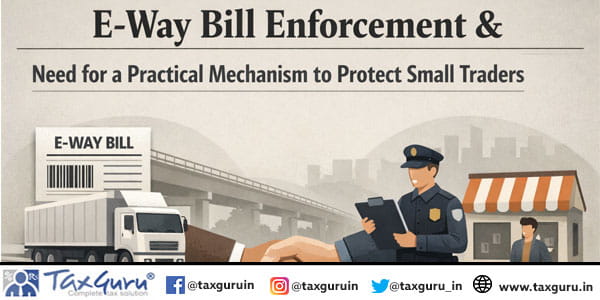
There is also a practical difficulty faced by traders when the penalty amount involved is relatively small. In many instances, the demand raised during such inspections is below ₹50,000. Although the trader may feel that the action is not legally sustainable, challenging the order through the appellate process often involves time, effort, and professional costs that may be comparable to, or even higher than, the amount in dispute. As a result, many traders prefer to pay the amount demanded in order to avoid delay in the movement of their goods.
This situation places the trader in a difficult position. When goods are detained on the road, delivery schedules are affected, transporters are under pressure, and business commitments have to be honoured. In such circumstances, traders often choose the quickest solution available, which is to pay the amount demanded so that the vehicle can continue its journey. While this may resolve the immediate problem, it leaves the underlying issue unaddressed and allows the practice to continue.
The cumulative effect of these situations is that a large number of small disputes never reach the appellate authorities or the courts, even though they may involve important questions of law. At the same time, the few cases that do reach the High Courts consume valuable judicial time, leading to avoidable litigation that could have been prevented through clearer administrative control.
This situation creates unnecessary financial strain on small traders and transporters. More importantly, it results in avoidable litigation, with many such matters eventually reaching the High Courts. Valuable judicial time is spent addressing issues that could have been resolved administratively through clearer and more consistent enforcement guidelines.
India has consistently emphasized the importance of improving the ease of doing business and creating a tax system that is fair, transparent, and taxpayer-friendly. For this objective to be realized in practice, it is important that enforcement mechanisms are applied with a balanced and pragmatic approach. While deliberate tax evasion must certainly be dealt with firmly, genuine mistakes should not result in disproportionate penalties or disruption of trade.
It may therefore be necessary for both the Central and State Governments to evolve a stronger and more effective administrative mechanism to address this issue. Clear operating procedures, proper monitoring of field-level actions, and accountability for misuse of enforcement provisions could go a long way in reducing such disputes.
A practical and balanced approach will not only protect honest traders but will also reduce unnecessary litigation and strengthen confidence in the GST system. After all, the true spirit of ease of doing business should be reflected not merely in policy statements but also in the day-to-day implementation of the law.