“Digital‑Era GST vs Old‑Mindset Enforcement: How Mechanical Cancellation and ITC Denial Punish Bona Fide Taxpayers”
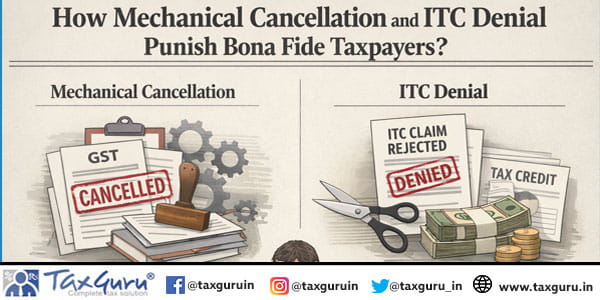
Under GST’s digital design, cancellation of registration and ITC denial based on a one‑time physical visit and “non‑existence” findings reflects an old, manual mindset that courts are increasingly rejecting, especially where recipients are bona fide and transactions are fully evidenced on the portal.
Digital design of GST vs old field practice
- GST is built around electronic registration, e‑invoicing, e‑way bills, online returns and bank‑linked payments; businesses routinely operate via mobiles, laptops, cloud ERPs and UPI without continuous physical presence at one premises.
- Yet many officers still treat “not found at registered place at one visit” or “phone not picked up” as proof of non‑existence, suspending and cancelling registration under section 29(2) without appreciating that the same taxpayer’s digital trail on GSTN shows ongoing, real business.
Case law on faulty “non‑existence” cancellations
- High Courts have repeatedly quashed cancellations where Rule 25 (physical verification) and REG‑30 were not followed (no prior notice, no report on portal, no evidence of date/time of visit or independent witnesses).
- Delhi HC has set aside orders cancelling registration on “non‑existence” with retrospective effect where the SCN and order were vague, did not disclose material, and ignored the taxpayer’s filings and documents; cancellation was held unsustainable and registration ordered to be restored.
- Madhya Pradesh HC in Empire Steel Holdings insisted that physical verification must be done in presence of a person, with statements of neighbouring shopkeepers and proper visit notes; a one‑sided note signed only by the inspector was held inadequate.
ITC denial, section 16(2) (aa), 74 and 86A in the digital era
- Gauhati HC and other courts (e.g. McLeod Russel India Ltd.) have read down section 16(2) (aa), holding that ITC cannot be denied to a bona fide buyer merely due to supplier’s GSTR‑1 default if the buyer proves genuineness by invoices, banking, and e‑way bills.
- Taxmann’s analysis of “non‑existent vs non‑functional suppliers” notes cases where ITC of recipients was protected despite suppliers later being found non‑traceable, because the buyer’s digital and transactional evidence established real movement of goods and payment of tax.
- Courts have criticised mechanical invocation of section 74 (fraud), section 64 (summary assessment), and Rule 86A (blocking credit) against recipients, without first investigating suppliers or considering the digital record, as contrary to natural justice and the scheme of GST.
How genuine recipients are suffering in this gap
- When registration is cancelled for alleged non‑existence based only on a field visit, the officer often labels all outward and inward supplies of that GSTIN as “suspicious”, leading to:
- ITC reversal demands on buyers under sections 16 and 74 solely due to supplier default.
- Rule 86A blocking of credit, paralysing cash flow even though buyers hold complete documentation and e‑compliance.
- This breaks the ITC chain, punishes bona fide purchasers, and contradicts the stated GST objective of avoiding cascading and facilitating ease of doing business in a digital economy.
Draft commentary you can adapt (for writs / appeals):
You can use and tweak the following commentary block in your pleadings to highlight “digital era vs old mindset”:
“The GST regime is fundamentally a technology‑driven system where registration, returns, e‑invoices, e‑way bills and tax payments are all executed electronically through the common portal. The petitioner (taxable person) conducts business through computerized accounts, mobile‑based applications, UPI payments and online communications, and regularly declares all supplies on the GST portal. In such a digital environment, continuous physical presence of the taxable person at the registered premises cannot be treated as the sole test of existence.
Nevertheless, the respondent (officer) has proceeded on an outdated, purely physical‑inspection model. A single visit, at an unspecified date and time, when the petitioner (taxable person) was away on business/personal work, has been treated as conclusive proof of ‘non‑existence’, leading to suspension and cancellation of registration under section 29(2) without proper notice, without uploading a physical verification report in FORM REG‑30 as mandated by Rule 25, and without granting any meaningful personal hearing. Courts have consistently held that such cancellations are unsustainable and must be set aside where Rule 25 procedure is not followed and orders are non‑speaking.
The impugned action not only ignores the petitioner’s (taxable person) robust digital compliance – including filed GSTR‑1 and GSTR‑3B returns, e‑way bills, e‑invoices and bank‑routed payments – but also causes severe collateral damage to bona fide purchasers. By branding the petitioner (taxable persons) as ‘non‑existent’ and cancelling registration (often with retrospective effect), the department triggers denial of input tax credit and even blocking of electronic credit ledgers of genuine recipients under section 16(2) (aa), section 74 and Rule 86A, solely on account of alleged supplier default. High Courts, including the Gauhati High Court and others, have now read down section 16(2) (aa) and held that ITC cannot be denied to bona fide buyers merely because of supplier non‑compliance, and that the department must first evaluate the purchaser’s bona fides on the basis of invoices, e‑way bills and banking trail.
The petitioner (taxable person) submits that continuation of a pre‑GST, manual‑era mindset in a digital tax system leads to arbitrary cancellations, unjust ITC denials and disruption of legitimate trade. It is therefore prayed that the impugned order be quashed, registration restored (or cancellation confined prospectively), and the respondents (officer) be directed to reassess the petitioner’s status and the recipients’ ITC claims by giving due weight to the available digital records instead of relying solely on a one‑off site visit or presumptions of non‑existence.”
How to “solve” or mitigate the problem in practice:
- In cancellation challenge (supplier side): attack non‑compliance with Rule 25, lack of REG‑30 upload, vague SCN and non‑speaking order; press for restoration or at least prospective cancellation and a fresh, reasoned decision.
- In ITC / section 74 / 86A disputes (recipient side): lead with digital evidence (invoices, e‑way bills, e‑invoices, GSTR‑1/3B, bank trail) and rely on McLeod Russel line and other decisions that read down section 16(2) (aa) and insist on hearing the buyer’s bona fides before denying ITC.
- Policy / representation angle: use these judgments to argue, in representations or professional forums, for CBIC/GST Council guidelines directing officers to treat portal data and digital trail as primary evidence, and to reserve “non‑existence” cancellations for truly fake, non‑functional entities backed by proper verification.
If you share one specific cancellation/ITC order (with dates and grounds), this commentary can be narrowed into precise grounds of writ/appeal tailored for that case.