Introduction
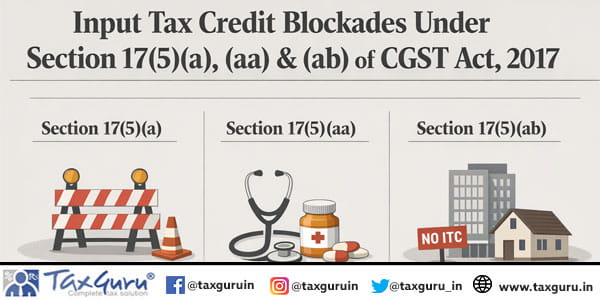
The original iteration of Section 17(5), enacted at the dawn of the GST regime in July 2017, was fraught with interpretational ambiguities, particularly concerning “motor vehicles and other conveyances”. To rationalise the law and resolve mounting litigation, the Central Goods and Services Tax (Amendment) Act, 2018 (brought into force on February 1, 2019), fundamentally restructured the blockades on vehicular assets and their related services. This amendment introduced the highly specific framework of clauses (a), (aa), and (ab), transitioning the law from a generalised, ambiguous restriction to a capacity-driven, asset-categorised restriction model.
The real-world application of these provisions cannot be executed linearly across all business models. Tax professionals frequently encounter significant interpretive friction when attempting to reconcile rigid statutory definitions with industry practices and diverse contractual structures. A critical nuance exists between Section 16(1) and Section 17(5). While Section 16(1) grants credit based on the liberal “use or intended to be used” criterion, the specific escape routes within Section 17(5)(a) and Section 17(5)(aa) permit claiming of ITC only “except when they are used” for certain taxable supplies. This omission of the phrase “intended to be used” in the exception clauses shifts the burden of proof onto the taxpayer.
Deep Analysis of Section 17(5)(a)
Section 17(5)(a) of the CGST Act dictates that ITC shall not be available in respect of “motor vehicles for transportation of persons having approved seating capacity of not more than 13 persons (including the driver), except when they are used for making the following taxable supplies, namely: (A) further supply of such motor vehicles; or (B) transportation of passengers; or (C) imparting training on driving such motor vehicles”. A meticulous deconstruction reveals the immense legal complexity embedded within this single sentence.
The Importation of the “Motor Vehicle” Definition
The CGST Act deliberately refrains from defining the term “motor vehicle” within its own boundaries. Instead, Section 2(76) of the CGST Act acts as a bridge, importing the definition directly from Section 2(28) of the Motor Vehicles Act, 1988. Section 2(28) of the Motor Vehicles Act defines a motor vehicle as “any mechanically propelled vehicle adapted for use upon roads, whether the power of propulsion is transmitted thereto from an external or internal source and includes a chassis to which a body has not been attached and a trailer”.
Crucially for tax professionals, this definition contains explicit statutory exclusions. It does not include a vehicle running upon fixed rails, a vehicle of a special type adapted for use only in a factory or any other enclosed premises, or a vehicle having less than four wheels fitted with an engine capacity not exceeding twenty-five cubic centimetres.
This imported definition creates immediate, intense interpretive hurdles compared with the Harmonised System of Nomenclature (HSN) classification used by the GST framework to determine tax rates. The Motor Vehicles Act relies heavily on the “adapted for use upon roads” principle, a broad umbrella that encompasses heavy earth-moving machinery, dumpers, and mobile cranes as they are technically capable of road transit. However, from an ITC eligibility perspective, appellate authorities and courts have increasingly recognised a functional interpretation. For instance, heavy excavators, JCBs, and tippers deployed exclusively within mining areas, construction sites, or factory premises are typically classified under HSN 8429 or 8430 as earth-moving machinery, rather than under the motor vehicle chapters (HSN 8702, HSN 8703). If an asset functions predominantly as “plant and machinery” and is confined to an enclosed premises (thus meeting the exclusion criteria of the Motor Vehicles Act), it escapes the definition of a blocked motor vehicle entirely.
Tax professionals must look beyond the mere presence of an engine and wheels. They must rigorously examine the primary design, HSN classification, and functional deployment of specialised equipment to defend ITC claims against revenue authorities who often apply a blanket denial based on the mere necessity of Regional Transport Office (RTO) registration.
“For Transportation of Persons” vs. “For Transportation of Goods”
The 2019 amendment brought vital clarity by qualifying the blocked motor vehicles with the precise phrase “for transportation of persons”. The immediate and most significant corollary of this phrasing is that any motor vehicle principally designed for the transportation of goods (such as heavy trucks, delivery vans, lorries, tractors, and cargo trailers falling under HSN 8701 or HSN 8704) is entirely and unconditionally immune from the blockade under Section 17(5)(a). For commercial goods transport vehicles, the liberal “use or intended to be used” principle of Section 16(1) applies directly, and the ITC is fully admissible without the taxpayer needing to satisfy any of the narrow exceptions listed in the sub-clauses of 17(5)(a).
However, this phrasing poses a significant challenge for dual-purpose vehicles, such as double-cab pickup trucks or utility vans. The determination relies on the vehicle’s principal design. If a dual-purpose vehicle is registered by the RTO primarily as a passenger vehicle, the revenue department will rely on that registration to deny the credit, even if the business uses the vehicle strictly for carrying commercial cargo to a worksite. The design and official documentation invariably supersede actual usage when determining whether the vehicle falls within the initial blocked category.
The Threshold Test of Approved Seating Capacity
If a vehicle is deemed a motor vehicle designed for the transportation of persons, the next statutory filter is the capacity test. The restriction applies only to vehicles “having an approved seating capacity of not more than thirteen persons (including the driver)”.
The operative word here is “approved.” Tax professionals should note that the number of physical seats currently installed in the vehicle is legally irrelevant; the definitive evidentiary document is the capacity approved by the transport authorities and recorded in the vehicle’s Registration Certificate (RC). If a corporate entity purchases a 14-seater mini-bus to transport its employees, the ITC is not blocked by Section 17(5)(a) because the capacity exceeds the threshold. Conversely, if a business purchases an 8-seater multipurpose vehicle and removes four seats to accommodate equipment, the vehicle remains blocked because its “approved” capacity remains below the 14-person threshold.
Phrase-by-Phrase Breakdown of the Exceptions
When a vehicle is caught within the parameters of the blockade (that it is a passenger vehicle with an approved capacity of 13 or fewer), the ITC is irrevocably lost unless the taxpayer can conclusively prove actual usage in one of three explicitly prescribed outward taxable supplies.
Exception (A): “Further supply of such motor vehicles” This exception is designed to protect the automotive supply chain. It ensures that automobile manufacturers, wholesale distributors, and authorised retail dealers can claim ITC on the vehicles they procure as stock-in-trade for onward sale. If a car dealership purchases inventory from a manufacturer, the GST paid is fully creditable because the dealership’s outward taxable supply is the same category of goods. The interpretive conflicts surrounding the word “such” and its application to demonstration vehicles are analysed in the section below.
Exception (B): “Transportation of passengers” A massive legal distinction exists between the phrase “transportation of persons” (which describes the physical nature of the vehicle in the opening text of the clause) and “transportation of passengers” (which describes the commercial nature of the outward taxable service in the exception). The term “passenger” implies a commercial contract for carriage, where a specific fare, ticket, or tariff is charged for the journey. A taxpayer that operates a municipal bus network, a commercial taxi service, or an airline provides passenger transportation. Therefore, a taxi operator can claim ITC on the purchase of a 4-seater sedan.
However, when a manufacturing company purchases a 4-seater sedan to transport its executives from the airport to the factory, the company is transporting “persons,” but it is not engaged in the outward taxable supply of “transportation of passengers” for a consideration. Consequently, the manufacturer is denied ITC for that vehicle.
Exception (C): “Imparting training on driving such motor vehicles” This final exception protects the operational assets of driving schools, commercial vehicle training institutes, and aviation academies, allowing them to capitalise on the tax paid on their core training conveyances.
Deep Analysis of Section 17(5)(aa)
Before the 2019 amendment, vessels and aircraft were classified with motor vehicles under the broad and rather ambiguous term “other conveyances.” The introduction of Section 17(5)(aa) created an independent, highly specific statutory silo for maritime and aviation assets.
Under clause (aa), ITC is completely blocked for all vessels and aircraft, thereby fundamentally disregarding the seating-capacity criterion that governs road vehicles. A 2-seater private aircraft and a 300-seater commercial airliner both fall into the initial blockade. To claim ITC, the taxpayer must satisfy one of the listed exceptions.
The exceptions under clause (aa) closely mirror the exceptions of clause (a) – further supply, passenger transportation, and imparting training on navigating or flying – but with one critical structural addition: ITC is explicitly permitted if the vessel or aircraft is used “(ii) for transportation of goods”.
The architectural difference between clause (a) and clause (aa) is profound and dictates the burden of proof during audits. For motor vehicles, the statute achieves the allowance for goods transport by completely excluding goods carriages from the definition of the blocked asset from the very beginning. For vessels and aircraft, the statute first seizes the asset in its entirety and then creates an exception for goods transportation. A business purchasing a cargo ship or a freighter aircraft must actively demonstrate that the asset is used for the transportation of goods to activate the exception under 17(5)(aa)(ii).
For high-net-worth individuals, large corporate conglomerates, and political organisations purchasing corporate jets, helicopters, or private yachts for executive travel or business meetings, the ITC is decisively and permanently blocked. Executive travel does not qualify as the outward taxable supply of passenger transportation (no tickets are sold), nor does it qualify as the transportation of goods. Thus, corporate aviation and maritime assets remain firmly trapped within the disallowed zone.
Deep Analysis of Section 17(5)(ab)
Section 17(5)(ab) constitutes a deliberate legislative attempt to seal a substantial revenue leak arising from the operational and maintenance expenditures associated with the blocked conveyances. The clause blocks ITC on “services of general insurance, servicing, repair and maintenance in so far as they relate to motor vehicles, vessels or aircraft referred to in clause (a) or clause (aa)”.
The provision operates on a strict-dependency model: the blockade on the ancillary service is entirely contingent on the ITC status of the underlying physical asset. If the underlying motor vehicle, vessel, or aircraft is eligible for ITC (either because it is a goods carriage, has a seating capacity exceeding 13, or qualifies under any other specific exception), the ITC on its insurance, repair, and maintenance is automatically and unconditionally allowable. If the ITC on the vehicle was blocked at the time of purchase, the ITC on all subsequent repairs and insurance policies for that vehicle is likewise blocked.
Furthermore, the proviso to Section 17(5)(ab) carves out independent, industry-specific exceptions. Even if the underlying vehicle is a blocked asset (e.g., a standard 4-seater passenger car), the ITC on insurance and repairs is permitted if the services are received by a taxable person engaged in the manufacture of such vehicles, or by a general insurance company providing insurance for such vehicles. This ensures that automotive manufacturers and the insurance sector are not burdened by cascading, non-creditworthy taxes on their core operational inputs.
The Interpretational Loophole
A widely debated interpretive loophole exists in the precise wording of Section 17(5)(ab). The statute restricts the services of general insurance to servicing, repair, and maintenance. It is conspicuously silent on the supply of “goods” relating to such vehicles.
When a taxpayer sends a blocked corporate passenger car to an authorised service centre, the service centre typically issues a tax invoice comprising two distinct elements: the supply of tangible items (spare parts, tyres, batteries, lubricants) and the supply of labour (repair services). Often, these are billed separately with distinct HSN (for goods) and SAC (for services) codes.
Because Section 17(5)(ab) solely and explicitly restricts services, a strictly literal interpretation of the statute dictates that the ITC on the standalone purchase of spare parts, tyres, batteries, and other accessories is not blocked by this clause. While the revenue department frequently attempts to categorise the entire garage invoice as a “composite supply” of repair services (where the principal supply is deemed to be the service, thereby tainting the goods and blocking the entire ITC amount), taxpayers possess a formidable defence if the procurement of parts is executed independently.
If a business purchases new tyres from a retail automotive vendor (a pure supply of goods) and subsequently pays a local mechanic to install them (a pure supply of service), the ITC on the high-value tyres cannot be lawfully denied under Section 17(5)(ab), as the clause exerts zero jurisdiction over the independent supply of goods and accessories. Tax professionals are increasingly utilising this strict, literal interpretation to unblock substantial credits on expensive automotive components.
Systemic Ambiguities and Structural Confusion
The overarching structure of these provisions generates intense confusion, compelling taxpayers to litigate interpretations across different business models. The core of this friction lies in the intersection of broad, dynamic commercial practices and rigidly narrow statutory phrasing.
The “Such Motor Vehicles” Debate
Perhaps the most fiercely litigated phrase under Section 17(5)(a) has been “further supply of such motor vehicles”. For years, a massive controversy raged around “demonstration vehicles” (demo cars) purchased by authorised automobile dealers. Dealers purchase these vehicles from manufacturers, capitalise them as fixed assets in their books, utilise them for providing customer test drives, and eventually sell them as used, second-hand vehicles at a depreciated value.
Historically, revenue authorities have denied ITC for such demonstration vehicles. The departmental argument was twofold: First, at the time of procurement, the vehicles were used for marketing and test drives, not used for further supply. Second, authorities argued that the eventual sale of a depreciated, used demo car did not constitute the supply of “such” motor vehicle (implying that “such” meant a brand-new vehicle identical to the one originally purchased). Advance Ruling Authorities across states delivered highly conflicting judgments, with some allowing the credit and others blocking it based on the classification of the eventual sale as “scrap” or “second-hand goods”.
This protracted dispute was definitively resolved by the Central Board of Indirect Taxes and Customs (CBIC) via the issuance of Circular No. 231/25/2024-GST on September 10, 2024. The CBIC adopted a purposive and highly logical interpretation, clarifying that the legislature deliberately utilised the phrase “such motor vehicles” rather than “the said motor vehicle”. The use of the word “such” designates a class, category, or type of vehicle. Because demo cars are instrumentally utilised to promote the sale of similar types of vehicles, they are inherently and legally “used for making a further supply of such motor vehicles”.
The Circular established formidable, foolproof guidelines that tax professionals must now operationalise:
| Parameter regarding Demo Vehicles | CBIC Circular 231/25/2024-GST Mandate | Implications for Tax Professionals |
|---|---|---|
| Basic ITC Eligibility | ITC is fully allowed. Qualifies under the “further supply” exception of 17(5)(a)(A). | Dealers must ensure demo vehicles are strictly segregated for customer trials and not diverted for personal use. |
| Impact of Capitalisation | Allowed, provided no income tax depreciation is claimed on the GST component (per Section 16(3)). | Accounting software must correctly map the GST component to the Electronic Credit Ledger, not the asset block. |
| Subsequent Disposal or Sale | Fully taxable under the forward charge mechanism. | Dealers must meticulously comply with Section 18(6) valuation rules when selling the depreciated vehicle. |
| Use for Staff Transport | ITC is strictly blocked. | Maintaining exhaustive vehicle logbooks and GPS data is essential to prove exclusive demo usage during audits. |
| Dealership Agency Model | ITC is blocked if the dealer acts merely as a marketing agent and does not take ownership of the vehicle. | Contracts between OEMs and dealers must reflect the actual purchase and the risk transfer to validate the “further supply” claim. |
This circular, and subsequent High Court affirmations (such as the Bombay High Court ruling in Sai Service (P.) Ltd.), established that the clarification applies retrospectively, overriding previous adverse assessment orders.
“Transportation of Passengers” (SAC 9964) vs. “Renting of Motor Vehicles” (SAC 9966)
A severe compliance challenge and audit risk arise when businesses hire vehicles for employee commuting or corporate travel. The eligibility of ITC hinges perilously on the legal distinction between the services of “Transportation of Passengers” (Service Accounting Code 9964) and the “Renting of Motor Vehicles” (SAC 9966).
In “Passenger Transportation” (SAC 9964), the service provider retains absolute dominion, possession, and control over the vehicle. The customer simply purchases the right to travel from a point of origin to a destination. The consideration is typically linked to the distance travelled, the specific route, or the individual journey. Under the exception in Section 17(5)(a), a service provider engaged in SAC 9964 can rightfully claim ITC on the vehicles they purchase to execute this service.
In “Renting of Motor Vehicles” (SAC 9966), the essence of the commercial contract is the transfer of the right to use the vehicle. The customer values the convenience of having the vehicle at their disposal for a specified period, regardless of whether it is actively driven or parked. The consideration is based on time and availability, not merely distance.
This distinction is frequently weaponised during departmental audits. If a corporate entity hires a 50-seater bus for employee transport, the vehicle itself falls safely outside the 13-seater restriction of Section 17(5)(a). However, the ITC on the service invoice may still be endangered if the contract is poorly drafted. If the department classifies the transaction as “renting” under SAC 9966, they may attempt to block the credit under the general provisions of Section 17(5)(b)(i), which restricts the leasing, renting, or hiring of motor vehicles.
Crucially, tax professionals must argue that post-2019, Section 17(5)(b)(i) restricts renting/leasing only in respect of vehicles “referred to in clause (a)” (i.e., those with up to 13 seats). Therefore, the hiring or renting of a >13 seater bus is entirely eligible for ITC, provided the invoice and contract accurately reflect the commercial reality and comply with the specific rate notifications (e.g., ensuring the supplier has charged 12% GST with forward charge ITC, rather than 5% without ITC, which shifts the burden to the recipient under Reverse Charge Mechanism).
The Interaction with Statutory Obligations: Section 17(5)(b) Proviso
Section 17(5)(b)(i) blocks ITC on food, beverages, outdoor catering, beauty treatments, and the leasing, renting, or hiring of motor vehicles referred to in clause (a). Section 17(5)(b)(iii) blocks travel benefits extended to employees. However, a critical proviso is inserted at the end of clause (b): “Provided that the input tax credit in respect of such goods or services or both shall be available, where an employer must provide the same to its employees under any law for the time being in force.”
An interpretational conflict exists regarding the scope of this proviso. Does it apply only to clause (b)(iii) (travel benefits), to all of clause (b) (including food and the renting of vehicles), or does it somehow override clause (a) entirely? The accepted legal consensus, supported by advanced rulings and the structural formatting of the statute, is that the proviso applies to the entirety of clause (b), but it does not override clause (a). This means the proviso can unblock the service of renting a vehicle, but it cannot unblock the purchase of a vehicle.
Therefore, if a state’s Shops and Establishments Act or the Factories Act mandates that an employer must provide secure transportation to women employees working night shifts, the ITC on the renting of a 4-seater cab (which is otherwise blocked under 17(5)(b)(i) referencing clause (a)) becomes explicitly allowable under the statutory obligation proviso. Tax authorities frequently object to this during audits, arguing that clause (a) constitutes an absolute block on anything related to small cars. However, formidable legal arguments dictate that since clause (b)(i) specifically restricts the “renting or hiring of motor vehicles… referred to in clause (a)”, the subsequent proviso lawfully unblocks this specific restriction when a statutory mandate exists. The business must prove the existence of the labour law and the fact that the specific invoice relates to fulfilling that exact obligation.
Progressively Highly Complex Simulated Scenarios
To illustrate the practical application of these provisions across industries, the following simulated scenarios examine the friction between dynamic business models and rigid statutory language.
Scenario 1: The Logistics Escort Vehicle and the Functional Utility Doctrine
Facts: Alpha Heavy Logistics operates multi-axle trailers (which are unequivocally goods carriages) to transport massive wind turbine blades across state lines. For safety, traffic control, and highway regulatory compliance, a 5-seater SUV (a passenger vehicle) must travel directly ahead of the trailer as an escort vehicle. Alpha purchases the SUV and claims ITC, arguing it is an essential, legally mandated component of the “transportation of goods.”
Taxpayer’s Argument: The SUV is never used for independent passenger transport. Its functional utility is entirely subsumed within the outward taxable supply of goods transportation. Relying on the functional utility doctrine established in landmark judgments (akin to the Safari Retreats logic regarding commercial assets), the taxpayer argues that if the primary service (goods transport) is taxable and eligible for ITC, the tools necessary to execute it should not be artificially segmented and blocked.
Tax Authority’s Objection: The statute operates on a strict physical identity test, not an economic or functional utility test. The SUV, as registered by the RTO, is a motor vehicle for the transportation of persons with an approved capacity of less than 13. It is not used for “further supply,” “transportation of passengers,” or “training.” The fact that it tactically assists a goods carriage does not magically transform the SUV itself into a goods carriage. The credit is absolutely blocked under Section 17(5)(a).
Legal Resolution: The Tax Authority’s position is legally unassailable under the current statutory framework. Section 17(5)(a) is rigid and unforgiving. Unless the asset itself is physically a goods carriage, or fits one of the three specific exceptions, its functional nexus to a broader, eligible business activity is entirely irrelevant for the purposes of claiming ITC on motor vehicles. The ITC on the SUV is blocked.
Scenario 2: The Cash-in-Transit Armour and the Definition of “Goods”
Facts: SecureVault Ltd. purchases standard 10-seater passenger vans. They immediately strip the interiors and install heavy steel armour, operating exclusively as cash-in-transit vehicles for commercial banks. SecureVault claims ITC on both the base vehicles and the expensive fabrication costs, classifying them as goods carriages.
Tax Authority’s Objection: The authority denies the ITC on the basis of statutory definitions. Under Section 2(52) of the CGST Act, the definition of “goods” explicitly excludes “money”. Therefore, transporting cash is technically not the “transportation of goods.” Since the vehicle is built on a passenger chassis with less than 13 seats, and it does not transport “goods” as defined by the Act, it falls squarely into the blockade of Section 17(5)(a).
Taxpayer’s Argument: The exclusion of money from the definition of goods is a mechanism to prevent GST from being levied on the mere transfer of monetary value or currency exchange. However, when physical currency is stored in a vault and transported in a van, it constitutes physical freight. SecureVault is not using the money as legal tender; it is treating it as a physical commodity (cargo) entrusted to it by a client for logistics purposes.
Legal Resolution: Relying on the highly persuasive jurisprudential logic established in appellate rulings like CMS Info Systems, the taxpayer’s argument holds formidable ground. When physical currency is transported as secured cargo, it ceases to act as legal tender in that specific logistical transaction and assumes the character of “goods.” Consequently, the heavily modified cash-in-transit van qualifies as a vehicle used for the “transportation of goods,” completely exempting it from the Section 17(5)(a) blockade.
Scenario 3: The Automotive Benchmarking Fleet
Facts: Beta Automotive Research (an engineering firm, not a vehicle manufacturer or dealer) purchases five high-end, 4-seater sedans. Their core business model involves disassembling, benchmarking, testing, and reverse-engineering these vehicles to generate and sell highly specialised analytical data to global automobile manufacturers. After 18 months of intensive testing, the dismantled, non-roadworthy vehicles are sold as scrap metal. They claim ITC on the vehicle purchases.
Taxpayer’s Argument: The vehicles are effectively raw materials or consumables for the engineering benchmarking service. Without the vehicles, the outward taxable supply (as reported in the data) cannot exist. The vehicles are not used for “transportation” in any traditional sense. Furthermore, selling the scrap later constitutes a “further supply.”
Tax Authority’s Objection: The taxpayer’s outward supply is an information/engineering service (benchmarking), not the supply of motor vehicles. Selling twisted scrap metal at 18% GST does not constitute the “further supply of such motor vehicles” (which implies selling actual, functional vehicles that retain their character).
Legal Resolution: The ITC is definitively blocked. The vehicles procured are motor vehicles with a capacity of less than 13. They do not satisfy any of the explicit exceptions in Section 17(5)(a). Disposing of the vehicles as scrap breaks the chain of identity required for the “further supply of such motor vehicles” exception. The taxpayer’s heavy reliance on absolute business necessity cannot override the explicit statutory bar.
Scenario 4: The Aviation Academy’s Dual-Use Corporate Charter
Facts: SkyHigh Aviation Academy purchases a 6-seater twin-engine aircraft. According to the flight logs, the aircraft is used 70% of the time for “imparting training on flying” to student pilots (an eligible exception under 17(5)(aa)). However, 30% of the time, the academy leases the aircraft as a private corporate charter to high-net-worth individuals for executive travel (a blocked use). SkyHigh claims 100% ITC upon purchase.
Tax Authority’s Objection: Since the aircraft is not used exclusively for the permitted exceptions, and is partly used for a blocked purpose (executive charter without ticketing), the ITC must be denied entirely, or at the very least, subjected to heavy proportionate reversal.
Taxpayer’s Argument: Section 17(5)(aa) states the credit is blocked “except when they are used” for imparting training. The aircraft is used for imparting training. The statute does not explicitly demand “exclusive” use for the exception. Therefore, the ITC is permitted, and any non-business or exempt use should be treated under the standard apportionment rules (Rules 42/43), not as a complete blockade under 17(5).
Legal Resolution: This is a highly grey area prone to intense litigation. Because the primary, dominant use is for an eligible exception (training), the initial availment of ITC is legally defensible. However, the 30% usage of corporate charters constitutes a separate outward supply. If the corporate charter is billed as a taxable supply of “transportation of passengers” (where the client buys a route), it remains eligible. If it is billed as “renting of aircraft” (where the client charters the entire aircraft for days), it falls within the blockade. In practice, the taxpayer must rigorously apply the apportionment principles of Section 17(1) and 17(2), together with Rule 42, and reverse the ITC proportionately to the non-eligible usage to survive an audit.
Scenario 5: The Complexities of the Insurance Claim Settlement
Facts: Delta Logistics owns a fleet of heavy goods trucks (fully eligible for ITC). One truck suffers a catastrophic accident. Delta files an insurance claim under a “Reimbursement Model.” Delta pays the third-party garage ₹10 Lakhs (inclusive of ₹1.8 Lakhs GST) for repairs. The invoice is in Delta’s name. Delta claims the ₹1.8 Lakhs ITC under Section 17(5)(ab) because the underlying vehicle is a goods carriage. The insurance company later reimburses Delta ₹8 Lakhs, applying a ₹2 Lakhs deduction for the salvage value of the destroyed parts that Delta retained.
Tax Authority’s Objection: The officer notices the insurance settlement and objects on two fronts. First, since the insurance company paid for the repairs, Delta did not bear the economic burden of the tax and therefore cannot claim the ITC. Second, by retaining the salvage (worth ₹2 Lakhs), Delta has effectively procured scrap without paying output tax on it, demanding an ITC reversal proportionate to the salvage value.
Legal Resolution: The Tax Authority’s first objection is legally flawed. Section 16 requires the recipient to pay the supplier; it does not specify the source of funds (e.g., insurance reimbursement). Since the invoice is in Delta’s name and Delta paid the garage, Delta is the lawful claimant of the ITC. Regarding the second objection, Circular No. 217/11/2024-GST clarifies the mechanics. The insurer’s deduction of salvage value is merely a financial calculation for claim settlement. Delta is not “supplying” the salvage to anyone; it is retaining its own damaged property. No outward supply has occurred, and therefore, no ITC reversal or output tax liability is triggered on the salvage value.
Debunking Pervasive Professional Misconceptions
The interplay of GST laws with traditional corporate accounting practices frequently generates systemic misconceptions within corporate finance teams:
Misconception 1: “If an asset is capitalised in the company’s balance sheet and used 100% for business, it is automatically eligible for ITC.” Reality: Capitalisation is entirely irrelevant to the blockades of Section 17(5). A luxury sedan purchased for the Managing Director, capitalised as a fixed asset, depreciated under the Income Tax Act, and used exclusively for negotiating business contracts, remains strictly and permanently blocked under 17(5)(a) due to its seating capacity. Business utility does not bypass the statutory category restriction.
Misconception 2: “Purchasing an ambulance for the manufacturing plant guarantees ITC because it is a vital, life-saving asset.” Reality: Under the Motor Vehicles Act, an ambulance is technically classified as a motor vehicle for the transportation of persons with a seating capacity of less than 13. It does not inherently qualify as a goods carriage, nor does it provide the commercial “transportation of passengers” for a fare. Unless the factory is legally mandated by the Factories Act or state labour laws to maintain a dedicated ambulance on-site (thereby activating the statutory obligation proviso to Section 17(5)(b)), the ITC on the ambulance purchase is categorically blocked.
Misconception 3: “Purchasing a 14-seater vehicle guarantees ITC without any further conditions.” Reality: While a vehicle with an approved seating capacity of more than 13 persons successfully escapes the primary blockade of Section 17(5)(a), it is still subject to the general restrictions of Section 16 and Section 17(1)/(2). If the company uses the 14-seater bus to provide a completely exempt output supply, or diverts it occasionally for the personal, non-business use of the directors, the ITC must be proportionately reversed under Rule 42 or 43 of the CGST Rules. The capacity test merely opens the gate; it does not grant unconditional, perpetual credit.
Misconception 4: “Input tax credit on health insurance and life insurance is entirely banned under GST.” Reality: While Section 17(5)(b)(i) generally blocks ITC on life insurance and health insurance, the sweeping proviso attached to clause (b) unblocks these credits if the employer is obligated to provide such insurance under any law in force. For example, under certain regulatory mandates (e.g., those issued under the Disaster Management Act during pandemics) or specific state labour acts requiring workmen’s compensation insurance, the ITC for those policies becomes fully eligible.
Practical Compliance Challenges During Audits and Scrutiny
During departmental audits, anti-evasion scrutiny under Section 61 of the CGST Act, or detailed audits under Section 65, the treatment of motor vehicles and their ancillary services generate intense, high-stakes friction. The transition of the GST portal to a highly digitised, data-matching environment via GSTR-2B has automated the identification of potentially blocked credits, removing the buffer of human oversight.
The GSTR-2B Reconciliation Trap
Form GSTR-2B auto-populates all inward supplies exactly as reported by a taxpayer’s vendors. The fundamental flaw in this digital ecosystem is that the GSTN portal is entirely agnostic to the end-use of the supply. The system cannot differentiate whether an inward invoice featuring SAC 9966 (Renting of Motor Vehicles) was generated for a 4-seater executive cab (which is blocked) or a 50-seater employee transport bus (which is Eligible).
Audit software utilised by the department routinely flags all HSN/SAC codes related to automotive purchases (HSN 8702, 8703), vehicle insurance (SAC 9971), and garage maintenance (SAC 9987). Many corporate taxpayers make the critical error of routinely posting the entirety of their GSTR-2B ITC into their Electronic Credit Ledger without performing a granular, invoice-by-invoice functional classification.
When audit officers detect these specific codes in the ledger, they issue blanket show-cause notices (Form DRC-01) proposing the reversal of the entire credit pool under Section 17(5). Worse, this demand for reversal is compounded by a punitive 24% interest charge under Section 50(3) of the CGST Act for wrongfully availing and utilising ineligible credit.
To survive scrutiny, tax professionals must proactively and visibly segregate the ITC at the time of filing the monthly GSTR-3B return. Eligible transport credits (e.g., >13-seater buses) must be routed to Table 4(A), while blocked transport credits (e.g., executive cabs) must be explicitly reported as reversals in Table 4(B)(1). Failing to isolate the eligible from the blocked at the filing stage creates an indefensible position during an audit three years later.
The Burden of Evidentiary Documentation
When claiming an exception under Section 17(5)(a) or (b), the burden of proof rests entirely on the taxpayer. Tax authorities operate on a presumption of ineligibility for vehicular assets. If a business claims ITC on a fleet of 4-seater cars under the “transportation of passengers” exception (e.g., a rent-a-cab operator), the audit officer will demand exhaustive proof that the vehicles were not used for the personal commute of the owners or directors. Tax professionals must ensure clients maintain meticulous, contemporaneous evidentiary documentation:
- GPS Tracking Logs: Proving the vehicles were exclusively deployed on commercial routes.
- Duty Slips and Logbooks: Bearing the signatures of the commercial passengers.
- RTO Permits: Proving the vehicle possesses a commercial ‘taxi’ permit (yellow plate) rather than a private registration.
Sophisticated and Lawful Tax Planning Possibilities
Tax planning within the rigid boundaries of Section 17(5) requires a sophisticated understanding of statutory interactions and the precise structuring of operations, contracts, and procurement models. These strategies represent responsible, legally sound professional optimisation rather than aggressive tax avoidance.
1. Contractual Recharacterisation: Renting vs. Transportation
When corporate entities require transportation for executives or employees using vehicles with fewer than 13 seats, entering into a traditional “dry lease” or “rent-a-cab” agreement (SAC 9966) definitively and permanently blocks the ITC under Section 17(5)(b)(i).
The Strategic Action: Businesses should meticulously restructure these engagements as “Passenger Transportation Services” (SAC 9964). The contract must be drafted as a “Service Level Agreement for Personnel Commute” rather than a “Vehicle Hire Agreement.” To legally sustain this classification, the service provider must retain absolute control over the route, the driver, and the fleet scheduling. Furthermore, the corporate entity should be billed on a per-trip, per-kilometre, or per-headcount basis, rather than paying a fixed monthly rental fee for exclusive use of a specific vehicle. While the commercial outcome (employees arriving at the office) is identical, this lawful contractual recharacterisation shifts the supply from a strictly blocked category to an eligible zone, provided the vendor correctly registers and classifies its outward supply.
2. Bifurcated Procurement for Repairs and Maintenance
As established in the analysis of Section 17(5)(ab), the statute explicitly blocks the services of repair and maintenance, but remains completely silent on the supply of goods related to blocked vehicles.
The Strategic Action: Corporate fleets utilising dual-use or executive vehicles should immediately abandon comprehensive “parts and labour” maintenance contracts with authorised OEM service centres. These centres typically issue unified invoices that the department categorises as a composite supply of service, thereby rendering the entire ITC, including the high tax paid on expensive parts, completely blocked.
Instead, businesses should restructure their procurement. They should independently procure high-value consumable goods (e.g., tyres, batteries, engine oils, specialised spare parts) via direct purchase orders from retail distributors. Because these are pure supplies of goods, the company can lawfully claim 100% ITC on these invoices, as they are completely outside the jurisdiction of 17(5)(ab). Subsequently, the company can hire a local garage or service centre solely for the labour and installation. While the ITC on the labour invoice (the pure service) remains blocked under 17(5)(ab), the massive tax incidence on the physical components is successfully and lawfully recovered, drastically reducing the total cost of ownership.
3. Leveraging the Statutory Obligation Proviso for HR Policies
For industries heavily reliant on human capital employed in shifts (such as IT/ITES, BPO, and continuous manufacturing), employee welfare and transport expenses constitute a substantial financial burden.
The Strategic Action: Human Resource policies and transport operations must be meticulously synchronised with state-specific labour laws. If the Shops and Establishments Act of a state requires employers to provide secure transportation to women employees working night shifts, the company must establish a distinct operational matrix for this specific commute.
The company should maintain distinct accounting cost centres, utilise distinct vendor contracts, and keep exact routing logs for these specific legally mandated night-shift commutes. By strictly segregating the legally mandated transport costs from the general, voluntary daytime employee commute costs, the company can seamlessly activate the powerful proviso to Section 17(5)(b). Consequently, the company can legitimately claim ITC for night-shift transport, even if that transport is performed using small 4-seater cabs that would otherwise be excluded under the general rules.
Conclusion
The blockades on Input Tax Credit formulated under Section 17(5)(a), (aa), and (ab) of the CGST Act represent the most fiercely contested and intellectually demanding terrain in Indian indirect tax law. The legislative transition from the ambiguous “conveyance” blockades of 2017 to the highly specific, capacity-driven, and asset-categorised restrictions of 2019 narrowed the immediate scope of disputes but exponentially deepened the analytical complexity required for compliance.
Tax professionals, legal advisors, and corporate taxpayers can no longer rely on binary assumptions of business utility to claim credit. The admissibility of ITC is now inextricably linked to a complex, multi-statute interplay involving Motor Vehicles Act classifications, subtle distinctions in HSN and SAC codes, structural dependencies between distinct sub-clauses, and the semantic chasm between “goods” and “services.”
By mastering these granular statutory distinctions, such as the functional unblocking of heavy earth-moving machinery, the linguistic loophole permitting ITC on automotive spare parts, the contractual restructuring required to navigate the rent-a-cab versus passenger transportation divide, and the tactical utilisation of the statutory obligation proviso, practitioners can effectively safeguard their clients against punitive departmental audits. Ultimate compliance in this domain requires a robust, evidentiary-driven approach in which every contract, vendor invoice, and accounting ledger entry is meticulously synchronised with the exact, unambiguous statutory phrasing of the GST law.