Goodbye Section 13(8)(b) of IGST Act 2017: How Budget 2026 Transforms Intermediary Service Taxation
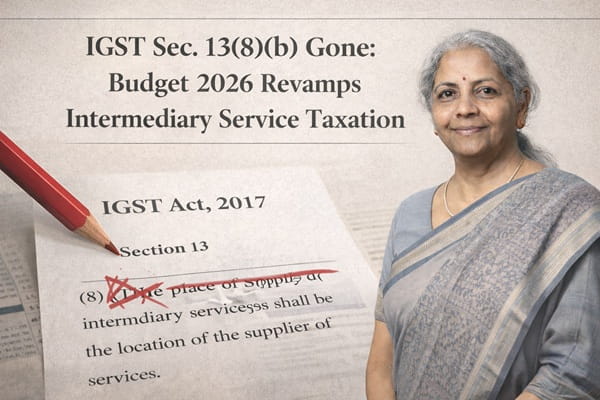
The Union Budget 2026 has unveiled one of the most transformative proposals in the GST regime-the deletion of clause (b) of sub‑section (8) of Section 13 of the IGST Act, 2017. This clause, which governed the place of supply for intermediary services, has long been viewed as a restrictive and anomalous provision within India’s indirect tax framework. Its proposed removal marks a historic shift in the taxation of cross‑border services, bringing India’s GST law closer to global best practices and delivering long‑awaited relief to the service export industry.
1. Existing Provision (Before Amendment)
Section 13(8)(b) of IGST Act 2017
The place of supply of the following services shall be the location of the supplier of services, namely:-
(a) services supplied by a banking company, or a financial institution, or a non-banking financial company, to account holders;
(b) intermediary services;
(c) services consisting of hiring of means of transport, including yachts but excluding aircrafts and vessels, up to a period of one month.
Section 13(8)(b) currently provides that:
For intermediary services, the place of supply shall be the location of the supplier of services, irrespective of where the recipient is located.
This provision created two major consequences:
(A) Export of Intermediary Services Not Treated as Export
Even if:
- the supplier is in India,
- the recipient is outside India, and
- payment was received in foreign exchange,
the place of supply was still considered India, resulting in GST liability and denial of export benefits.
(B) Import of Intermediary Services Not Taxable Under RCM
If:
- the supplier was outside India, and
- the recipient was in India,
the place of supply was considered outside India, and therefore reverse charge did not apply.
2. Proposed Amendment – Deletion of Section 13(8)(b)
The Budget proposes to delete Section 13(8)(b) entirely.
As a result:
Place of Supply for Intermediary Services will now be determined under Section 13(2)
Section 13(2) states:
Place of supply = Location of the recipient of services
This is the general rule for cross‑border services.
3. Impact of the Amendment
The deletion of Section 13(8)(b) will have two major effects:
(A) Export of Intermediary Services Will Now Qualify as Export
If:
- the supplier is in India,
- the recipient is outside India,
- consideration is received in foreign exchange, and
- supplier and recipient are not merely establishments of the same person,
then the place of supply will be outside India, and the service will qualify as export of service.
Result: No GST (Zero‑rated supply)
(B) Import of Intermediary Services Will Now Be Taxable Under RCM
If:
- the supplier is outside India, and
- the recipient is in India,
then the place of supply will be India, and the recipient will be liable to pay GST under the Reverse Charge Mechanism (RCM).
Result: GST payable under RCM
4. Example – Export of Intermediary Services (After Deletion)
Scenario:
- Indian company A provides intermediary services to a US company B.
- A only facilitates or arranges a transaction.
- Payment is received in USD.
Before deletion (Section 13(8)(b) applicable):
- Place of supply = Location of supplier = India
- Not treated as export
- GST payable
After deletion (Section 13(2) applicable):
- Place of supply = Location of recipient = USA
- All export conditions satisfied
- Zero‑rated supply
- No GST
5. Example – Import of Intermediary Services (After Deletion)
Scenario:
- Indian company X receives intermediary services from a UK company Y.
- Y facilitates a business deal for X.
Before deletion (Section 13(8)(b) applicable):
- Place of supply = Location of supplier = UK
- Supply considered outside India
- No RCM liability
After deletion (Section 13(2) applicable):
- Place of supply = Location of recipient = India
- Import of service
- GST payable under RCM
6. Conclusion
The deletion of Section 13(8)(b) represents a major policy correction. With this change:
- Intermediary services will now follow the general rule of Section 13(2).
- Export of intermediary services will finally receive zero‑rated status, benefiting Indian service providers.
- Import of intermediary services will become taxable under RCM, ensuring tax neutrality.
This amendment aligns the GST law with global tax principles and addresses long‑standing concerns of the service export industry.