
Manohar Gangwani Vs ITO (ITAT Raipur)
Section 148 Notice Giving 90 Days From Issue Instead of Three Months From Month-End Is Void Where It Shortens the Statutory Period ITAT Raipur
Raipur ITAT Quashes Reassessment for Shorter Return-Filing Period
The Raipur Bench of the Income Tax Appellate Tribunal held that a notice under Section 148 is void ab initio where it gives the assessee less time to furnish a return than the statute prescribes. The notice dated 29 March 2024 required the assessee to file his return within 90 days from the date of issue. Section 148, as it stood on that date, prescribed three months from the end of the month in which the notice was issued. The Tribunal treated the shortfall as a jurisdictional defect and quashed the consequential reassessment.
Additional Ground Admitted in Recalled Appeal
The appeal for Assessment Year 2020–21 came up for hearing after the Tribunal recalled its earlier order pursuant to the Revenue’s miscellaneous application in MA No. 53/RPR/2026. At the hearing, the assessee raised an additional ground challenging the validity of the reassessment notice itself.
The assessee’s counsel drew attention to paragraph 2 of the notice, which expressly required a return within 90 days from its issue. The objection went to the Assessing Officer’s jurisdiction to initiate reassessment. The Tribunal admitted the additional ground because it went to the root of the matter and examined the notice against the statutory provision applicable at the time.
The Statutory Period Ran From the End of March 2024
Under the version of Section 148 applicable to the notice, the return could be furnished within three months from the end of the month of issue, or within such further period as the Assessing Officer might allow on an application by the assessee. Since the notice was issued on 29 March 2024, the statutory period ran from the end of March and expired on 30 June 2024.
The notice changed both the starting point and the unit of calculation. It counted from the date of issue and specified 90 days, which gave the assessee a shorter period than the end-of-month calculation under the Act. The statutory option to seek additional time operated beyond the prescribed period. It gave the Assessing Officer no basis to shorten that period in the notice itself.
Coordinate Bench Had Quashed a Similar Notice
The Tribunal followed DCIT v. Anand Kumar Agrawal, ITA No. 707/RPR/2025 and CO No. 1/RPR/2026, order dated 5 August 2026. In that case, a notice dated 28 March 2024 similarly required the return within 90 days from issue. The coordinate bench held that the shorter period failed to satisfy Section 148 and quashed the reassessment proceedings founded on the notice.
In Anand Kumar Agrawal, the Tribunal relied on CIT v. Ramsukh Motilal, (1955) 27 ITR 54 (Bom). The Bombay High Court, dealing with reassessment under the Income-tax Act, 1922, held that a valid notice under the applicable provision was a condition precedent to assuming jurisdiction. Where the notice gave less time than the statute allowed, the assessee’s consent or waiver could not confer jurisdiction on the officer. The coordinate bench applied that reasoning to Section 148 of the 1961 Act. The Gauhati High Court decision in Tansukhrai Bodulal v. ITO, (1962) 46 ITR 325 (Gauhati) was also cited in that earlier proceeding.
A Defective Notice Could Not Support a Valid Reassessment
The Tribunal also referred to Union of India v. Rajeev Bansal, Civil Appeal No. 8629 of 2024, decided on 3 October 2024, for the principle that a quasi-judicial authority must exercise its power in accordance with the statute conferring it. Applying that principle, the Tribunal held that the Assessing Officer had failed to comply with the mandatory return-filing period under Section 148 and therefore lacked jurisdiction to proceed on the notice.
The Tribunal declared the notice void ab initio and quashed the resulting reassessment as null and void. Once the assessee succeeded on the additional legal ground, the remaining grounds became academic. The appeal was allowed.
Author’s Comments
The ruling turns on the actual time granted by the notice when measured against the statutory deadline. In this case, the difference mattered because the notice cut short the period that the Act gave the assessee. For a notice governed by the same wording, the calculation starts with the last day of the month of issue. The date printed on the notice determines the relevant month, and the statute determines how the filing period runs from that point.
The other significant feature is that the Tribunal admitted the jurisdictional ground in the recalled appeal and decided it by examining the notice itself. That document supplied both the issue date and the shorter period demanded. Once the Tribunal found that the statutory condition for a valid notice had failed, the reassessment fell at its foundation, without any adjudication of the underlying additions.
Cases Discussed:
- DCIT Vs Anand Kumar Agrawal (ITAT Raipur); ITA No. 707/RPR/2025 & CO No. 1/RPR/2026; 05/08/2026; AY: 2019-20.
- Union of India & Ors. Vs Rajeev Bansal (Supreme Court of India); Civil Appeal No. 8629 of 2024; 2024 INSC 754; (2024) 469 ITR 46; 03/10/2024.
FULL TEXT OF THE ORIGINAL JUDGMENT/ORDER
This is a recalled matter by virtue of Miscellaneous Application filed by the Revenue in MA No.53/RPR/2026, dated 16.10.2026.
2. That at the time of hearing, the Ld. Counsel for the assessee filed additional ground which goes to the root of the matter, hence, the same is admitted for adjudication. The said additional ground of appeal is extracted as follows:
“That on the facts and circumstances of the case and in law, the reassessment proceedings initiated vide notice under Section 148 of the Income Tax Act, 1961, dated 29.03.2024, are illegal and bad in law, inasmuch as the said notice erroneously requires the assessee to furnish the return of income ‘within 90 days from the issue of this notice’ instead of the mandatory statutory period of ‘three months from the end of the month in which such notice is issued’ as prescribed under Section 148 of the Act, thereby rendering the notice violative of the statutory mandate and unsustainable in law; and consequently, all subsequent proceedings based on the said defective notice being null and void ab initio, are liable to be quashed.”
3. In relevance to the said ground assailed before me, notice u/s.148 of the Income Tax Act, dated 29.03.2024 for A.Y.2020-21 is extracted as follows:
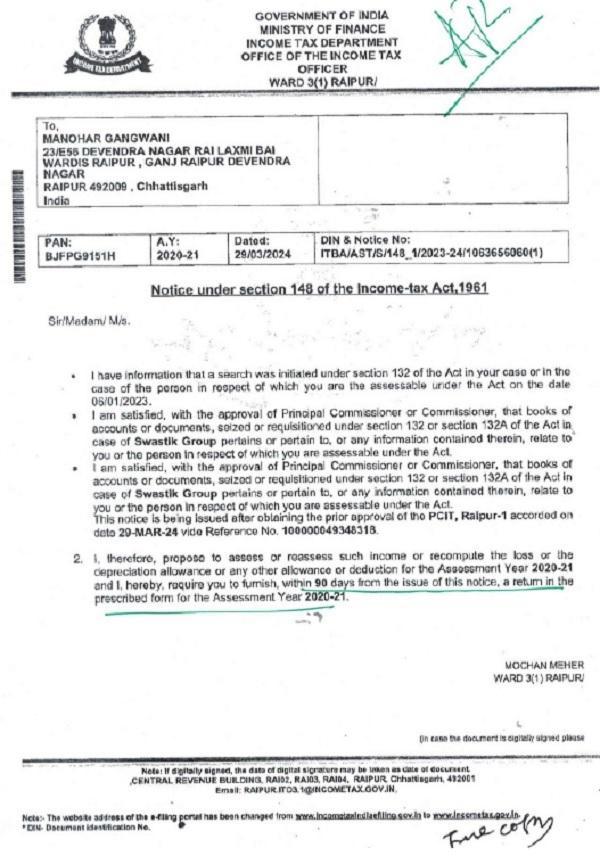
4. The Ld. Counsel for the assessee submitted that as evident from Para 2 of the said notice, it is written that “…….require you to furnish within 90 days from the issue of this notice, a return in the prescribed form for the Assessment year 2020-21”. The relevant provisions of Section 148 of the Act are being extracted as follows:
“Issue of notice where income has escaped assessment.
148. Before making the assessment, reassessment or recomputation under section 147, and subject to the provisions of section 148A, the Assessing Officer shall serve on the assessee a notice, along with a copy of the order passed, if required, under clause (d) of section 148A, requiring him to furnish within a period of three months from the end of the month in which such notice is issued, or such further period as may be allowed by the Assessing Officer on the basis of an application made in this regard by the assessee, a return of his income or the income of any other person in respect of which he is assessable under this Act during the previous year corresponding to the relevant assessment year, in the prescribed form and verified in the prescribed manner and setting forth such other particulars as may be prescribed; and the provisions of this Act shall, so far as may be, apply accordingly as if such return were a return required to be furnished under section 139”
Therefore, mandate of Section 148 of the Act is “a period of 3 months from end of the month, in which, such notice is issued i.e. notice u/s.148 of the Act is issued, a return of income to be filed by the assessee.”
5. I find that similar issue has been dealt with in favour of the assessee by this Bench in the case of DCIT, Raipur Vs. Anand Kumar Agrawal, ITA No.707/RPR/2025 & CO No.1/RPR/2026, order dated 05.08.2026 observing as follows:
“8. He submitted that as per the above provision the assessee is required to furnish his return of income within a period of 3 months from the end of the month in which such notice is issued and therefore the due date in the instant case is 30.06.2024. However, the Assessing Officer in the instant case has directed the assessee to file the return within 90 days from issue of the notice dated 28.03.2024 meaning thereby he has given a shorter period. Referring to the decision of the Hon’ble Bombay High Court in the case of CIT vs. Ramsukh Motilal reported in (1955) 27 ITR 54 (Bom), he submitted that the Hon’ble High Court in the matter of sections 34 and 22 of the Income Tax Act, 1922, which relates to the reassessment proceedings, has held that for initiating re-assessment proceedings, if the Assessing Officer gives a notice, allowing the assessee a lesser time period for furnishing his income tax return, than what is allowed in the provision of law, in such a case, it shall not be merely a procedural defect which can be waived, but it shall be a jurisdictional defect which cannot be waived.
9. Referring to the decision of the Hon’ble Gauhati High Court in the case of M/s. Tansukhrai Bodulal vs. ITO reported in (1962) 46 ITR 325 (Gauhati), he submitted that the Hon’ble High Court, following the decision of the Hon’ble Bombay High Court in the case of CIT vs. Ramsukh Motilal (supra) has also taken a similar view. He submitted that in the instant case the Assessing Officer instead of giving 3 months clear notice from the end of March, 2024 has given 90 days from the issue of notice dated 28.03.2024, which is a lesser period, therefore, it is a jurisdictional defect which cannot be waived. He submitted that the issuance of a valid notice u/s 148 is a mandatory condition precedent for assumption of jurisdiction and not a procedural provision. Therefore, the Assessing Officer cannot assume jurisdiction if the notice issued u/s 148 is not a valid notice. He accordingly submitted that since the notice issued u/s 148 is not a valid notice, the subsequent proceedings on the basis of such invalid notice are liable to be quashed being null and void.
10. The Ld. DR on the other hand submitted that the assessee has never challenged the validity of such notice before the lower authorities. He accordingly submitted that he has no objection if the matter is restored to the file of the Ld. CIT(A)/NFAC for adjudication of this legal ground.
11. We have heard the rival arguments made by both the sides, perused the orders of the Assessing Officer and the Ld. CIT(A)/NFAC and the paper book filed on behalf of the assessee. We have also considered the various decisions cited before us. We find the Assessing Officer in the instant case, on the basis of information obtained that the assessee has paid cash of Rs.1,56,00,000/- for purchase of 1200 sq.ft. land at Naharpara, Raipur during the year under consideration, reopened the assessment by recording reasons and issued notice u/s 148 of the Act dated 28.03.2024 which reads as under:
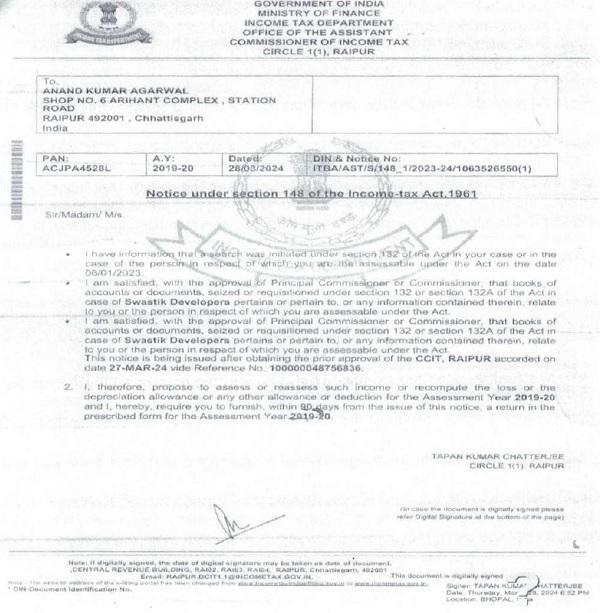
12. A perusal of the above shows that the Assessing Officer has given 90 days time from the date of notice i.e. 28.03.2024 for filing of the return. We find the provisions of section 148 as stood at the relevant time read as under:
“Issue of notice where income has escaped assessment.
148. Before making the assessment, reassessment or recomputation under section 147, and subject to the provisions of section 148A, the Assessing Officer shall serve on the assessee a notice, along with a copy of the order passed, if required, under clause (d) of section 148A, requiring him to furnish within a period of three months from the end of the month in which such notice is issued, or such further period as may be allowed by the Assessing Officer on the basis of an application made in this regard by the assessee, a return of his income or the income of any other person in respect of which he is assessable under this Act during the previous year corresponding to the relevant assessment year, in the prescribed form and verified in the prescribed manner and setting forth such other particulars as may be prescribed; and the provisions of this Act shall, so far as may be, apply accordingly as if such return were a return required to be furnished under section 139”
13. A perusal of the above provisions shows that the Assessing Officer is required to give a period of 3 months time from the end of the month in which such notice was issued. However, the Assessing Officer in the instant case has given 90 days time from the date of issue of notice. Thus, the mandate of section 148 has not been fulfilled since the Assessing Officer has given lesser time to file the return of income.
14. We find the Hon’ble Bombay High Court in the case of CIT vs. Ramsukh Motilal (supra) while quashing the notice issued u/s.34 of the Income Tax Act, 1922 giving the assessee to comply with its requirement within a period of less than 30 days is invalid and the illegality cannot be waived by the assessee since a defect in its was not procedural but a condition precedent to the assumption of jurisdiction. The relevant observations of the Hon’ble High Court read as under:
“9. Therefore, it is clear that the learned Chief Justice in that case takes the view that a notice under s. 34 is a condition precedent to the commencement of proceedings in exercise of jurisdiction. But having held that a proper notice under s. 34 is a condition precedent to the assumption of jurisdiction the learned Chief Justice goes on to consider the question of waiver and on the facts of the case he holds there is no waiver. With very great respect to the learned Chief Justice, it is difficult to understand how there can be a waiver of the condition precedent, compliance with which alone can confer jurisdiction upon an authority or a Tribunal. It is well settled that no consent can confer jurisdiction upon a Court if the Court has no jurisdiction, and if we take the view that the ITO can have jurisdiction only provided he complies with the conditions laid down in s. 34, then no consent by the assessee or no waiver on his part can confer jurisdiction upon the ITO. Therefore, while agreeing with the Calcutta High Court that the notice provided for in s. 34 is a condition precedent to the assumption of jurisdiction, with respect we are unable to accept the view that a defect in a notice given under s. 34 or a failure to give notice under s. 34 can be waived by the assessee.”
15. Although the above decision was rendered under the Income Tax Act, 1922, still the ratio laid down in the aforementioned decision in our opinion, holds good, for the Income Tax Act, 1961. Since the Assessing Officer in the instant case has admittedly given a period of 90 days from the date of notice i.e. 28.03.2024 instead of giving 3 months clear time from the end of relevant month, therefore, such notice issued u/s 148 of the Act is invalid and therefore, all proceedings based on such invalid notice are liable to be quashed being null and void. We, therefore, quash the re-assessment proceedings and the 2nd ground raised by the assessee in the application under Rule 27 of the Income Tax (Appellate Tribunal) Rules, 1963 is allowed.
16. Since the assessee succeeds on this legal ground, the other grounds raised by the assessee in the CO are not being adjudicated being academic in nature. Since, the re-assessment proceedings are quashed, the appeal filed by the Revenue becomes infructuous and accordingly the same is dismissed.”
6. That on examination of the facts and circumstances of the case and judicial pronouncements, it is observed that the very provision of Section 148 of the Act states that ……….requiring him to furnish within a period of three months from end of the month in which such notice is issued…….. a return of his income…….”. But in the present case, the A.O has given 90 days from the issue of notice for filing return of income, therefore, mandatory requirement of three months time from end of the relevant month was not followed by the A.O. The Hon’ble Apex Court in the case of Union of India & Ors. vs. Rajeev Bansal, in Civil Appeal No. 8629 of 2024, dated 03.10.2024 has clearly laid down that a quasi-judicial authority should exercise its power vested with it as per Act itself and it will then be considered that such authority is having valid inherent jurisdiction to exercise such power. In the present case, when the A.O is not following the mandate of the provision itself and issuing notice u/s.148 of the Act, then the A.O ceases to possess any valid inherent jurisdiction, therefore, such notice u/s. 148 of the Act is void ab initio and any void ab initio notice cannot give rise to a valid reassessment order, which therefore, is quashed as null and void. This legal ground is answered in favour of the assessee against the Revenue. Rest other grounds stand academic only.
7. In the result, appeal of the assessee is allowed.
Order pronounced in open court on 23rd day of November, 2026.



