DCIT Vs Anand Kumar Agarwal (ITAT Raipur)
The appeal filed by the Revenue and the Cross Objection filed by the assessee concerned Assessment Year 2019-20. The assessee had filed his return on 21.10.2019 declaring total income of Rs.28,85,660/-. Following a search and seizure operation conducted under section 132 in the Swastik Group and associated entities/persons on 06.01.2023, incriminating documents identified as LPS-6 were seized from the office premises of Shri Narendra Agrawal at Raipur. The seized material allegedly recorded cash payment of Rs.1,56,00,000/- by Shri Anand Kumar Agrawal (Goyal) towards purchase of 1200 sq.ft. land at Naharpara, Raipur.
The Assessing Officer recorded satisfaction under Explanation (2)(iv) of section 148 and issued notice under section 148 dated 27.03.2024 after obtaining approval of the prescribed authority. The assessee filed a return in response on 06.05.2024. The reassessment was completed under section 143(3) read with section 147 determining total income at Rs.1,84,85,660/-, including an addition of Rs.1,56,00,000/- as unexplained investment under section 69 read with section 115BBE.
Before the CIT(A)/NFAC, the assessee challenged the addition as well as the validity of the reassessment proceedings. The CIT(A)/NFAC deleted the addition of Rs.1,56,00,000/- but dismissed the legal objections concerning, inter alia, issuance of notice by the Jurisdictional Assessing Officer instead of NFAC, non-supply of material relied upon for issuing notice under section 148 and denial of cross-examination.
Before the Tribunal, the assessee invoked Rule 27 of the Income Tax (Appellate Tribunal) Rules, 1963 and pressed the legal ground concerning the period allowed in the notice under section 148. The assessee pointed out that the notice dated 28.03.2024 required the return to be furnished within 90 days from the date of issue. According to the assessee, section 148, as applicable at the relevant time, required the assessee to furnish the return within three months from the end of the month in which the notice was issued. Thus, for a notice dated 28.03.2024, the statutory period extended to 30.06.2024.
The assessee relied upon CIT vs. Ramsukh Motilal, reported in (1955) 27 ITR 54 (Bom), where the Bombay High Court had held, in the context of reassessment proceedings under the Income Tax Act, 1922, that a notice allowing a period shorter than that prescribed by law constituted a jurisdictional defect and not merely a procedural defect capable of waiver. Reliance was also placed on M/s. Tansukhrai Bodulal vs. ITO, reported in (1962) 46 ITR 325 (Gauhati), which was submitted to have taken a similar view.
The Revenue submitted that the assessee had not challenged the validity of the notice before the lower authorities and stated that it had no objection if the matter were restored to the CIT(A)/NFAC for adjudication of the legal ground.
The Tribunal examined the notice issued under section 148 and found that the Assessing Officer had allowed only 90 days from 28.03.2024 for filing the return. It considered the statutory language of section 148 requiring three months from the end of the month in which the notice was issued. The Tribunal therefore held that the Assessing Officer had allowed a lesser period than the period mandated by section 148.
Following the principle stated in CIT vs. Ramsukh Motilal, the Tribunal held that a proper notice was a condition precedent to assumption of jurisdiction and that the defect could not be waived. Although Ramsukh Motilal was decided under the Income Tax Act, 1922, the Tribunal held that the ratio continued to apply under the Income Tax Act, 1961.
The Tribunal concluded that the notice dated 28.03.2024 under section 148 was invalid because it allowed 90 days from the date of notice instead of three months from the end of the relevant month. Consequently, all proceedings based on the invalid notice were held to be null and void. The reassessment proceedings were quashed and the assessee’s relevant ground under Rule 27 was allowed.
Since the assessee succeeded on the legal ground, the remaining grounds in the Cross Objection were not adjudicated as academic. As the reassessment proceedings had been quashed, the Revenue’s appeal became infructuous and was dismissed. The appeal filed by the Revenue was accordingly dismissed and the Cross Objection filed by the assessee was allowed. The order was pronounced in the open Court on 5th August, 2026.
FULL TEXT OF THE ORDER OF ITAT RAIPUR
This appeal filed by the Revenue is directed against the order dated 10.09.2025 of the Ld. CIT(A) / NFAC, Delhi relating to assessment year 2019-20. The assessee has filed the CO against the appeal filed by the Revenue. For the sake of convenience, the appeal filed by the Revenue and the CO filed by the assessee were heard together and are being disposed of by this common order.
2. Facts of the case, in brief, are that the assessee is an individual and filed his return of income on 21.10.2019 declaring total income of Rs.28,85,660/-. The return was processed u/s 143(1) of the Income Tax Act, 1961 (hereinafter referred to as ‘the Act’) on 24.11.2019. Information was available with the Assessing Officer that a search and seizure operation u/s 132 of the Act was conducted in the case of Swastik Group and associated entities / persons at various residential and office premises of the group on 06.01.2023. During the course of search and seizure operation in the office premises of Shri Narendra Agrawal situated at Gopal Dall Mill, Ramsagar Para, Raipur, various incriminating loose documents identified as LPS-6 were seized which contain the details of the transactions made in respect of land situated at Naharpara, Raipur. As per the seized documents Shri Anand Kumar Agrawal (Goyal) has paid cash of Rs.1,56,00,000/- for purchase of 1200 sq.ft. land at Naharpara, Raipur. Accordingly, satisfaction was recorded in the case of the assessee as per Explanation (2)(iv) of section 148 and notice u/s 148 was issued on 27.03.2024 after obtaining approval of the prescribed authority. Subsequently the case was transferred to the Assessment Unit, National Faceless Assessment Centre. In response to the notice u/s 148 the assessee filed his return of income on 06.05.2024 declaring total income of Rs.28,85,660/-. Thereafter, notice u/s 143(2) of the Act was issued and served on the assessee. Subsequently notice u/s 142(1) along with a questionnaire was issued and served on the assessee in response to which the assessee filed certain details. The Assessing Officer completed the assessment u/s 143(3) r.w.s. 147 determining the total income of the assessee at Rs.1,84,85,660/- wherein he made addition of Rs.1,56,00,000/- as unexplained investment u/s 69 r.w.s. 115BBE of the Act.
3. Before the Ld. CIT(A) / NFAC the assessee apart from challenging the addition on merit, challenged the validity of the re-assessment proceedings. Based on the arguments advanced by the assessee, the Ld. CIT(A) / NFAC deleted the addition of Rs.1,56,00,000/- made by the Assessing Officer u/s 69 r.w.s. 115BBE of the Act. He however, dismissed the legal ground challenging the validity of re- assessment proceedings being the notice issued by the JAO instead of NFAC, non- submission of cogent material relied on by the department for issue of notice u/s 148 and not granting opportunity to cross-examination.
4. Aggrieved with such order of the Ld. CIT(A) / NFAC the Revenue is in appeal before the Tribunal by raising the following grounds:
(1) Whether on the facts and in the circumstance of the case and in law, the Ld. CIT(A) was justified in deleting the addition of Rs.1,56,00,000/- made by the AO u/s 69 of the I.T. Act, 1961 on account of unexplained investment in purchase of land, ignoring the incriminating material seized during search in case of Swastik group which clearly indicated payment of on-money by the assessee.
(2) Whether on the facts and in the circumstance of the case and in law, Ld. CIT(A) was justified in deleting the addition of Rs.1,56,00,000/- made by the AO u/s 69 of the I.T. Act, 1961 on account of unexplained investment in purchase of land, without appreciating that the seized document identified as LPS-6, particularly page 19 thereof, contained contemporaneous record of actual purchase consideration paid by 11 buyers, including the assessee, showing on-money amounts (Rashi Kacche me) which is other than those declared in the registered sale deeds, thereby clearly evidencing investment of unaccounted money.
(3) Any other ground which may be adducted at the time of hearing.
5. The assessee filed the following grounds in his Cross Objection:
1. That, on the facts and in law, the order passed by Ld. ACIT, Circle-1(1), Raipur, dt. 27/03/2025 is bad in law and illegal as no per approval has been taken from Ld. Chief Commissioner of Income Tax, Raipur (here-in- after called CCIT] u/s 151 on 27/03/2024, and therefore, in the absence of valid approval from specified authority u/s 151, the impugned order dt. 27/03/2025 is liable to be quashed.
2. That, the appellant reserves the right to add, alter or delete any ground.
6. The Ld. Counsel for the assessee at the time of hearing invoking Rule 27 of the Income Tax (Appellate Tribunal) Rules, 1963 filed the following grounds of appeal which reads as under:
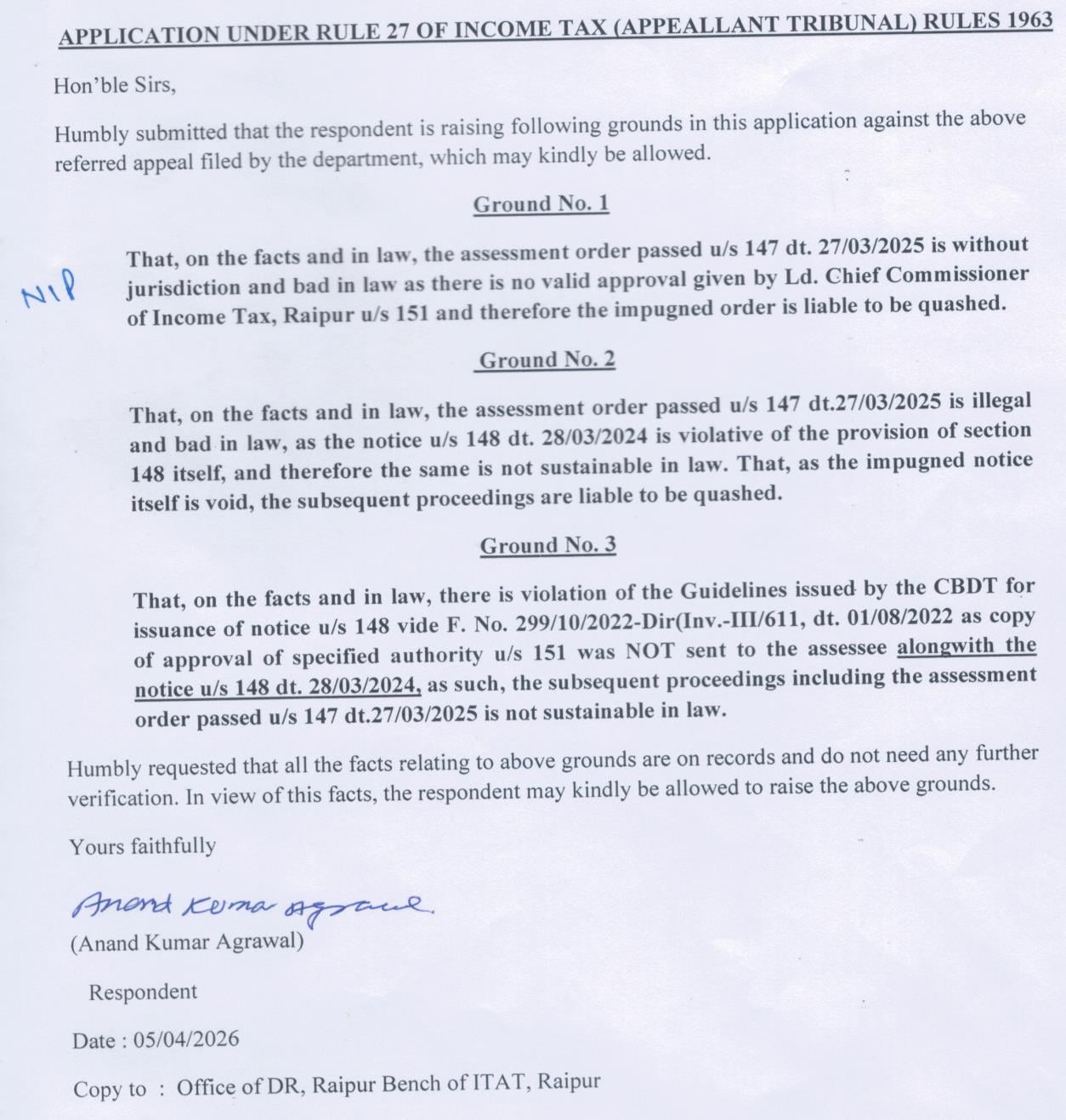
7. He however, did not press ground of appeal No.1 and 3 above for which the Ld. DR has no objection. Therefore, the first ground and third ground of the No.2 of the application is concerned, the Ld. Counsel for the assessee submitted that as per notice issued u/s 148 dated 28.03.2024 the Assessing Officer has given 90 days time to file the return of income from the date of issue of notice dated 28.03.2024. Referring to the provisions of section 148 stood at the relevant time, he drew the attention of the Bench to the same which read as under:
“Issue of notice where income has escaped assessment. 148.
Before making the assessment, reassessment or recomputation under section 147, and subject to the provisions of section 148A, the Assessing Officer shall serve on the assessee a notice, along with a copy of the order passed, if required, under clause (d) of section 148A, requiring him to furnish within a period of three months from the end of the month in which such notice is issued, or such further period as may be allowed by the Assessing Officer on the basis of an application made in this regard by the assessee, a return of his income or the income of any other person in respect of which he is assessable under this Act during the previous year corresponding to the relevant assessment year, in the prescribed form and verified in the prescribed manner and setting forth such other particulars as may be prescribed; and the provisions of this Act shall, so far as may be, apply accordingly as if such return were a return required to be furnished under section 139”
8. He submitted that as per the above provision the assessee is required to furnish his return of income within a period of 3 months from the end of the month in which such notice is issued and therefore the due date in the instant case is 30.06.2024. However, the Assessing Officer in the instant case has directed the assessee to file the return within 90 days from issue of the notice dated 28.03.2024 meaning thereby he has given a shorter period. Referring to the decision of the Hon’ble Bombay High Court in the case of CIT vs. Ramsukh Motilal reported in (1955) 27 ITR 54 (Bom), he submitted that the Hon’ble High Court in the matter of sections 34 and 22 of the Income Tax Act, 1922, which relates to the re- assessment proceedings, has held that for initiating re-assessment proceedings, if the Assessing Officer gives a notice, allowing the assessee a lesser time period for furnishing his income tax return, than what is allowed in the provision of law, in such a case, it shall not be merely a procedural defect which can be waived, but it shall be a jurisdictional defect which cannot be waived.
9. Referring to the decision of the Hon’ble Gauhati High Court in the case of M/s. Tansukhrai Bodulal vs. ITO reported in (1962) 46 ITR 325 (Gauhati), he submitted that the Hon’ble High Court, following the decision of the Hon’ble Bombay High Court in the case of CIT vs. Ramsukh Motilal (supra) has also taken a similar view. He submitted that in the instant case the Assessing Officer instead of giving 3 months clear notice from the end of March, 2024 has given 90 days from the issue of notice dated 28.03.2024, which is a lesser period, therefore, it is a jurisdictional defect which cannot be waived. He submitted that the issuance of a valid notice u/s 148 is a mandatory condition precedent for assumption of jurisdiction and not a procedural provision. Therefore, the Assessing Officer cannot assume jurisdiction if the notice issued u/s 148 is not a valid notice. He accordingly submitted that since the notice issued u/s 148 is not a valid notice, the subsequent proceedings on the basis of such invalid notice are liable to be quashed being null and void.
10. The Ld. DR on the other hand submitted that the assessee has never challenged the validity of such notice before the lower authorities. He accordingly submitted that he has no objection if the matter is restored to the file of the Ld. CIT(A) / NFAC for adjudication of this legal ground.
11. We have heard the rival arguments made by both the sides, perused the orders of the Assessing Officer and the Ld. CIT(A) / NFAC and the paper book filed on behalf of the assessee. We have also considered the various decisions cited before us. We find the Assessing Officer in the instant case, on the basis of information obtained that the assessee has paid cash of Rs.1,56,00,000/- for purchase of 1200 sq.ft. land at Naharpara, Raipur during the year under consideration, reopened the assessment by recording reasons and issued notice u/s 148 of the Act dated 28.03.2024 which reads as under:
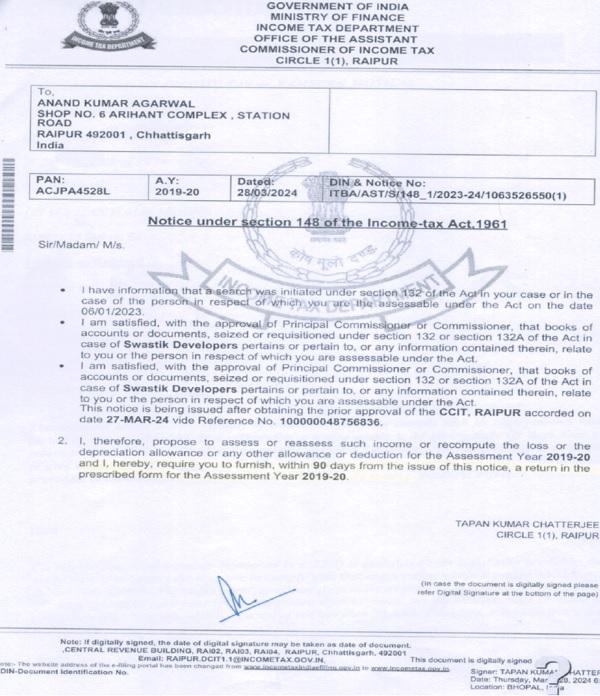
12. A perusal of the above shows that the Assessing Officer has given 90 days time from the date of notice i.e. 28.03.2024 for filing of the return. We find the provisions of section 148 as stood at the relevant time read as under:
“Issue of notice where income has escaped assessment. 148.
Before making the assessment, reassessment or recomputation under section 147, and subject to the provisions of section 148A, the Assessing Officer shall serve on the assessee a notice, along with a copy of the order passed, if required, under clause (d) of section 148A, requiring him to furnish within a period of three months from the end of the month in which such notice is issued, or such further period as may be allowed by the Assessing Officer on the basis of an application made in this regard by the assessee, a return of his income or the income of any other person in respect of which he is assessable under this Act during the previous year corresponding to the relevant assessment year, in the prescribed form and verified in the prescribed manner and setting forth such other particulars as may be prescribed; and the provisions of this Act shall, so far as may be, apply accordingly as if such return were a return required to be furnished under section 139”
13. A perusal of the above provisions shows that the Assessing Officer is required to give a period of 3 months time from the end of the month in which such notice was issued. However, the Assessing Officer in the instant case has given 90 days time from the date of issue of notice. Thus, the mandate of section 148 has not been fulfilled since the Assessing Officer has given lesser time to file the return of income.
14. We find the Hon’ble Bombay High Court in the case of CIT vs. Ramsukh Motilal (supra) while quashing the notice issued u/s 34 of the Income Tax Act, 1922 giving the assessee to comply with its requirement within a period of less than 30 days is invalid and the illegality cannot be waived by the assessee since a defect in its was not procedural but a condition precedent to the assumption of jurisdiction. The relevant observations of the Hon’ble High Court read as under:
“9. Therefore, it is clear that the learned Chief Justice in that case takes the view that a notice under s. 34 is a condition precedent to the commencement of proceedings in exercise of jurisdiction. But having held that a proper notice under s. 34 is a condition precedent to the assumption of jurisdiction the learned Chief Justice goes on to consider the question of waiver and on the facts of the case he holds there is no waiver. With very great respect to the learned Chief Justice, it is difficult to understand how there can be a waiver of the condition precedent, compliance with which alone can confer jurisdiction upon an authority or a Tribunal. It is well settled that no consent can confer jurisdiction upon a Court if the Court has no jurisdiction, and if we take the view that the ITO can have jurisdiction only provided he complies with the conditions laid down in s. 34, then no consent by the assessee or no waiver on his part can confer jurisdiction upon the ITO. Therefore, while agreeing with the Calcutta High Court that the notice provided for in s. 34 is a condition precedent to the assumption of jurisdiction, with respect we are unable to accept the view that a defect in a notice given under s. 34 or a failure to give notice under s. 34 can be waived by the assessee.”
15. Although the above decision was rendered under the Income Tax Act, 1922, still the ratio laid down in the aforementioned decision in our opinion, holds good, for the Income Tax Act, 1961. Since the Assessing Officer in the instant case has admittedly given a period of 90 days from the date of notice i.e. 28.03.2024 instead of giving 3 months clear time from the end of relevant month, therefore, such notice issued u/s 148 of the Act is invalid and therefore, all proceedings based on such invalid notice are liable to be quashed being null and void. We, therefore,nd quash the re-assessment proceedings and the 2 ground raised by the assessee in the application under Rule 27 of the Income Tax (Appellate Tribunal) Rules, 1963 is allowed.
16. Since the assessee succeeds on this legal ground, the other grounds raised by the assessee in the CO are not being adjudicated being academic in nature. Since, the re-assessment proceedings are quashed, the appeal filed by the Revenue becomes infructuous and accordingly the same is dismissed.
17. In the result, the appeal filed by the Revenue is dismissed and the CO filed by the assessee is allowed.
Order pronounced in the open Court on 5th August, 2026.